Last updated: November 20, 2026
Quick answer: a SOAP note has 4 parts, and in What Is a SOAP Note in Pet Insurance Records Review? it is the veterinary record format insurers read to see what was observed, what was suspected, what was done, and what the plan was. If a claim turns on wording, the SOAP note can help explain the case; if it is sparse, mixed up, or missing the diagnosis trail, the claim can be harder to assess. This is information, not financial advice, and a qualified adviser should be consulted for your own situation. For background on the medical-record format, see the AVMA’s guidance on veterinary medical records and Merck Veterinary Manual.
Key takeaways
- SOAP stands for Subjective, Objective, Assessment, and Plan.
- In pet insurance review, the note helps show whether a visit was for a new problem, a follow-up, or routine care.
- Insurers look for the chain from symptoms to exam findings to the vet’s working assessment and treatment plan, though a vet or claims professional can explain how a specific policy may treat the record.
- A clean note can help support approval, while a thin note may make review harder, but neither outcome is guaranteed.
- The most useful records usually pair the SOAP note with the invoice, lab results, and any discharge notes.
Who is this for?
This is for pet owners who already have a claim in motion, expect a records request, or want to understand why an insurer asked for veterinary records at all. It assumes you know the basics of your policy, including deductible and cost-sharing terms, but not the language used inside a veterinary chart.
It is not for someone trying to decode every denial reason code or line item on a claim breakdown. That is a different job, and this page should not try to do both. The same goes for treatment decisions; if the note mentions a diagnosis that affects health care, consult your vet or a qualified adviser rather than using the claim file as a shortcut. For policy wording and claim handling basics, see the site’s hub on pet insurance claims documentation.
Why do insurers ask for SOAP notes?
Insurers ask for SOAP notes because the note shows the clinical story behind the bill. A receipt tells them what was charged on a 1-page invoice; a SOAP note tells them why the visit happened and how the vet reached the assessment. That difference matters when a policy has waiting periods, exclusions, prior-condition rules, or separate limits for certain services.
A SOAP note also helps separate symptoms from conclusions. For example, “vomiting for 2 days” is not the same as “gastroenteritis,” and “limping after running” is not the same as “cranial cruciate injury.” The record review process looks for that bridge between what the owner reported, what the vet found, and what the vet planned next. If you are comparing how records support a claim, see the site’s guide to pet insurance claim denial.
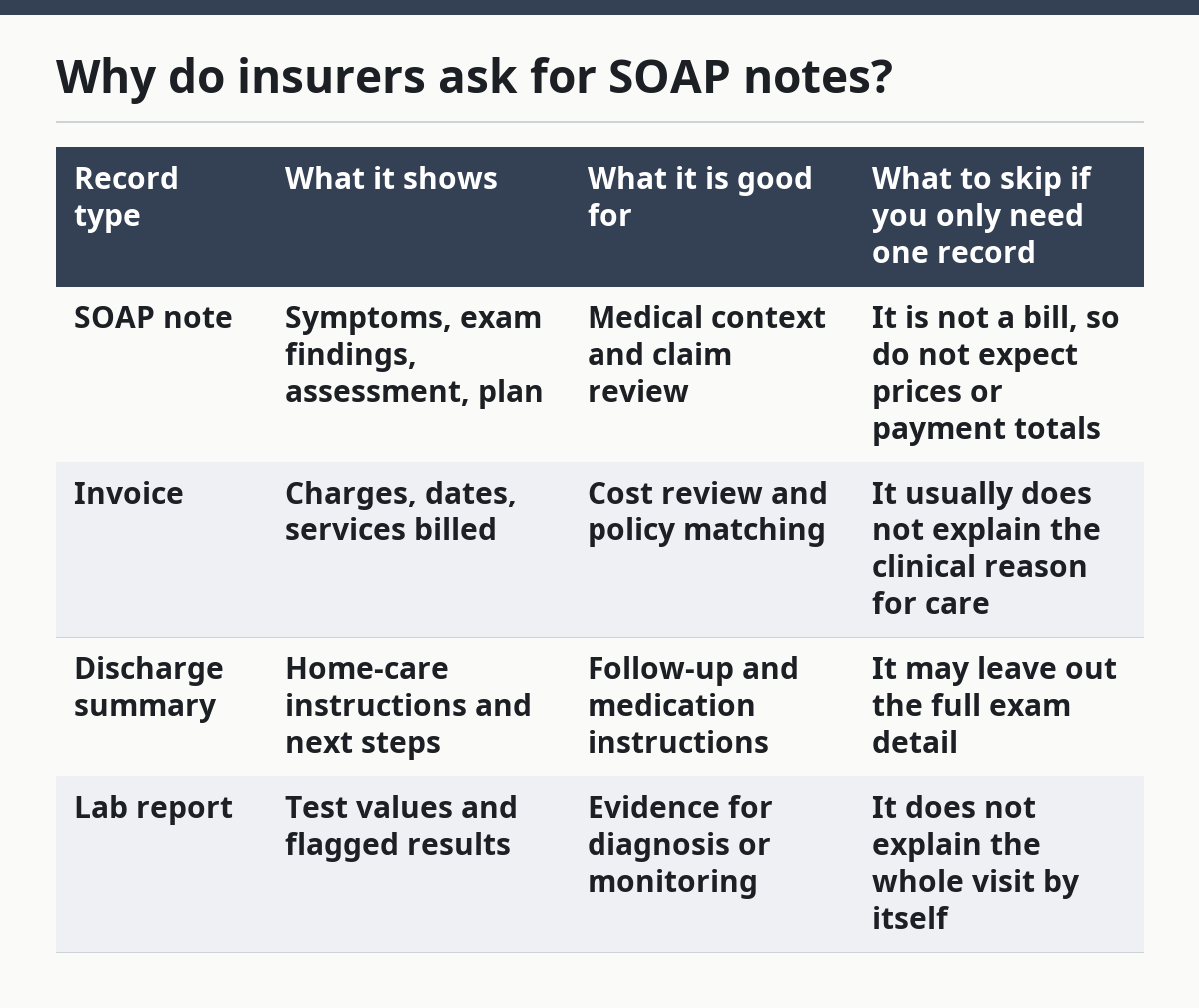
Here is a simple comparison of the records insurers may see:
| Record type | What it shows | What it is good for | What to skip if you only need one record |
|---|---|---|---|
| SOAP note | Symptoms, exam findings, assessment, plan | Medical context and claim review | It is not a bill, so do not expect prices or payment totals |
| Invoice | Charges, dates, services billed | Cost review and policy matching | It usually does not explain the clinical reason for care |
| Discharge summary | Home-care instructions and next steps | Follow-up and medication instructions | It may leave out the full exam detail |
| Lab report | Test values and flagged results | Evidence for diagnosis or monitoring | It does not explain the whole visit by itself |
For broader context on how claim paperwork fits together, see the site’s hub on pet insurance claims documentation.
What does SOAP mean in a vet record?
SOAP means Subjective, Objective, Assessment, and Plan, and each part answers a different question. The format is common in veterinary medicine because it keeps the visit organized across a 15-minute or 30-minute appointment.
Subjective is what the owner noticed or reported. That can include coughing, scratching, refusing food, or a change that started 3 days ago.
Objective is what the clinic could measure or observe, such as temperature, weight, gait, swelling, lab values, or imaging results.
Assessment is the vet’s working conclusion about what is most likely going on.
Plan is the next step, such as medication, follow-up, monitoring, or more testing.
A note can be complete even if the plan is conservative. A good SOAP note does not need fancy wording; it needs a clear path from complaint to exam to action. For more on how records are organized, see the site’s page on veterinary records requests.
How does a SOAP note affect a claim?
A SOAP note affects a claim by showing whether the medical record supports the billed services. If the note says the dog was seen for acute ear itching, the exam found redness, and the plan included ear treatment, the claim reads differently than a record with a vague note and a long bill. Insurers use that match to decide whether the visit lines up with the policy terms, though a claims professional can explain the exact policy treatment of a given file.
The note can also reveal timing. A symptom that began before coverage, or before a waiting period ended, may be treated differently from a new event after coverage was active, so consult your insurer or a qualified adviser for the specific policy rules. That is why record wording matters so much in pet insurance records review: the language in the chart can change how the case is categorized.
The most important part is often the assessment and plan because those lines tell the reviewer what the vet thought the problem was and what was done about it. Still, the other three parts matter too. A strong subjective note with weak objective findings may point to a mild problem; a strong objective note with a vague plan may raise questions about what happened next. For claim timing questions, see the site’s guide to pet insurance waiting periods.
How do I read a SOAP note?
A SOAP note is easiest to read if you follow the 4 parts in order and check whether the claim story stays consistent. Start with the complaint, then look for proof in the exam, then see whether the assessment matches those findings, then check whether the plan fits the case. If those pieces line up, the record is usually easier to review.
- Find the chief complaint. Look for the first reason the pet was seen, such as vomiting, lameness, or skin irritation. Verify that the complaint is specific, not just “recheck,” and note whether it has a start time, such as 2 days ago. A problem is a vague complaint with no date, because it makes timing harder to judge.
- Check the subjective section. Confirm what the owner reported, including appetite, energy, stool, urination, or injury history. A good note names the symptom and the timeline; a bad one only says “not well.” If the note lacks owner observations, the reviewer may have less context for the claim.
- Read the objective findings. Look for measured or observed facts like weight, temperature, exam findings, or test results. Verify that the findings support the complaint, such as ear redness in an ear-pain visit. A problem is when objective findings are missing or clearly unrelated to the billed services.
- Match the assessment. See whether the vet’s working diagnosis or differential diagnosis fits the complaint and the exam. The assessment may be a tentative call, not a final disease label. Trouble starts when the assessment changes without explanation or does not line up with the findings.
- Check the plan. Look for treatment, monitoring, medication, recheck timing, or more testing. Verify that the plan is realistic for the case and that it matches the assessment. A problem is a plan that mentions medication but no exam reason for it.
- Compare the note with the invoice. Make sure the services billed appear in the note or are reasonably tied to the visit. This is where gaps show up fast, such as a billed test with no mention in the record. If the bill and note do not match, the claim reviewer may ask for more records.
- Look for follow-up language. A note may mention return precautions, recheck windows, or change in symptoms over time. Verify whether the case is closing, continuing, or escalating. A problem is a note that ends without any next step in a case that clearly needed one.
If you want one rule of thumb, read the note as a chain, not as isolated lines. The chain should make sense in about 30 seconds. When it does not, that is usually the part an insurer will question first.
What if the note is thin or messy?
A thin or messy note does not always mean the claim will fail, but it does make review harder. Missing dates, shorthand that is too vague, or a plan that says only “monitor” can leave the reviewer guessing. That uncertainty can slow the claim or trigger a request for more records.
Emergency visit with brief charting: The record may be short because the clinic had to act fast — Ask for the full record set, not just the summary, because triage notes, discharge notes, and lab pages may fill the gaps.
Referral or specialty care: The primary vet’s SOAP note may not tell the whole story — Gather the specialty consult and any imaging report, because the assessment may have moved to another clinic.
Follow-up after a prior visit: The note may reference an earlier problem instead of restating it — Check both dates, because insurers may link the second visit to the first episode.
Phone or portal advice: There may be no standard SOAP note at all — Look for a message log or advice record, because not every contact has a full exam note.
Chronic condition management: The note may focus on maintenance rather than new symptoms — Ask for the most recent exam and treatment plan, because old context can matter more than the latest bill.
In these cases, the right move is usually to collect the full packet, not to guess from a single page. That means the SOAP note, invoice, lab work, and any discharge paperwork together. For a fuller list of record types, see the site’s page on pet insurance claim documents.
What mistakes do people make with these records?
The biggest mistake is assuming the invoice tells the whole story. It does not. A bill can show a CBC, x-ray, or office exam, but it will not explain why the vet ordered it or what the findings meant. The better alternative is to pair the invoice with the SOAP note before you send anything to the insurer.
A second mistake is ignoring the assessment line. That line often carries the most weight because it shows the vet’s working conclusion. If you skip it, you can miss whether the visit was being treated as a new injury, a flare-up, or a chronic problem.
A third mistake is reading too much into owner-reported symptoms alone. Subjective notes matter, but they are not the same as measured findings. The correct approach is to look for support in the objective section and the plan.
A fourth mistake is assuming every missing detail means denial. Sometimes the clinic chart is brief because the case was simple or because the important details are in another document. The safer alternative is to ask for the full medical record packet before drawing conclusions.
A fifth mistake is treating the SOAP note as a verdict. It is not a claim decision; it is evidence. The claim result still depends on the policy terms, the date of loss, the record trail, and the insurer’s review rules. If you want a broader overview, see the site’s guide to the pet insurance claim process.
When does the standard SOAP format not tell the whole story?
The standard SOAP format does not tell the whole story when the case spans multiple visits, multiple clinics, or multiple body systems. In those cases, the note is still useful, but you need more than one page to understand the claim. A 2-visit issue can look simple in the first note and much less simple in the second.
Complex cases often include specialist notes, lab panels, imaging reports, and discharge instructions. The SOAP note may mention “rule out” conditions or a provisional assessment, which means the vet is still narrowing the cause. That is normal. It just means the claim review needs the whole file, not a single excerpt.
For owners, the practical question is not “Is there a SOAP note?” but “Does the record packet explain the episode?” If it does not, ask the clinic for the complete chart for the dates in question. If you are unsure how the policy will treat the episode, a qualified adviser or your insurer can explain the paperwork requirements for your own case.
Where the SOAP note fits in the paperwork stack
The SOAP note sits in the middle of the paperwork stack. The invoice shows the charge; the SOAP note shows the clinical reason; the lab or imaging report shows evidence; the discharge note shows home care. When all four line up, the claim file is easier to read and less likely to stall.
For pet owners who are comparing policies or trying to understand a claim denial, the SOAP note is rarely the only document that matters. It is the main clinical note, but it works best as part of a set. If one page is missing, the rest of the file may still answer the question. If several pages are missing, that is when claim review becomes slower and less predictable.
Drafted with AI; not yet reviewed by a person.