Last updated: November 20, 2026
Quick Answer: Coverage rules and exclusions can decide a claim in one clause, and this guide shows how to read them.
Key Takeaways
- Coverage rules show when an insurer may pay, based on date, cause, place, person, and loss type.
- Exclusions can remove a loss from coverage even when it looks covered at first glance.
- Trace one claim from start to finish instead of skimming bold headings.
- Narrow wording like “sudden,” “direct,” or “expected or intended” can limit coverage.
Coverage rules decide what a policy pays for; exclusions decide what it will not pay for. Coverage Rules and Exclusions: The Complete Guide shows you how to read both, spot the traps, and check a policy before you need it.
I write policy language for a living, and the same four questions keep coming up: what counts, what doesn’t, what proof is needed, and where the exceptions hide. Those are the ones this page settles.
What coverage rules actually decide
Coverage rules tell you when the insurer will step in, and they usually turn on date, cause, place, person, and type of loss. If one of those pieces falls outside the policy, the claim can be reduced or denied.
Picture this: you bought a policy for a rental unit, then the pipe bursts after a long freeze. The claim does not rise or fall on the word “water” alone; it turns on whether the loss fits the policy’s covered peril, the property type, and any conditions you had to meet first. That’s where readers get surprised.
Common coverage rules often include:
- The loss must happen during the policy period.
- The event must match a covered peril or insured risk.
- The damaged item must be listed property, or a category the policy covers.
- The claimant must have an insurable interest or legal standing.
- Notice, documentation, or mitigation steps may be required.
The catch is that coverage rules are often not written as one neat paragraph. They are scattered through declarations, definitions, insuring agreements, endorsements, and conditions. A policy can say “covered” in one section and quietly narrow that promise in another.
What an exclusion does to a claim
An exclusion removes a loss from coverage even if the event looks covered at first glance. That means the real question is not only “what happened?” but also “does any exclusion take this out?”
Picture this: the policy covers fire, but the loss started with an arson finding or with work you hired an unlicensed contractor to do. The claim may still fail if the exclusion or a related condition applies. That’s the part most people skip.
Exclusions usually target specific dangers such as:
- Flood or surface water
- Earth movement
- Wear and tear
- Mold, rot, or rust
- Intentional acts
- Business use of a personal policy
- War, nuclear events, or government action
A good policy reader checks exclusions line by line, then checks the exceptions to those exclusions. One sentence can matter a lot. “Exclusion” is not always the end of the story.
How to read the policy without getting tricked
You read a policy by tracing one claim from start to finish, not by skimming the bold headings. The cleanest path is: covered property, covered cause, exclusions, conditions, then endorsements.
Picture this: you have a policy packet with a declarations page, a long form policy, and three endorsements. The declarations page says what you bought, but the endorsements often rewrite the base form. If you stop at page one, you may miss the real rule set.
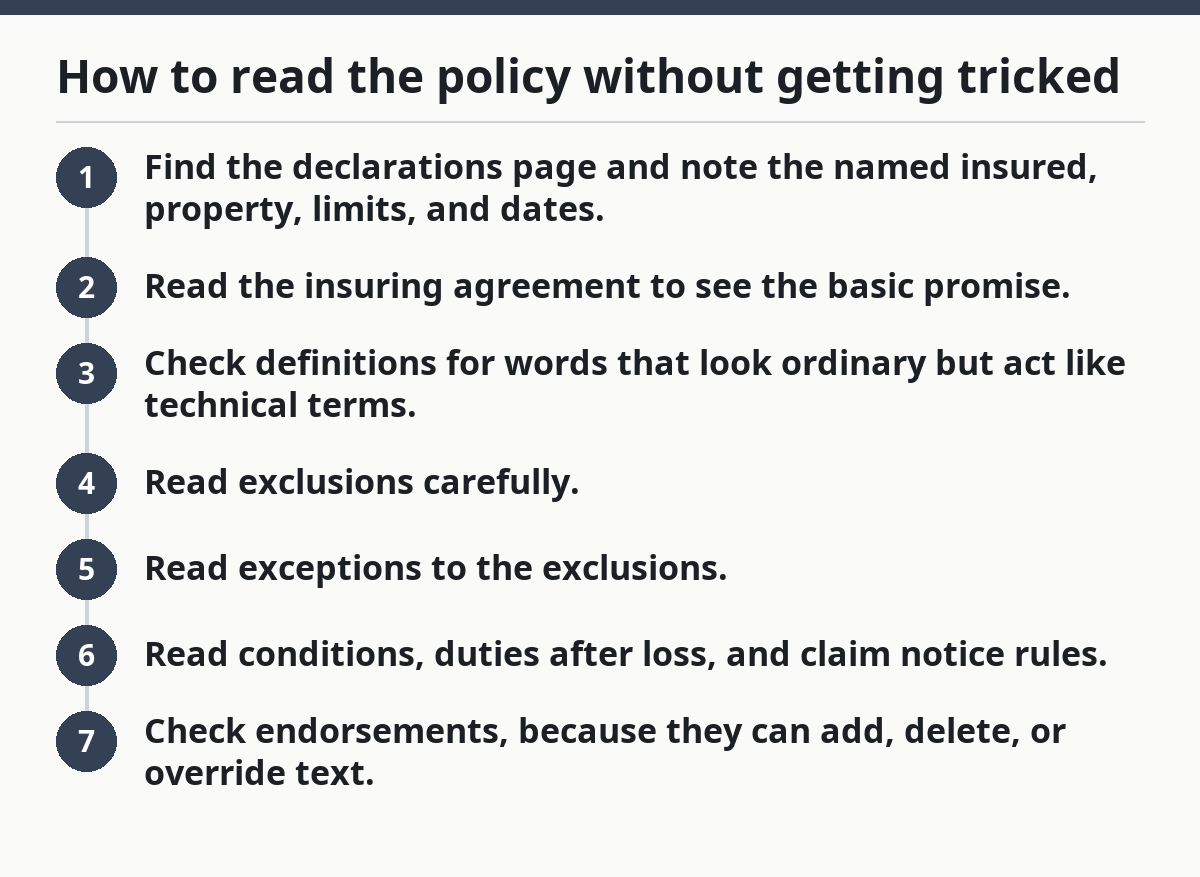
Use this order:
- Find the declarations page and note the named insured, property, limits, and dates.
- Read the insuring agreement to see the basic promise.
- Check definitions for words that look ordinary but act like technical terms.
- Read exclusions carefully.
- Read exceptions to the exclusions.
- Read conditions, duties after loss, and claim notice rules.
- Check endorsements, because they can add, delete, or override text.
The best part? This process works on most policy types: home, auto, health, travel, business, and specialty coverages. The labels change. The logic does not.
Where coverage gets narrowed in plain sight
Coverage often gets narrowed by words that look harmless, like “sudden,” “direct,” “accidental,” “owned,” “regular use,” or “expected or intended.” Those words are doing legal work.
Picture this: the policy says it covers “direct physical loss,” but the claim involves smoke odor, loss of use, or a hidden slowdown in equipment. The fight may turn on whether the harm counts as direct physical loss, not on whether you suffered a real problem. That distinction can decide the claim.
Watch for these narrow points:
- Timing terms: “occurrence,” “claims-made,” “during the policy period”
- Location terms: “on premises,” “off premises,” “at the insured location”
- Use terms: “personal use,” “business use,” “rented to others”
- Cause terms: “sudden and accidental,” “external event,” “wear and tear excluded”
- Status terms: “resident relative,” “authorized driver,” “employee”
A clause can be narrow without sounding harsh. That’s why people get burned by a policy that looks broad on the sales page but tight in the form language.
What to circle first
The three most useful places to mark are the definitions, the exclusions, and the endorsement schedule. Those sections usually carry the real answer faster than the marketing summary.
- Definitions tell you what the policy means by its own words.
- Exclusions tell you what is out, even if the event seems similar to a covered one.
- Endorsements tell you what changed after the base form was printed.
If you only have time for one pass, read those three sections first.
The difference between an exclusion and an exception
An exclusion cuts something out; an exception puts part of it back in. That sounds simple, but it is where many claims turn.
Picture this: a policy excludes water damage, then says the exclusion does not apply if the water came from a fire sprinkler system. The loss is still in the exclusion section, but the exception gives you a narrow path back into coverage. That is not a contradiction. It is how the policy is written.
Here’s the catch: exceptions can be tiny. They may apply only if the loss comes from one source, one kind of property, or one fixed event. If you read fast, you will think the exclusion won. If you read carefully, you may find the carve-back.
Common exception patterns can include:
- A named peril is excluded, except for a listed sub-cause
- Damage is excluded, except when caused by another covered peril
- Business use is excluded, except for a small side activity
- Flood is excluded, except for water from a burst pipe that is not flood-related
This is why a clean denial letter is not always the final word. The exception may be sitting two sentences later.
Why claims are denied even when the loss feels covered
Claims are denied when the loss fails one of the policy’s gatekeepers, not only when the event sounds unusual. A covered event can still fail for lack of proof, late notice, missing documentation, or an exclusion you did not spot.
Picture this: the kitchen catches fire, but you wait weeks to report it, fail to save photos, and throw out the damaged item before the adjuster sees it. Even a valid claim can become hard to prove. Insurance is not only about the event; it is also about the record.
Denials usually fall into these buckets:
- The loss is outside the policy dates.
- The cause is excluded.
- The property or person is not covered.
- The claim lacks needed proof.
- A condition was not met, such as notice, repair steps, or cooperation.
Not all denials are equal. Some are fixable with documents. Others are rooted in the policy text itself.
The documents that matter most
If you ever need to challenge a coverage call, the paper trail matters more than a good explanation. These records usually carry the most weight:
- The full policy form, not only the summary
- The declarations page
- All endorsements
- Photos or video from before and after the loss
- Repair estimates or invoices
- Police, fire, or incident reports where relevant
- Claim letters and denial reasons in writing
Missing paperwork is a common reason a claim stalls. It is also the easiest thing to prevent.
Coverage rules and exclusions in common policy types
The same logic shows up in different places, but the wording changes with the policy type. Auto, home, health, travel, and business policies all use coverage rules and exclusions, yet each one hides the traps in different sections.
Picture this: you are comparing two policies that both say they cover “damage,” but one is for a car and the other is for a building. The word is the same; the rule is not. Context matters more than the label on the page.
Home insurance
Home policies usually turn on covered perils, property categories, and specific exclusions like flood, earth movement, and wear and tear. They also tend to separate dwelling coverage from personal property and liability.
A home policy can cover a burst pipe but still deny damage from long-term seepage or neglect. It may cover wind damage to the roof but not every cosmetic repair that follows. That split matters when the loss is messy.
What to check first:
- Whether the loss was sudden or gradual
- Whether the damaged item is part of the dwelling or personal property
- Whether flood, sewer backup, or earth movement is excluded
- Whether mold coverage is limited
- Whether vacancy rules apply
A common mistake is assuming “water damage” is one thing. It is not. Water from a broken appliance, water from rising outside water, and water from seepage are often treated differently. For a claim with those facts, consult a licensed insurance professional and review the policy language closely.
Auto insurance
Auto policies are usually driven by who was driving, what the car was doing, and whether the use fits the policy. Exclusions often focus on racing, intentional damage, commercial use, or drivers who are not listed or permitted.
Picture this: your policy covers a family car, but the vehicle was being used for paid delivery work when the crash happened. The loss can become a use issue, not just a driving issue. That is the difference between a clean claim and a hard one.
Check for these points:
- Who is a named insured or permitted driver
- Whether business or delivery use is excluded
- Whether the car was being used on a public road or off-road
- Whether the damage is to your car, another car, or property
- Whether exclusions for racing, towing, or intentional acts apply
Auto coverage often looks simple on the front end. The exclusions decide how simple it really is.
Health and disability coverage
Health and disability policies use coverage rules to define medically necessary care, covered services, waiting periods, pre-existing condition treatment, and network rules. Exclusions can be much narrower than people expect, but the definitions are exact. For a specific claim, consult a licensed benefits professional and review the plan documents; one 2023 CMS fact sheet notes that most Medicare Advantage enrollees were in plans with prior authorization requirements for some services.
Picture this: you expect a treatment to be covered because it is common, but the plan excludes elective care, experimental treatment, or services outside the approved network. The denial may be based on the rule for the service, not the service itself. That distinction matters.
What to check:
- Whether the service is medically necessary under the plan
- Whether prior authorization was required
- Whether the provider is in-network
- Whether the plan has waiting periods or pre-existing condition rules
- Whether the exclusion is for the service, the setting, or the provider
Health policies are especially sensitive to definitions. A procedure can be covered in one setting and excluded in another.
Travel and specialty coverage
Travel policies often look broad in ads but narrow in execution. They may cover trip cancellation, interruption, baggage, or medical emergencies, while excluding known events, pre-existing conditions, or losses tied to travel warnings.
Picture this: your trip is canceled, but the reason was known before you bought the policy. A trip protection plan may deny the claim even if the cancellation felt unavoidable. The date of purchase can be as important as the event itself.
Specialty policies may also use tight triggers:
- Event must happen during the covered travel window
- The loss must be caused by a listed event
- The claim must be reported quickly
- Certain destinations or activities may be excluded
These policies can work well, but only if the trigger matches the trip you actually took.
How to challenge a denial without guessing
You challenge a denial by matching the denial reason to the exact policy language, then gathering the proof that fits that language. Guessing about “fairness” helps less than quoting the rule.
Picture this: the insurer says your loss was excluded as wear and tear, but the photos show a sudden break at a joint rather than a slow leak. That is the kind of fact pattern that can shift the claim if the policy language supports it. The issue is not emotion. It is wording plus evidence.
A useful challenge usually includes:
- The denial letter
- The exact policy clause cited
- A short written explanation of why the clause does not apply
- Supporting proof, such as photos, expert reports, or repair invoices
- A request for a second review or appeal, if the policy allows one
Do not argue every clause at once. Attack the one that actually blocked the claim.
A quick read of the denial
The denial letter usually tells you whether the fight is about coverage, exclusion, timing, or proof. That matters because each type of denial needs a different answer.
- Coverage denial: the insurer says the loss never fit the policy promise.
- Exclusion denial: the insurer says a carve-out removes the loss.
- Condition denial: the insurer says you missed a required step.
- Proof denial: the insurer says the facts are not documented well enough.
If the letter is vague, ask for the specific clause in writing. Vague denials are hard to defend.
What a smart policy review looks like before you buy
A smart review checks the exclusions first, then the coverage promise, then the conditions that could make the promise hard to use. That order saves time and prevents the most common mistake: buying the headline and skipping the fine print.
Picture this: two policies both advertise broad protection, but one excludes the exact risk you care about and the other only covers it after a waiting period. The better choice is the one that matches the risk you actually have, not the one with the nicer brochure.
Use this checklist before you buy:
- What exact event is covered?
- What exact event is excluded?
- Are there exceptions that restore coverage?
- What proof will the insurer require?
- Are there deadlines for notice or filing?
- Does an endorsement change the base form?
- Is the policy written for your actual use, property, or activity?
A policy is not “good” in the abstract. It is good for a specific risk, on specific terms, with specific limits.
The verdict: how to think about coverage rules and exclusions
Choose a policy only if the covered event, the exclusion list, and the conditions all match the risk you actually face. Choose a different policy if the only thing making the first one look good is the headline.
Picture this: you are deciding between two plans that sound similar, but one excludes the exact loss you worry about most. The right choice is the one that keeps that risk in play without hiding it behind vague wording. That is the whole game.
The most useful rule of thumb
If a clause seems broad, read the exception. If a clause seems protective, read the exclusion. If both still look unclear, ask for the full form and the endorsements before you sign.
That simple habit catches a lot of bad surprises. It also keeps you from buying coverage you cannot actually use.
FAQ
What is the difference between coverage and an exclusion?
Coverage is the promise the policy makes to pay for a defined loss. An exclusion is a rule that takes a loss out of that promise. A claim can fail even when the event seems covered if an exclusion applies.
Why do policies have exclusions at all?
Policies have exclusions to narrow the risk to what was priced and promised. Without exclusions, the insurer would be taking on losses that were never part of the contract. That would make the policy cost more and the language much less precise.
Can an exclusion have exceptions?
Yes, and that is one of the most important parts to read. An exception can restore coverage for a narrow kind of loss, even when the main exclusion seems to apply. The exception may be short, so it is easy to miss.
What should I read first in a policy?
Read the declarations page, then the definitions, exclusions, conditions, and endorsements. That order usually gets you to the real rule faster than reading front to back. The summary page alone is not enough.
Why was my claim denied if the loss happened during the policy period?
A loss can happen during the policy period and still be denied if it falls under an exclusion, fails a condition, or lacks the proof the policy requires. Timing is only one part of coverage. The cause and the paperwork still matter.
Drafted with AI; not yet reviewed by a person.