Last updated: November 20, 2026
Quick Answer: Most pet insurance claims are paid after review, and many insurers pay within 7 to 14 days once the file is complete. Pet Insurance Claims and Payments: Complete Guide can still be slow, confusing, and denied if the paperwork is off. The cleanest path is to file the claim fast, match the invoice to the policy terms, and track the payment until the insurer closes the file. This guide explains the steps, the payment flow, and the common mistakes that stall reimbursement.
Who this guide is for, and what it assumes
This guide applies to pet owners who already have a policy and need to get paid after a vet visit, surgery, imaging, or medicine purchase in Pet Insurance Claims and Payments: Complete Guide. It assumes you can read a bill, a policy schedule, and an explanation of benefits, which is the insurer’s breakdown of what it accepted, reduced, or denied.
It also assumes you know the basic claim flow: visit the vet, pay the provider or your card, submit a claim, wait for review, then receive reimbursement if the claim qualifies. Rates, deductibles, reimbursement rules, and waiting periods vary by country and insurer, so the exact numbers on your policy matter more than any general rule. For policy definitions and claim rights, see the ACCC’s insurance guidance and your insurer’s own claims page.
This is information, not financial advice. A qualified adviser or licensed insurance professional should be consulted for your own situation, especially if a claim is large, disputed, or tied to a pre-existing condition.
Key takeaways
- Claims are usually paid after you submit the invoice and medical records, not at the time of care.
- The insurer pays only what your policy allows after deductible, reimbursement rate, and exclusions are applied.
- Missing records, vague invoices, and pre-existing-condition disputes are the most common reasons claims stall.
- If your policy has direct pay, the vet may be paid first, but you still need proper claim paperwork.
- A denial may be appealable under the insurer’s review process, but the deadlines and steps vary.
How pet insurance claims and payments work

Pet insurance claims and payments move in a simple order: you pay for care, send the claim, the insurer reviews the file, then it reimburses eligible costs or pays the clinic under a direct-pay setup. The core math usually runs through three policy terms: deductible, reimbursement percentage, and annual limit.
A deductible is the amount you must pay before the insurer starts sharing eligible costs. Reimbursement percentage is the share of covered costs the insurer pays after the deductible is met. Annual limit is the maximum the policy pays in a policy year, which may reset on a calendar year or contract anniversary basis.
Picture this: you leave the clinic with a detailed invoice, a lab report, and a prescription receipt. You submit all three, and the claim examiner checks whether the event is covered, whether the date falls inside the waiting period, and whether the condition is new or pre-existing. For claim timelines and recordkeeping, the NAPHIA pet insurance consumer information is a useful starting point.
- Collect the right documents the same day: itemized invoice, exam notes, diagnostics, discharge instructions, and any prescription record. Verify that the pet’s name, date of service, and clinic name match across documents. A problem shows up when the invoice is only a total with no line items.
- Confirm the policy terms before filing: deductible status, reimbursement rate, waiting periods, annual limit, and any deductible per condition. Verify the policy period and renewal date. A problem shows up when the invoice date falls before coverage started or during a waiting period.
- File through the insurer’s claim channel within the required window, which is often 30 days, 60 days, or another policy-specific period. Verify that every required field is filled in, especially diagnosis and payment proof. A problem shows up when the portal rejects the upload or asks for missing records.
- Match the diagnosis to the policy wording exactly enough for review. Verify whether the condition is classed as accident, illness, hereditary, chronic, or preventive care. A problem can show up when the vet note uses a term that the policy excludes or treats as pre-existing, so it is wise to check the wording with the insurer or a licensed adviser.
- Track the claim status in the portal or by email. Verify whether the file is “received,” “in review,” “pending documents,” “approved,” or “denied.” A problem shows up when the status does not change for several business days and the insurer says it never got the attachment.
- Check the explanation of benefits when the insurer finishes the review. Verify the allowed amount, deductible applied, reimbursement percentage, and any exclusion used to reduce payment. A problem shows up when the insurer used a different invoice amount than the one you submitted.
- Watch the payment method and timing. Verify whether the insurer pays by direct deposit, cheque, or card reimbursement, and whether bank details are correct. A problem shows up when the account is wrong, the cheque is lost, or the payment is issued to the wrong policyholder.
- Save the closed claim file for future disputes. Verify that the final decision, payment amount, and explanation match the policy terms. A problem can show up when a later claim for the same condition is treated as new because the records are incomplete, so keep the chart with the file and check with the insurer if the history is unclear.
The truth is, most payment problems start before the claim ever reaches the insurer. Not after.
What you need before you file a claim
You need the invoice, clinical records, and proof of payment before you submit most pet insurance claims. Some insurers also want the full medical history, especially if the case involves a repeat condition, orthopaedic issue, or anything that could be pre-existing.
A clean claim file usually has five pieces: the itemized bill, the vet’s medical notes, test results, medication receipts, and the claim form or portal submission. If the insurer uses a digital form, the same information still matters; the format changes, the evidence does not. For record requests and consumer claim guidance, see the Insurance Information Institute.
Picture this: the clinic gave you a handwritten receipt, but the insurer wants an itemized invoice and the consult notes from the same date. The claim is not dead, but it is stalled until you get the missing record.
- Itemized invoice: should show each service, such as exam, X-ray, blood work, sedation, or surgery. If the bill only says “treatment,” the insurer may ask for more, so check the policy checklist or ask the insurer before you upload.
- Medical notes: should show symptoms, diagnosis, and treatment plan. If the note is too vague, the claim may be pushed into review, so ask the clinic or a licensed insurance professional if you are unsure what is needed.
- Payment proof: card slip, receipt, or bank confirmation. If you paid in instalments, keep the full record.
- Policy details: policy number, start date, waiting periods, deductible, and limit. If you cannot find these, the insurer can still process the claim, but errors are more likely.
- Claim form: any consent or declaration the insurer requires. If the form is unsigned, the file may be returned.
One more detail matters: keep the records in the same date order. Claims often hinge on sequence, especially when symptoms started before the visit or when a condition had earlier signs. A note from 2024 that mentions a limp for 2 months can change how a 2025 surgery claim is reviewed, so ask the clinic to clarify the timeline if the dates are not obvious.
What actually happens during review and payment

The insurer reviews the claim by checking coverage, timing, medical wording, and cost breakdowns against the policy. If the claim is clean, payment can move quickly; if the file is incomplete, the insurer usually pauses it and asks for more records.
Picture this: you submit a claim for vomiting, the vet file mentions “dietary indiscretion,” and the insurer checks whether this is covered under illness, accident, or a policy exclusion. The adjuster is not guessing. The review follows the policy language and the clinical notes.
A payment is usually calculated in this order:
- first, eligible charges are identified;
- then the deductible is applied if it has not already been met;
- then the reimbursement percentage is used on the remaining covered amount;
- then any annual limit or sublimit is checked;
- then the insurer issues payment by the method on file.
If your plan uses a per-condition deductible, the insurer may track each illness or injury separately. If it uses an annual deductible, all eligible claims in the policy year may count toward one deductible. That difference changes how fast reimbursement starts, so it is worth checking the policy wording before you assume a claim will pay the same way as the last one. See also your insurer’s claims page and the Consumer Financial Protection Bureau style guidance on reading explanations of benefits, even though pet insurance terms differ.
- Claims with clear accident dates and clear invoices usually move faster.
- Claims tied to chronic disease, dental issues, or orthopedic history usually get more scrutiny.
- Claims that include supplements, grooming, or routine care often need closer review because many policies exclude them.
- Claims with missing pathology, radiology, or surgeon notes often sit in “pending” status until the insurer gets the records.
The best part? You can reduce most delays by matching the clinic’s language to the policy language before you submit.
Why claims get denied, reduced, or delayed
Claims get denied, reduced, or delayed when the insurer cannot connect the bill to covered care under the policy terms. That usually comes down to timing, documentation, exclusions, or a mismatch between the medical history and the claim.
Picture this: the treatment was real, the pet was genuinely sick, and the bill is large. The insurer can still refuse some or all of the claim if the condition started before coverage, the waiting period had not ended, or the service falls under a policy exclusion.
Common reasons include:
- Pre-existing condition: signs or treatment existed before the policy started or during the waiting period. Consequence: the insurer may deny the whole claim or treat later episodes as related. Correct alternative: submit earlier records and ask for the exact pre-existing basis used.
- Missing records: no exam notes, no diagnostics, or no itemized invoice. Consequence: payment pauses or the claim is reduced. Correct alternative: ask the clinic for the full chart, not just the receipt.
- Coverage exclusion: dental cleaning, breeding care, elective procedures, or routine prevention may not be covered. Consequence: the insurer pays only the covered slice. Correct alternative: separate eligible from non-eligible line items.
- Incorrect dates: the service date, symptom onset, or payment date conflicts. Consequence: the claim may fail the waiting-period check. Correct alternative: correct the timeline before resubmitting.
- Missing proof of payment: the insurer cannot confirm what you paid. Consequence: reimbursement is delayed or held. Correct alternative: upload a bank or card record with the bill.
- Policy limit reached: the annual maximum or sublimit is exhausted. Consequence: the insurer stops paying even if the bill is legitimate. Correct alternative: check remaining limit before expecting reimbursement.
A reduced payment is not always a mistake. Sometimes the insurer is paying exactly what the contract allows after deductible and limit checks. The dispute is often about the contract, not the math.
When you should pause the claim and get help
You should pause and get qualified help when the claim is tied to a serious dispute, a possible policy error, or a condition that could be pre-existing. That includes a large bill, a cancellation issue, or a disagreement over how the insurer classified the condition.
Picture this: the insurer says the condition is pre-existing, but the pet had no documented symptoms before the policy started. Or the claim is only partly paid, and the explanation uses language that does not match the vet record. These are not “wait and see” cases.
The insurer cites a pre-existing condition: this can wipe out payment for the same body system or symptom pattern — ask for the exact records used and review the timeline with the clinic.
The policy was cancelled or lapsed: coverage may have stopped before the service date — check the effective dates before resubmitting anything.
The bill includes surgery, imaging, or hospitalization: the file may need a fuller medical record — ask the clinic for the chart, radiology report, and discharge summary.
The insurer asks for more history than you have: missing earlier records can slow or defeat the claim — contact the previous clinic for the chart rather than guessing.
The payment amount looks wrong under the policy terms: there may be a deductible, sublimit, or reimbursement calculation issue — compare the explanation of benefits line by line.
The claim is linked to a complaint process or formal dispute: payment rights can be time-sensitive — a qualified adviser or consumer complaint body may be the right next step.
If the claim is small, routine, and clearly covered, the standard process is usually enough. If the file touches contract rights, cancellation, or a large medical bill, the stakes are different.
How to avoid the mistakes that slow payment
You avoid the worst delays by treating the claim like a records job, not a quick upload. The insurer needs a paper trail that shows what happened, when it happened, and why the policy should pay.
Picture this: you have a clinic receipt in one hand and a portal form in the other, but the portal asks for a diagnosis code, a service date, and a payment method. One missing field can push the claim back into the queue for another 7 to 14 days.
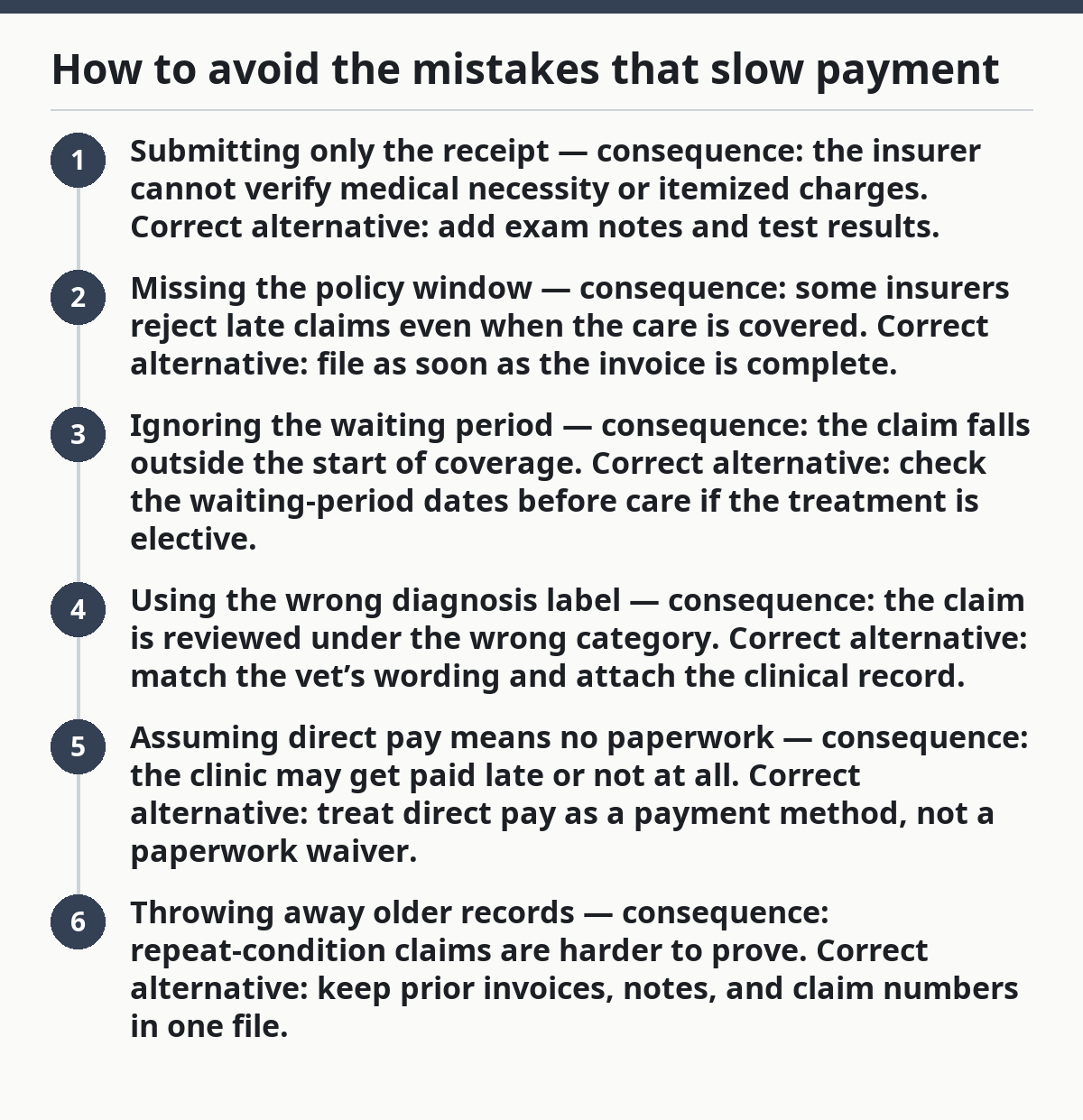
- Submitting only the receipt — consequence: the insurer cannot verify medical necessity or itemized charges. Correct alternative: add exam notes and test results.
- Missing the policy window — consequence: some insurers reject late claims even when the care is covered. Correct alternative: file as soon as the invoice is complete.
- Ignoring the waiting period — consequence: the claim falls outside the start of coverage. Correct alternative: check the waiting-period dates before care if the treatment is elective.
- Using the wrong diagnosis label — consequence: the claim is reviewed under the wrong category. Correct alternative: match the vet’s wording and attach the clinical record.
- Assuming direct pay means no paperwork — consequence: the clinic may get paid late or not at all. Correct alternative: treat direct pay as a payment method, not a paperwork waiver.
- Throwing away older records — consequence: repeat-condition claims are harder to prove. Correct alternative: keep prior invoices, notes, and claim numbers in one file.
A lot of claim pain comes from speed. People upload too soon, before they have the records that matter. Slow down by one day if it means the insurer gets the full file the first time.
What changes in edge cases
Edge cases need different handling when the care is ongoing, the claim spans more than one illness, or the policy uses special limits. That is where generic advice starts to break down.
Picture this: your pet has a chronic skin problem, but this month’s visit also includes an ear infection and a medication refill. The insurer may split the claim into covered and non-covered parts, or it may track the condition history as one ongoing file.
Common edge cases include:
- Chronic conditions: the insurer may treat future visits as part of one problem. Keep a single timeline with all dates and notes.
- Orthopedic claims: hips, knees, and ligaments often bring closer scrutiny. Add imaging reports and referral notes if the policy requires them.
- Dental claims: insurers often separate injury-related dental work from routine cleaning. Make sure the bill distinguishes each service.
- Preventive care add-ons: vaccination, flea control, and wellness benefits may have their own annual allowance. Keep those receipts separate from treatment claims.
- Multi-pet households: one invoice can cover more than one animal. Make sure the insurer can see which line belongs to which pet.
- Direct pay by the clinic: some clinics bill the insurer directly, but the policyholder still needs to confirm what remains unpaid. Ask for the final balance sheet.
The hard part is that the same vet visit can trigger three different policy rules. One part may be covered, one part may be limited, and one part may be excluded. A clean claim separates them clearly instead of forcing the insurer to sort it out.
How long it takes, and what a good result looks like
A good result is a claim that is approved, paid to the correct account, and documented clearly enough that the next claim is easier. The time it takes depends on the insurer, the completeness of the file, and whether the claim needs extra medical review.
Picture this: you submit on Monday, the insurer requests a missing lab report on Wednesday, and payment lands after the file is complete. That kind of stop-start process is common when records are incomplete. A simple claim can be faster; a disputed one can take much longer.
What “good” looks like:
- the claim shows received and in review status;
- the insurer asks for no extra documents, or only one targeted document;
- the explanation of benefits clearly shows the allowed amount and deduction;
- payment lands in the stated method without a banking error;
- the file closes with a reference number you can reuse if another claim follows.
What does not look good:
- repeated requests for the same document;
- unexplained reductions;
- payment issued to the wrong policyholder or account;
- a denial with no cited policy term;
- a claim that disappears from the portal without a final answer.
If the insurer is not responding after the usual processing window listed on the policy or portal, ask for the claim reference and the exact missing item. If the answer still makes no sense, escalate through the insurer’s complaint route or an outside complaint body that fits your country. For consumer complaint paths, the NAIC and local insurance regulators are relevant reference points.
Pet insurance claims and payments: common questions
Do I always have to pay the vet first?
No, not always. Many policies reimburse you after you pay the clinic, but some insurers offer direct pay to the vet for eligible claims. The method depends on the insurer, the clinic’s setup, and whether the file is approved for that payment path.
Why was my pet claim only partly paid?
Your claim was probably reduced by the deductible, reimbursement percentage, an annual limit, or an excluded service. The explanation of benefits should show the reason line by line. If the math still looks wrong, compare the decision against the policy wording and the itemized invoice.
What if the insurer says the condition was pre-existing?
That means the insurer believes signs, treatment, or records existed before the policy start date or during the waiting period. Ask for the records used in that decision and check the timeline carefully. Earlier clinic notes often matter more than the single visit that triggered the claim.
Can I submit a claim without the full medical record?
You can sometimes start the claim, but a missing chart can slow or block payment. The insurer may ask for notes, test results, or a full itemized invoice before it finishes review. The cleaner move is to file once the record set is complete.
How do I know if my claim was paid correctly?
Check the invoice, deductible, reimbursement rate, and policy limit against the explanation of benefits. A correct payment usually matches those terms exactly, even when the amount is lower than expected. If anything in the math or policy citation looks off, request a review with the claim reference number.
Can a denied claim be appealed?
Often, yes. Many insurers have a review or appeal process, but the steps and deadlines vary by country and company. A strong appeal usually includes the original claim, the denial reason, and any missing or corrected records from the clinic.
Drafted with AI; not yet reviewed by a person.