Last updated: November 19, 2026
An itemized vet invoice is the document to ask for when a pet insurance claim needs line-by-line charges, visit date, and procedure codes. Call the veterinary practice’s billing office, ask for an itemized invoice for insurance, and verify that each service and medication is listed separately before you submit it.
Key takeaways
- Ask for the billing office, not just the front desk, if the first copy is only a total.
- The document should show each charge on its own line, including medications and procedures.
- Missing dates, vague labels, or lump-sum billing can slow a claim or trigger a follow-up.
- If the practice uses a portal, request the exact invoice file your insurer can read.
- This is information, not financial advice; if your policy terms affect your money or coverage, consult a qualified adviser for your situation.
Who needs this invoice?
This applies to a pet owner who already has a veterinary visit and needs proof of each charge for a pet insurance claim. It assumes you know the visit date, the pet’s name, and the clinic that treated the pet; if you do not have those details, the billing office may not be able to find the right account. This page covers the invoice itself, not how to file the claim or what all records an insurer may ask for.
If the practice has already sent a receipt with only one total line, that is usually not enough for a claim that asks for details. An itemized invoice is the cleaner document because it separates the exam fee, procedure code, medication charges, and other billing line items. That makes it easier for an adjuster to see what was done on that date.
This is also the right page if the clinic is asking you to choose between “receipt,” “statement,” and “invoice.” In many cases, the insurer wants the document that shows the work performed, not just the amount paid. For broader records, see the pet insurance claims documentation hub.
How do you ask for an itemized vet invoice?
You get an itemized vet invoice by asking the veterinary practice for a billing copy that breaks out each charge on its own line. The easiest path is usually the billing office, because front-desk staff may only see the checkout receipt, not the full invoice. If the clinic has a client portal, the same document may be downloadable there as a PDF.
- Call the billing office and ask for the invoice. Say you need an itemized invoice for pet insurance, not a simple payment receipt; if the practice has multiple phones or departments, ask for the billing desk by name. Verify that they can pull the correct visit date, because the wrong date can attach the wrong services to the claim.
- Confirm the patient details before they search. Give the pet’s name, your name, and the approximate visit date so the practice can match the right account; if the clinic has more than one pet under the same owner, this matters. A mismatch here often shows up as missing charges or another pet’s invoice.
- Ask for line items, not a summary. Request that every service appear separately, including exam fees, procedure codes, medication charges, and any lab or supply charge listed by the practice. If the invoice only shows one lump sum, the insurer may treat it as incomplete for review.
- Request the format your insurer can read. Ask for a PDF, emailed copy, or portal download that preserves the original billing layout. If the file is a photo or a cropped screenshot, verify that dates and amounts are still visible; blurred corners or cut-off lines are a problem.
- Check the invoice for the visit date and provider name. Look for the exact date of service, the veterinary practice name, and the treating doctor or clinic identifier if it appears on the form. If any of those are missing, the insurer may ask for a corrected copy or cross-check records.
- Verify each charge line by line. Make sure medications, procedures, and any recheck or follow-up visit are listed separately, with clear labels rather than broad terms like “services.” If a line just says “miscellaneous,” ask the practice to clarify what that charge covers.
- Save the invoice before you submit the claim. Keep the file name simple, such as the pet’s name and visit date, so you can find it later if the insurer asks for a second copy. If the practice later corrects the invoice, use the newest version and keep the old one only as backup.
- Follow up if the office sent the wrong document. Ask for a revised invoice if you received only a receipt, a balance statement, or a page without itemized charges. If the practice cannot produce a proper invoice, note that early, because your insurer may pause the claim until the paperwork is corrected.
What should an itemized invoice show?
An itemized invoice should show what happened at the visit in billing terms, not just the final amount due. At a minimum, look for the visit date, the pet’s identity, the veterinary practice name, and separate billing line items for the exam, procedure code, medication charges, and any other billed service. If those pieces are missing, the document is less useful for claims review.
The term procedure code means the practice’s billing code for a service, test, or treatment. Some invoices list the code itself; others list only the plain-language service name. Either can work if the charge is still clearly tied to the visit, but a vague label makes the insurer’s job harder and can trigger a request for more records.
A good invoice also shows whether the charge is for the initial visit or a later recheck. That matters because some policies treat follow-up care differently from the original appointment. If the invoice mixes both visits on one page, the service dates should still be easy to separate.
What are the best ways to request it?
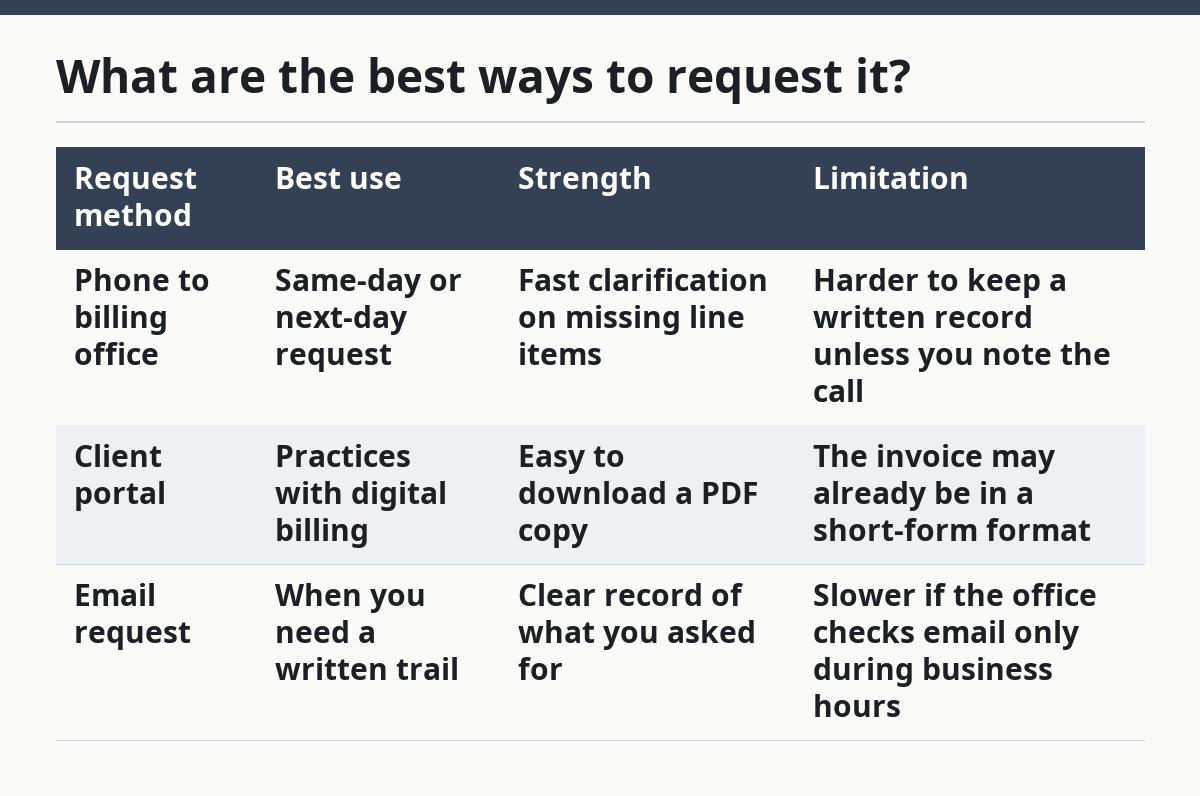
The best way to request it depends on how the veterinary practice handles records, but a phone call to the billing office is usually the fastest first step. A portal request is useful when the clinic already uses electronic billing, and email can work if the office accepts written requests and sends PDFs. Each option has trade-offs.
| Request method | Best use | Strength | Limitation |
|---|---|---|---|
| Phone to billing office | Same-day or next-day request | Fast clarification on missing line items | Harder to keep a written record unless you note the call |
| Client portal | Practices with digital billing | Easy to download a PDF copy | The invoice may already be in a short-form format |
| Email request | When you need a written trail | Clear record of what you asked for | Slower if the office checks email only during business hours |
If the first staff member says they cannot help, ask to speak to the billing office or records desk. That is usually the right place for itemized paperwork, not the treatment room staff. For practices with older software, the office may need a short turnaround to reprint the invoice in a claim-friendly format.
When should you stop and ask for help?
You should stop and ask the veterinary practice or your insurer for help when the invoice does not match the claim requirements. This is not a case for guessing, because a small paperwork error can delay a reimbursement decision. If the policy terms are unclear or the amount at stake matters to your budget, a qualified adviser can help you interpret the financial side for your situation.
The invoice has only one total line: that means the charges are not itemized — ask the billing office for a revised copy before you submit anything.
The visit date is missing or wrong: that can tie the charges to the wrong appointment — request a corrected invoice with the exact service date.
The practice name or pet name is absent: that makes matching the claim harder — ask for a version that clearly identifies the provider and the patient.
The document is a receipt only: that often shows payment, not services — request an itemized invoice or statement with line items.
The invoice shows charge codes you do not understand: that may still be fine, but it needs clarification — ask the billing office to explain the labels before the insurer does.
The insurer asks for something else entirely: that means the invoice alone is not enough — follow the insurer’s request instead of guessing which document to resend.
What mistakes slow claims down?
The most common mistake is asking for “the bill” and assuming any printout will do. That can leave you with a checkout receipt that shows a total but no line items, and the insurer may send it back. The fix is simple: ask for an itemized invoice for insurance, not just a payment receipt.
Another mistake is skipping the billing office and asking only at the front desk. Front-desk staff may be busy with check-ins, phones, and medical questions, while the billing office can usually print the correct record faster. If one person cannot help, ask for the department that handles invoices and account statements.
A third mistake is missing the visit date. Even a good invoice can be hard to use if the insurer cannot match it to the right claim. The correct move is to confirm the date before the office sends the file, especially if the pet had more than one appointment in the same week.
A fourth mistake is accepting a document with vague labels like “services” or “other charges.” Those labels hide what was actually billed and can cause extra follow-up. Ask for clearer billing line items, especially for medication charges and procedure code entries.
A fifth mistake is sending a photo that cuts off the bottom of the page. The insurer needs the full page, including totals and any small print. A clean PDF is better than a cropped image, because the whole charge list stays readable.
What changes in special cases?
Special cases need a slightly different request, but the goal stays the same: a readable invoice with the right visit details. If the pet had more than one appointment on the same day, ask the practice to separate the visits or label each service block clearly. Otherwise, the insurer may not know which charge belongs to which claim.
If the invoice includes medications dispensed by the clinic, check that the medication charges are listed separately from the exam fee. Some insurers want to see exactly what was given, not just the total for the visit. If the practice used bundled pricing, ask whether they can split the bundle into line items on the invoice.
If the clinic uses a paperless system, the invoice may arrive as a portal download rather than a printed sheet. That is fine as long as the PDF shows the visit date, practice name, and itemized charges. If the portal only shows a balance due, ask for the full billing copy from the office.
If the claim is for a follow-up visit, make sure the invoice does not merge that visit into the original appointment. A mixed invoice can confuse the claim review and create a request for more paperwork. A separate line for the recheck date usually makes the file easier to read.
If the practice refuses to change the invoice, ask what record they can provide instead, then check whether it still shows each service line. Some clinics will send a statement, a detailed ledger, or a corrected reprint. The useful version is the one that clearly ties the charges to the date of care.
Why do insurers require an itemized invoice?
Insurers ask for an itemized invoice because a total number does not show what was billed on the visit. The line items help the claim reviewer separate the exam fee, medications, procedures, and any follow-up care. That makes the charge easier to compare against the policy terms.
Can a receipt work instead of an invoice?
A receipt can work only if it already includes the same detail as an invoice. Many receipts show payment only, with no line-by-line services, so they are often not enough on their own. If the document does not show billing line items, ask the veterinary practice for a fuller invoice before you submit the claim.
What if the invoice is missing line items?
If the invoice is missing line items, ask the billing office for a corrected copy with the charges broken out. Missing detail can slow the claim review because the insurer cannot see what each charge is for. If the practice cannot revise it quickly, ask whether a detailed statement or ledger can fill the gap until the proper invoice is ready.
Drafted with AI; not yet reviewed by a person.