Last updated: November 20, 2026
Quick answer: Yes, pet insurance often covers ultrasounds and x-rays when they are diagnostic tests for a covered illness or injury, but coverage is not automatic. The exact result depends on the policy, the diagnosis, and the timing. Talk to a qualified veterinary professional about your pet’s case.
This guide sorts out what insurers usually cover, where the fine print bites, and when an imaging claim gets denied. For broader context, see our Pet Insurance Guide and How Pet Insurance Claims Work.
Key takeaways
- Ultrasounds and x-rays are often reimbursable when they are part of a covered illness or injury.
- The reason for the scan matters more than the scan itself.
- Pre-existing conditions, wellness-only policies, and exclusions are the most common reasons for denial.
- Emergency imaging may be covered, but the visit, exam, and related tests can be handled differently.
- A policy can cover one imaging test and exclude another if the insurer treats them as different tiers of care; check the policy or ask an insurance professional.
What pet insurance usually covers for imaging
Pet insurance usually covers ultrasounds, x-rays, and radiographs when they are used to diagnose a covered problem, not when they are done as routine screening. Picture this: you’re at the vet because your dog is limping or your cat won’t eat, and the clinic orders imaging to find the cause. In that setting, the scan is often part of a covered diagnostic test.
The catch is that coverage follows the policy language, not the machine. A radiograph is just an x-ray image, and an ultrasound is sound-wave imaging; insurers still ask whether the test was tied to an illness, injury, or other covered event. If the policy is accident-and-illness, that usually gives broader room than an accident-only plan. Check the policy wording and, if needed, ask a qualified insurance or veterinary professional.
A good rule is simple: the test is more likely covered when the medical problem is covered. If the condition is excluded, the imaging tied to it often is too. The ASPCA says coverage depends on the policy and the condition, not just the procedure.
- Illness workup: usually covered under accident-and-illness plans
- Injury workup: often covered if the injury itself is covered
- Routine screening: usually not covered
- Wellness add-ons: may help with preventive checks, but not all imaging is included
For the broader map of specialty care, the hub on Specialty, Surgery, and Advanced Treatment Coverage is the place to start.
Does pet insurance cover ultrasounds and x-rays in every case?
No, pet insurance does not cover every ultrasound or x-ray just because the scan exists. Picture this: you bring in a healthy pet for a checkup and the vet suggests imaging “just to be safe.” That may be smart medicine, but many policies still treat it as non-covered unless the plan includes wellness benefits or the test is tied to a covered diagnosis. Ask the clinic or insurer before the test if you are unsure.
This is where people get tripped up. An ultrasound can be used for abdominal pain, bladder stones, pregnancy checks, or fluid in the chest. An x-ray can be used for fractures, swallowed objects, heart size, or lung changes. The image type does not decide coverage by itself. The medical reason does.
If a policy only pays for unexpected illness or injury, then a scan done for a known, long-term problem may be denied as pre-existing. If the policy has a waiting period, the test may also be excluded if the symptoms started before that window ended. The NAIC notes that waiting periods and exclusions vary by policy.
- Coverage follows the diagnosis
- Waiting periods matter
- Pre-existing conditions matter
- Routine screening usually does not count
The truth is, the claim often turns on one line in the chart.
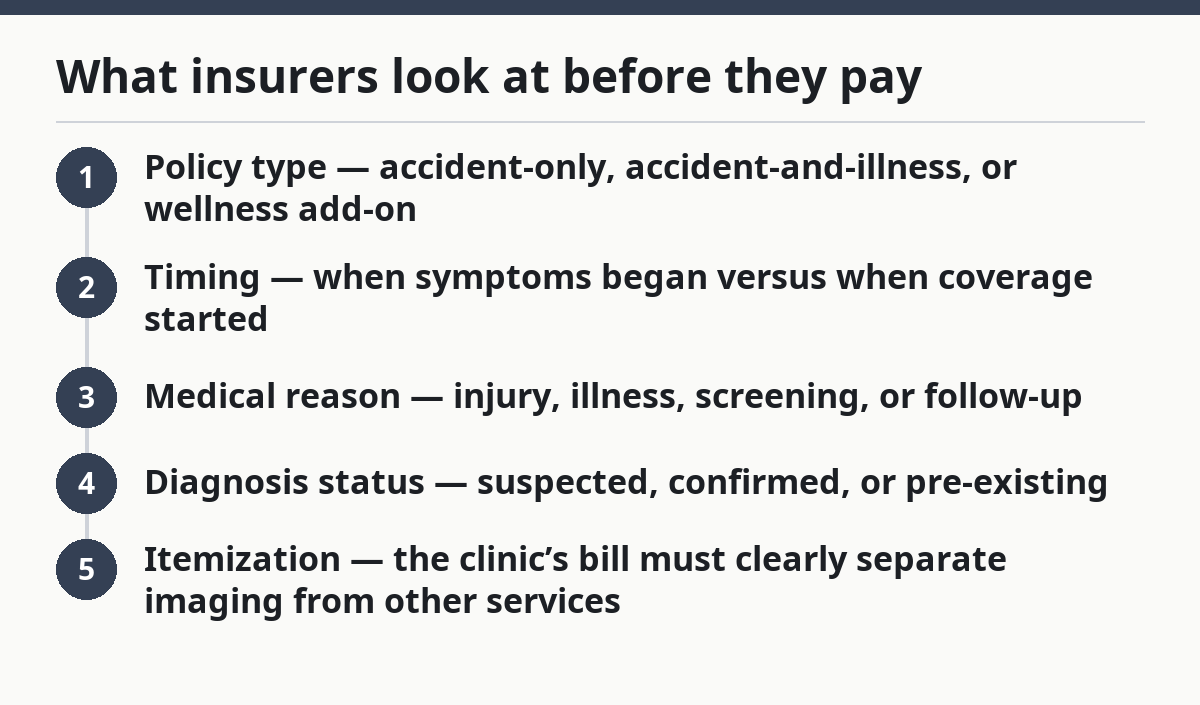
What insurers look at before they pay
Insurers usually look at the medical record, diagnosis, and policy exclusions before they pay for imaging. Picture this: the clinic submits a bill with a radiograph, ultrasound, exam fee, and lab work all in one visit. The adjuster does not just ask, “Was an x-ray done?” The adjuster asks, “What problem was being worked up, and is that problem covered?”
That means the same scan can land very differently depending on the file. A chest x-ray after a car accident may be treated differently from the same x-ray done to follow a chronic cough that began before enrollment. A scan after trauma may fit an accident claim, while the same scan for an old condition may not. That said, check the policy or ask a professional, because carriers can define these services differently.
A few details usually matter:
- Policy type — accident-only, accident-and-illness, or wellness add-on
- Timing — when symptoms began versus when coverage started
- Medical reason — injury, illness, screening, or follow-up
- Diagnosis status — suspected, confirmed, or pre-existing
- Itemization — the clinic’s bill must clearly separate imaging from other services
If the bill lumps everything together, the claim can slow down. If the record is vague, denial risk goes up. The North American Pet Health Insurance Association says clear records can help claims processing.
How to read a policy before the bill shows up
You can usually tell whether imaging is likely covered by reading the policy’s definitions, exclusions, and reimbursement rules. Picture this: you have the policy PDF open and you’re looking for one clear answer about ultrasound or x-ray coverage. The answer is rarely in a single sentence. It’s usually spread across the sections for covered conditions, diagnostics, and exclusions.
Start with the words diagnostic tests, imaging, radiographs, ultrasound, and pre-existing conditions. Then check whether the policy distinguishes between accident and illness, or whether it only covers accidents. Some plans also treat diagnostic tests done during the same visit as the emergency differently from tests ordered later. Read the definitions carefully, then confirm them with the insurer if anything is unclear.
Use this checklist:
- Look for imaging in the covered services section
- Find the definition of diagnostic test
- Check whether the plan covers illness, injury, or both
- Read the pre-existing condition clause word for word
- Check any waiting period for accidents and illnesses
- See whether exam fees are covered, because many plans handle them separately
A clean policy usually answers these questions without guessing. A vague policy often means you need to ask the insurer before the next appointment. The FTC advises getting the terms in writing when possible.
When imaging is more likely to be denied
Imaging is more likely to be denied when it is tied to a condition the policy excludes or treats as routine care. Picture this: your pet has had the same limp for months, the vet orders an x-ray, and the insurer says the problem started before enrollment. That is a classic denial pattern.
The hard cases are usually not about the machine. They’re about timing and cause. A scan for a known arthritis flare may be handled differently from a scan for a sudden fracture. An ultrasound for a long-standing digestive issue may be denied if the insurer sees it as part of a pre-existing pattern. If the policy excludes the condition, the imaging can follow the same rule.
Common denial triggers include:
- Symptoms that began before the policy started
- A condition listed as pre-existing
- A preventive or screening scan with no illness or injury behind it
- A policy that excludes diagnostics tied to a non-covered problem
- Missing or unclear medical notes
The best part? Many denials are explainable once the chart is reviewed line by line. The bad part is that the explanation can still leave the claim unpaid.
Does the reason for the test matter?
Yes, the reason for the test matters a lot more than the test name. Picture this: the same ultrasound is ordered for belly pain in one pet and for routine pregnancy checking in another. Those are not the same claim, even though the imaging tool is identical.
That difference matters because insurers usually cover medical necessity, not convenience. If the scan was ordered to find the cause of new symptoms, it is more likely to fit the policy. If the scan was done to check something routine, confirm something expected, or monitor a known issue, the claim may be treated differently. Ask a professional if the chart or policy wording is unclear.
This is also why vet notes count. A short note like “r/o foreign body” — meaning “rule out foreign body” — can support a diagnostic claim. A note that says “screening only” gives the insurer a stronger reason to deny.
- New symptom: more likely to support coverage
- Routine check: more likely to be excluded
- Known condition: depends on policy language
- Preventive scan: often not covered unless wellness benefits say so
If the reason is unclear, ask the clinic what diagnosis code or note is being sent. That can make or break the claim.
What if imaging is part of an emergency visit?
Emergency imaging may be covered if the emergency itself is covered, but the exam fee, stabilization care, and imaging can be handled in separate ways. Picture this: your pet needs care right away, and the clinic orders x-rays or an ultrasound to rule out a blockage, fracture, or internal problem. That is exactly the kind of setting where people hope insurance will help.
It often does, at least partially, if the plan covers accidents or emergency illness. Still, emergency rooms can stack charges fast, and not every line item is treated the same. One insurer may cover the radiograph but not the initial exam fee. Another may cover the illness workup but exclude a pre-existing problem found during the visit. The AVMA and your insurer can help clarify how the visit is billed.
A few things help:
- Ask for an itemized invoice
- Get the diagnosis listed clearly
- Keep the discharge summary
- Save the imaging report if the clinic provides one
- Submit the claim quickly with all records attached
On the flip side, an emergency label does not erase exclusions. If the underlying problem is excluded, the imaging tied to it may be excluded too.
Common mistakes that lead to denied imaging claims
The most common mistake is assuming all diagnostics are covered once a pet has insurance. Picture this: you see “x-ray” on the bill and assume that ends the question. It doesn’t. The policy can still deny the claim if the reason for the scan falls outside coverage.
Another mistake is waiting until after the appointment to check the policy. That is how people end up surprised by a denial for a pre-existing condition or a routine scan. A third mistake is sending a claim with a vague invoice that does not separate the ultrasound, x-ray, exam, and medication charges.
Watch for these:
- Assuming imaging equals coverage — can lead to denied claims
- Ignoring pre-existing condition language — can hide the real issue
- Skipping itemized records — can slow or weaken the claim
- Mixing preventive and diagnostic care — can confuse the adjuster
- Not checking waiting periods — can make a new claim ineligible
The fix is boring but effective: read the policy, ask the clinic for clear records, and match the claim to the medical reason, not just the bill.
What to do before your next vet visit
You can reduce claim problems by checking coverage before the scan is ordered. Picture this: your pet’s symptoms are new, and the vet may recommend imaging right away. A five-minute policy check before the visit can tell you whether the likely claim is a good fit or a risk.
Start with the basics:
- Confirm whether the plan covers illness, injury, or both
- Look for diagnostic test coverage
- Check the waiting period dates
- Read the pre-existing condition rule
- Ask the clinic whether the visit will be coded as diagnostic, preventive, or emergency
If you’re unsure, ask the insurer a direct question: “Would an ultrasound or x-ray ordered for this symptom be eligible under my policy?” Get the answer in writing if you can. That is not overkill. It is paperwork that can save a claim.
Are diagnostic tests covered?
Sometimes, yes. Diagnostic tests are often covered when they are used to investigate a covered illness or injury, but the exact rule depends on the policy wording. Picture this: your vet orders x-rays for a sudden limp or an ultrasound for vomiting. If the policy covers that underlying problem, the imaging may be eligible too.
The problem is that “diagnostic tests” is not a magic phrase. Some plans cover them broadly, while others limit them to certain causes or exclude exam fees. The best check is the covered-services section plus the exclusions page. For a side-by-side overview, see What Pet Insurance Covers.
Does the reason for the test matter?
Yes, it matters a lot. A scan ordered for a new symptom is usually treated differently from one ordered for screening or a long-known condition. Picture this: one pet gets an ultrasound for sudden abdominal pain and another gets one for routine monitoring. Same machine, different claim risk.
Insurers usually follow the charted reason, the diagnosis code, and the timing of symptoms. If the reason points to a pre-existing or non-covered issue, the claim can be denied even when the scan itself was medically sensible. For definitions of common policy terms, check Pet Insurance Terms Explained.
What if imaging is part of an emergency visit?
Emergency imaging may be covered if the policy covers the emergency condition, but not every charge in the visit is treated the same way. Picture this: an emergency x-ray after trauma or an urgent ultrasound for suspected internal trouble. The imaging may be payable, while the exam fee or another service line is handled separately.
Itemized records matter here. So do discharge notes and the exact diagnosis. If the emergency revealed a pre-existing problem, that part of the claim may still be excluded.
Drafted with AI; not yet reviewed by a person.