Last updated: November 19, 2026
Quick answer: a diagnosis-based exclusion in pet insurance is a written policy carve-out for 1 named condition, and it can affect a claim even when the pet is otherwise insured. For What Is a Diagnosis-Based Exclusion in Pet Insurance?, the safest step is to review the policy wording with a qualified professional and compare it with the pet’s medical records before you buy or file a claim.
A diagnosis-based exclusion in pet insurance is a policy rule that refuses coverage for one named condition, such as arthritis or a heart murmur, because that diagnosis is already known. If your pet has that diagnosis on medical records, the insurer can leave it out of the policy even when other illnesses are still covered. Speak to a qualified professional about your pet’s specific medical history before you rely on any policy wording.
Key takeaways
- A diagnosis-based exclusion names a specific condition, not just a vague symptom or a body part.
- It usually comes from underwriting, where the insurer reviews medical records before or after enrollment.
- The exclusion can be narrow, covering 1 disease, or broad enough to affect a related group of conditions.
- It is easy to confuse this with a pre-existing condition rule, but the two are not the same thing.
- The exact wording matters more than the label on the brochure.
What is a diagnosis-based exclusion?
A diagnosis-based exclusion is a written carve-out in a pet insurance policy that excludes treatment tied to a specific diagnosis; if the wording is unclear, a qualified professional can help you review it. The insurer is saying, in effect, “This condition is not covered,” and it may remain excluded for the life of the policy.
This is different from a general exclusion that applies to a whole class of care. A diagnosis-based exclusion can be very narrow, such as one named condition in one limb or one organ system, or broader if the policy language reaches related complications. The key clue is the diagnosis itself, not just a symptom like limping, coughing, or vomiting. See the FTC’s pet insurance guidance for a consumer overview: https://consumer.ftc.gov/articles/pet-insurance.
This matters because the same symptom can come from many causes. A limp after a sprain is not the same as a limp linked to hip dysplasia, so a qualified professional can help you compare the medical record with the policy wording before you assume the claim outcome. The exclusion usually follows the written diagnosis found in the pet’s medical records and the insurer’s underwriting file.
Where does it show up?
A diagnosis-based exclusion shows up in the policy schedule, exclusions section, or underwriting notes. It can appear in a 1-line addendum or in a longer list of conditions the insurer will not pay for.
Sometimes the wording is plain: “Excludes cruciate ligament disease.” Sometimes it is broader and says “conditions related to, arising from, or secondary to” a named diagnosis. That extra phrase can matter a lot, because it may reach surgery, medication, imaging, and follow-up care tied to the same disease process.
Medical records are the usual source. If a vet record says a pet has a prior diagnosis, the insurer may use that note during underwriting and then write the exclusion into the policy. That is why a clean summary from the sales page is not enough; the actual contract controls. The AVMA’s pet insurance page also explains why policy terms matter: https://www.avma.org/resources-tools/pet-owners/petcare/pet-insurance.
For a wider map of how this fits into policy rules, the pet insurance coverage rules hub is the right place to start.
How does underwriting create one?
Underwriting creates a diagnosis-based exclusion by turning medical history into policy terms. The insurer reviews records, identifies a named diagnosis, and then decides whether to cover it, exclude it, or cover it only after a waiting period.
A practical way to understand the process is to trace the paper trail. The diagnosis in the medical record leads to an underwriting review, and that review leads to a contract term. If the diagnosis is specific and well documented, the exclusion often is too. If the records are vague, the wording may be broader and less predictable.
What usually happens next
- List every known diagnosis: Pull together the medical records and note each named condition, not just symptoms. Verify the exact wording in the chart; if it is unclear, a qualified professional can help you read it correctly. A problem is a vague label such as “joint issue” with no diagnosis attached.
- Check the policy form: Read the exclusions section and any underwriting attachment line by line. Verify whether the policy names 1 condition or several; a problem is language that says “related conditions” without a clear definition. If needed, compare the wording with the insurer’s policy guide or a consumer source such as the FTC page above.
- Match the diagnosis to the wording: Compare the pet’s record with the exclusion term. Verify that the excluded condition is actually the same diagnosis; a problem is assuming “ear infection” and “chronic otitis” are interchangeable without checking the contract. If the terms are unfamiliar, ask a qualified professional to help interpret them.
- Look for related-condition language: Find phrases such as “secondary to,” “associated with,” or “arising from.” Verify whether those words are present; a problem is ignoring them and later finding treatment denied for a complication tied to the same 1 diagnosis. A qualified professional can help you decide whether the wording is narrow or broad.
- Ask for written clarification: Request the exclusion in writing if the wording is unclear. Verify that the insurer answers with the same terms used in the policy; a problem is relying on a phone summary that never appears in the file. Keep that written reply with the policy documents.
- Check whether the exclusion is permanent: See whether the policy says the condition is excluded for the life of the policy or only until a waiting period ends. Verify the duration; a problem is assuming the exclusion disappears after 6 months when the contract says otherwise. If you are unsure, consult a qualified professional before enrolling.
- Review renewals and updates: Recheck the policy at each renewal date, especially if the insurer updates its terms. Verify that the exclusion has not expanded; a problem is assuming the same wording carries over unchanged year after year. The policy document, not the brochure, controls the result.
The point of this process is not to predict every claim outcome. It is to see whether the insurer has tied 1 diagnosis to a clear exclusion before a bill arrives.
What is it confused with?
A diagnosis-based exclusion is often confused with a pre-existing condition rule, a breed-specific exclusion, or a temporary waiting period. Those are not the same tool, even though they can overlap in one policy.
| Term | What it means | What it usually affects |
|---|---|---|
| Diagnosis-based exclusion | A named condition is excluded | 1 diagnosis, sometimes related complications |
| Pre-existing condition | A condition existed before coverage started or before a waiting period ended | Any illness or injury already known |
| Breed-specific exclusion | A condition linked to a breed risk is excluded or limited | A breed-specific condition, such as one tied to a known genetic risk |
| Waiting period | Coverage is delayed for a set time | New claims during a short initial period, often measured in days |
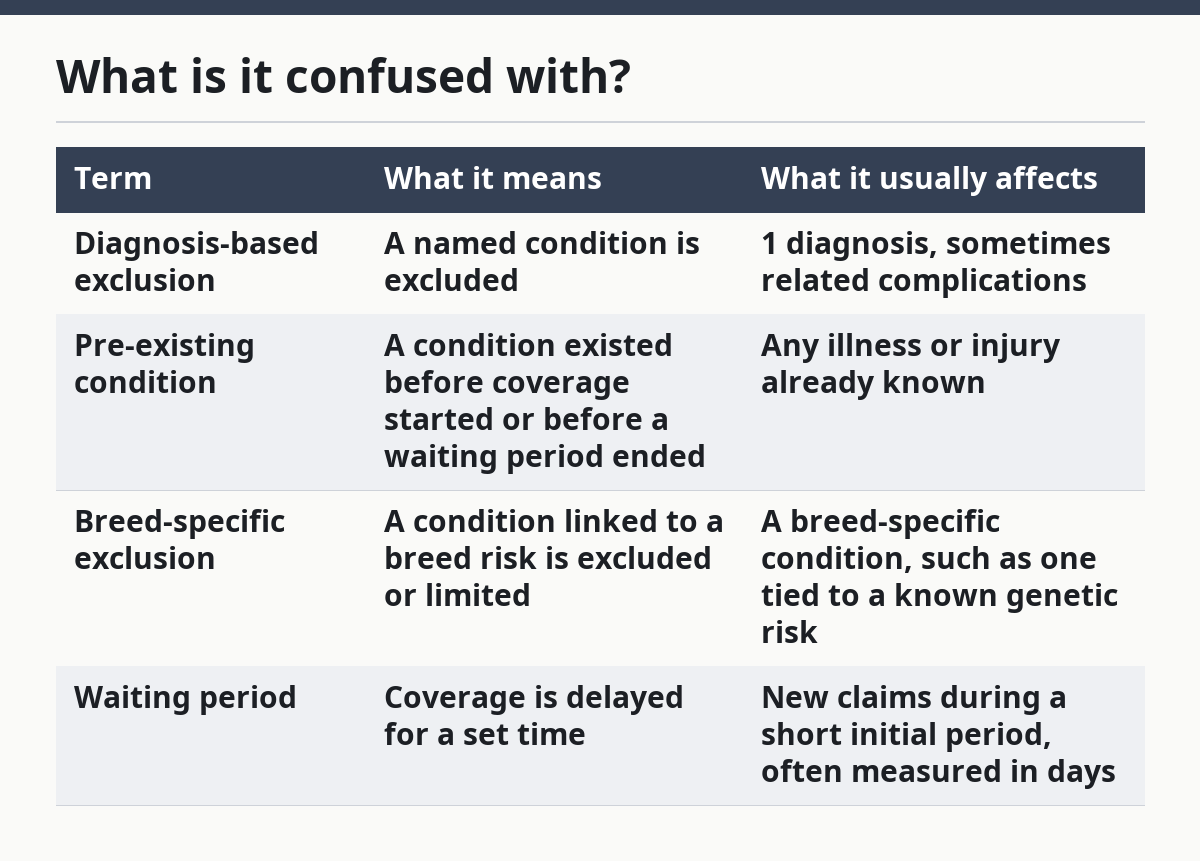
The difference matters because a pet can have a diagnosis-based exclusion without the condition being labeled “pre-existing” in a broad sense. The insurer may have enough medical evidence to exclude only that named condition, not every future illness. That is why the exact wording, not the headline label, controls the claim.
When does it matter most?
A diagnosis-based exclusion matters most when a pet already has a known condition and the owner still wants broad coverage for everything else. It also matters when the diagnosis is likely to affect more than 1 body system, because related-care wording can widen the exclusion.
1 named disease with ongoing follow-up: This means future vet visits, tests, or medications for that condition may not be covered — review the exclusion before assuming any claim will pay.
Breed-specific condition in the file: This means the insurer may tie the diagnosis to breed risk and write broader exclusions — check whether the policy limits only that condition or the full chain of related problems.
Medical records show an old diagnosis but the pet looks fine now: This means the condition can still be excluded even if symptoms are quiet — do not assume a symptom-free period erases the diagnosis from underwriting.
The wording includes “secondary to” or “associated with”: This means a second problem linked to the original diagnosis may also be excluded — ask for the exact chain of conditions in writing.
The policy was issued after a record review: This means underwriting already shaped the contract — read the exclusions before a claim, not after a denial.
This is the part people often miss. They focus on whether the pet is healthy today and forget that the insurer is insuring the record, not just the exam room appearance. That distinction can change what happens with a $500 imaging bill or a 12-month medication plan.
What should you check before you buy?
A diagnosis-based exclusion should be checked against the pet’s medical records before you buy, because the contract will usually follow those records. The safest way to read the diagnosis-based exclusion is to look for the diagnosis name, the related-condition language, and the date or stage of the exclusion.
After that, compare the diagnosis in the chart with the policy wording. A diagnosis written as a precise term should match the exclusion with the same precision. If the policy is vague, ask for the same wording in writing before enrollment closes.
Next, check whether the exclusion is limited to 1 condition or stretched to everything “related to” it. That phrase can be the difference between excluding a single knee problem and excluding a broader orthopedic chain. If the policy does not define the phrase, the risk is ambiguity at claim time.
Then ask how the insurer handles future symptoms that point to a new issue. A limping dog can develop a new injury, but the policy may still deny anything that seems tied to the named diagnosis. The answer depends on the contract, not on the symptom alone.
If you want a broader consumer overview after this page, the FTC’s pet insurance guidance is a useful starting point: https://consumer.ftc.gov/articles/pet-insurance. The AVMA also has pet insurance information here: https://www.avma.org/resources-tools/pet-owners/petcare/pet-insurance. For related reading, see the pet insurance coverage rules hub and the pre-existing condition coverage guide.
What are the common mistakes?
The most common mistake is treating a diagnosis-based exclusion like a routine fine-print footnote, but a qualified professional can help you judge the wording before you rely on it. It is not fine print once the claim is tied to a named disease. A single excluded diagnosis can change whether a future $1,000 bill is partly covered or not covered at all.
Another mistake is reading only the summary page. Summaries often leave out related-condition language and exceptions, which is where the real cost sits. The full exclusions section and underwriting notes are the documents that matter, and a qualified professional can help you compare them.
A third mistake is assuming symptoms and diagnoses are interchangeable, so it helps to review the policy with a qualified professional if the terms are unclear. They are not. A symptom such as coughing can have many causes, while a diagnosis names one condition that may be excluded in the policy language.
A fourth mistake is forgetting that breed-specific exclusion and diagnosis-based exclusion can overlap. If the pet is from a breed with a known risk, the policy may exclude one named condition and still leave the door open to other unrelated problems. The reverse can also happen, which is why the exact wording matters.
A fifth mistake is waiting until after a denial to read the policy. By then, the contract is usually already in force. The better move is to read the exclusion during the quote stage and keep a copy of the wording. For plan comparisons, the pet insurance coverage rules hub can help you sort policy terms before you enroll.
FAQ
How is a diagnosis-based exclusion different from a pre-existing condition?
A diagnosis-based exclusion names 1 condition in the policy itself, while a pre-existing condition rule applies to an illness or injury that was already present before coverage started. They can overlap, but they do not mean the same thing. One is a written carve-out; the other is a timing rule tied to medical history.
Can a policy exclude only one named disease?
Yes, a policy can exclude only 1 named disease if the underwriting file supports that narrower wording. That said, some policies use broader phrases that reach related complications too. The practical question is not whether the exclusion is single or broad in theory, but how the contract defines it in writing.
Do diagnosis-based exclusions apply to new symptoms?
They can, if the new symptoms are linked to the excluded diagnosis. A limp, cough, or skin flare may be treated as separate at first, but the insurer can still deny it if the records connect it to the named condition. The claim outcome usually turns on medical records and policy wording, not on the symptom alone.
Drafted with AI; not yet reviewed by a person.