Last updated: November 19, 2026
Key Takeaways
- Policy terms decide who is covered, what is covered, and when payment is allowed.
- A covered loss fits the coverage grant, avoids exclusions, and meets payment conditions.
- Definitions explain policy words; exclusions remove losses the insurer won’t pay.
- Policy conditions are the steps you must follow to keep coverage in force.
Policy terms decide what gets paid, what gets denied, and what paperwork you need when you file a claim. Quick Answer: this guide to Understanding Policy Terms & Coverage Rules starts with the declarations page, definitions, exclusions, and conditions — those four parts control coverage. This article on Understanding Policy Terms & Coverage Rules shows how to tell what your policy really covers and where people get tripped up.
I write about policy language for a living, so I know the trap: a plan can look generous until one word changes the outcome. That’s the catch with Understanding Policy Terms & Coverage Rules.
What policy terms actually control
Policy terms control three things: who is covered, what is covered, and when payment is allowed. If a term is defined narrowly, the insurer can limit the claim even when the loss sounds covered in plain English.
Picture this: you’re reading a policy after a loss, and the sentence you thought was obvious turns out to hinge on one defined word. The page may say “insured,” “resident relative,” “occurrence,” or “replacement cost” — and each one can change the result. The definitions section is not filler. It is the rulebook.
Here’s how the main parts work:
- Declarations page: lists the named insured, policy period, limits, deductibles, and sometimes endorsements.
- Definitions: tells you what key words mean in this contract, not in everyday speech.
- Coverage grant: says what the insurer promises to pay for.
- Exclusions: lists what is not covered, even if the loss would otherwise fit.
- Conditions: spells out your duties, like reporting a loss, protecting property from more damage, or cooperating in an investigation.
The first thing to check is the policy period. If the loss date falls outside it, the rest of the policy may not matter. The second is the named insured. If the person or business filing the claim is not listed, coverage can fail fast.
For a basic consumer explanation of these terms, the National Association of Insurance Commissioners explains common policy language in plain English.
What does “covered loss” mean in a policy?
A covered loss means the claim fits the policy’s coverage grant, does not hit an exclusion, and meets the conditions for payment. That sounds simple, but the details decide most disputes.
Picture this: you’ve got a water leak, a theft, or a car crash, and the loss feels obviously insured. The policy still asks a tighter question: does this loss match the exact trigger, cause, and place named in the contract? That is the real test.
A basic coverage analysis usually follows this order:
- Was the loss caused by a covered peril or event?
- Did the loss happen during the policy period?
- Did it involve covered property, covered people, or a covered activity?
- Does an exclusion remove it from coverage?
- Did you meet the policy conditions?
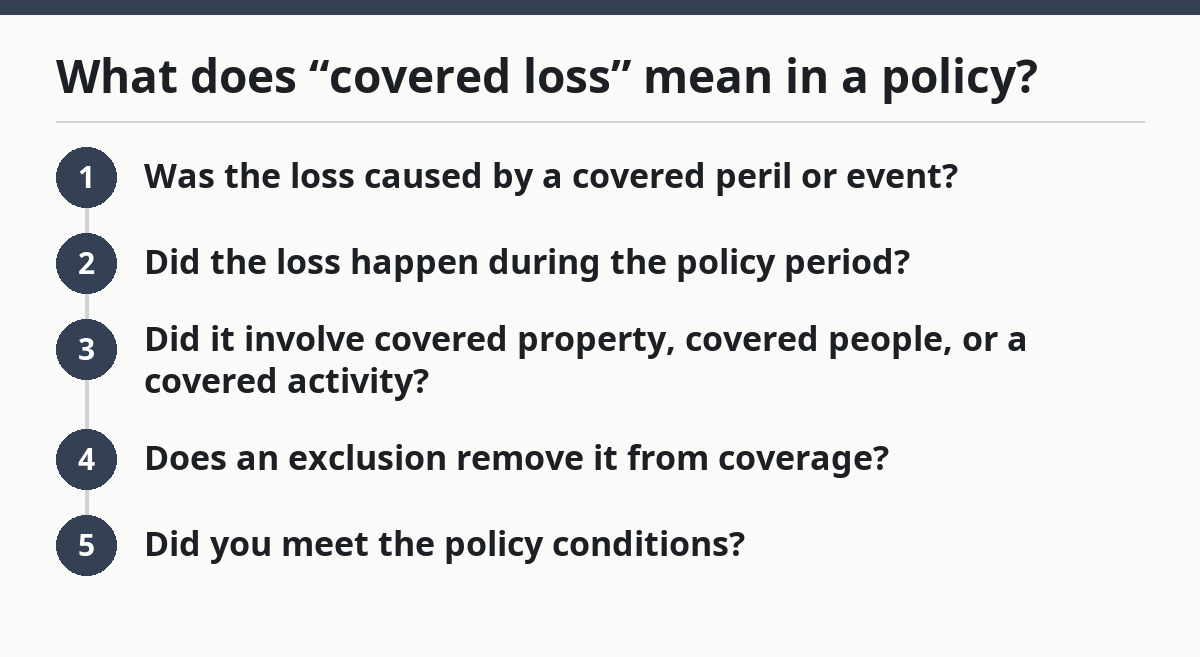
If the answer to any one of those steps is no, the claim may shrink or disappear.
A common mistake is stopping at step one. People see “water damage” or “liability coverage” and assume the claim is done. It isn’t. A policy may cover sudden pipe breaks but exclude gradual seepage. It may cover accidents but not intentional acts. It may cover business property at one location and say nothing about inventory stored elsewhere.
Two terms matter a lot here:
- Peril: the cause of loss, such as fire, wind, theft, or collision.
- Occurrence or accident: the event that starts the claim, often defined more tightly than a layperson expects.
The difference between definitions and exclusions
Definitions tell you what a word means; exclusions tell you what the insurer won’t pay for even if the loss would otherwise fit. Definitions shape the door, exclusions lock it.
Picture this: you think your claim is covered because the policy mentions the type of damage you suffered. Then the exclusion page removes the exact cause, the exact surface, or the exact use case. That’s why reading only the coverage section is a bad habit.
A few examples show the difference:
- If a policy defines “flood” narrowly, water from outside may not count unless it meets that definition.
- If a policy excludes earth movement, a sinkhole or landslide claim may be denied even if the damage looks sudden.
- If a business policy defines “employee” in a way that excludes contractors, that affects liability and payroll-related terms.
- If a policy excludes wear and tear, damage from slow deterioration may not be paid even when the loss is real.
The logic is simple. Definitions explain the contract’s vocabulary. Exclusions remove categories from coverage. A reader who treats them as the same thing should consider getting help from a licensed agent, attorney, or other qualified professional, and should consult the policy wording or a state insurance resource before relying on a denial or approval. A reader who treats them as the same thing will miss the strongest denial language in the policy.
You’ll also see endorsements. Those are amendments that add, remove, or change terms. An endorsement can override the base policy. In practice, that means a small rider on page 12 can beat a broad promise on page 3. Never ignore the endorsement list.
How policy conditions affect payment
Policy conditions are the steps you must follow to keep coverage alive. Miss them, and the insurer may reduce payment or deny the claim altogether.
Because those conditions can matter after a loss, picture this: you report a loss late, toss damaged items before they’re documented, or ignore a request for records. The claim may still be valid in spirit, but the policy can still punish the process. Procedure matters.
Common conditions include:
- Prompt notice of the loss
- Proof of loss or claim forms
- Protection from further damage
- Cooperation in the investigation
- Inspection of damaged property
- Medical or repair documentation
- No voluntary payment or admission of liability without permission
Some conditions are easy to miss because they sound polite rather than strict. “Please cooperate” can still be a binding requirement. “Keep records” can mean receipts, photos, repair estimates, police reports, or logs, depending on the policy type.
A practical rule helps here: if a condition asks you to do something soon, keep a dated record that you did it. Save the email. Save the form. Save the name of the person you spoke with. If the policy requires notice “as soon as practicable,” the insurer can later argue about delay. Documentation narrows that fight.
There’s another trap: duty to mitigate. If your policy says you must prevent more damage, that does not mean you must make a perfect repair. It means you should take reasonable steps to stop the loss from growing. A tarp after roof damage may help. Leaving the opening exposed may hurt.
That timeline helps more than guesswork, so save the dates and keep proof.
What the declarations page tells you that the rest does not
The declarations page gives you the snapshot facts that control the policy: names, dates, limits, deductibles, and covered locations. It is the fastest way to spot obvious gaps.
Picture this: you’re holding a policy that feels complete, but the declarations page lists a different business name, a different home address, or a limit lower than the loss. That page often decides the claim before the fine print even starts. Check it first.
Here’s what to verify:
- Named insured: the person or entity that bought the policy
- Policy period: the start and end dates of coverage
- Limits: the maximum the insurer will pay, sometimes per claim and sometimes overall
- Deductible: the part you pay before coverage starts
- Covered property or location: where coverage applies
- Forms and endorsements: the added pages that change the base policy
The declarations page can also reveal a bad surprise: a line item that seems broad but is actually limited by another form number. If the declarations say a coverage part exists but the attached form narrows it, the attached form usually wins for that subject.
The declarations page rarely tells the whole story. It gives you the map, not the terrain. You still need the insuring agreement, exclusions, and conditions to know what happens after a loss.
For general consumer help on policy setup, the Consumer Financial Protection Bureau explains how coverage documents and complaints work in plain language.
How to read coverage limits, deductibles, and sublimits
Coverage limits, deductibles, and sublimits control how much the insurer pays and where the payment ceiling sits. The headline limit is often not the practical limit once a sublimit applies.
Picture this: the policy says you have a large coverage amount, but the specific type of loss falls under a smaller sublimit. That smaller number may be the one that matters when the check is written. The fine print can shrink the recovery.
Here’s the basic hierarchy:
- Overall limit: the most the policy will pay in the policy period or for a claim, depending on the form
- Per-occurrence limit: the cap for one event
- Aggregate limit: the cap across multiple claims or events
- Sublimit: a smaller cap for a specific type of loss
- Deductible: the amount you absorb before the insurer pays
A policy might have a $100,000 overall limit but a much lower sublimit for jewelry, electronics, water backup, business income, or certain liability claims. If you never check the sublimits, you can overestimate the payout by a lot.
The deductible works differently from the limit. It does not reduce coverage itself; it reduces the amount paid on a covered claim. If a covered loss is smaller than the deductible, there may be no payment at all. If the loss is larger, the deductible comes off the top.
Two questions help you read these numbers correctly:
- Is the limit per claim, per item, per person, or for the full policy period?
- Does a special sublimit replace the general limit for this kind of loss?
That second question catches more surprises than people expect. The Insurance Information Institute also explains deductibles and limits in standard policy terms.
Which policy terms cause the biggest claim problems?
The biggest claim problems come from terms that define timing, cause, scope, and proof. If those four areas are fuzzy, the claim gets risky.
Picture this: you’ve filed the claim and everything seems normal until the adjuster asks for the exact cause, the exact date, the exact damaged item, and the exact paperwork. The policy was built for that moment. The insurer reads for limits; you read for coverage.
The most disputed terms usually include:
- Occurrence / accident / event: determines what counts as one claim
- Sudden and accidental: can exclude gradual damage
- Wear and tear: often used to deny aging or maintenance-related loss
- Actual cash value vs. replacement cost: changes how depreciation is handled
- Residence premises / covered premises: narrows where the policy applies
- Intentional acts: removes planned or expected damage
- Late notice: can be used to challenge the claim process
These terms matter because they sit at the border between ordinary life and insurance language. A homeowner may say “my roof was damaged by age and weather.” The policy may split that into covered storm damage and excluded deterioration. A business owner may say “one event caused everything.” The policy may split losses by location, time, or cause.
This is where a clean timeline helps. Write down when the damage started, when you found it, when you reported it, and what happened next. If the policy uses a phrase like “promptly” or “reasonable time,” your timeline becomes evidence.
Why policy language changes the result even when the facts stay the same
Policy language changes the result because insurance pays on contract terms, not on general fairness. Two claims with the same facts can end very differently if one word changes.
Picture this: the same leak, the same crash, or the same injury lands on two policies with different wording. One says “sudden and accidental.” Another says “loss caused by a covered peril.” One defines “resident” one way; another uses a broader test. The wording is the result.
This is why a generic summary is often useless. It says “check your policy,” but that leaves out the hard part: checking which words matter most. The key is to match the loss to the exact wording on the page.
A simple read-through works best:
- Find the coverage grant.
- Find the definitions for the words used there.
- Find the exclusions that remove the loss.
- Find the conditions that could block payment.
- Compare the facts of the loss to those words, not to your memory of the conversation with the agent.
If the policy uses a standard form, that can help because standard wording is often reused and easier to compare against guidance from the insurer, the state department of insurance, or the policy form itself. If the policy is a custom manuscript form, the wording can be less familiar and harder to sort out.
Two authoritative places to check plain-language explanations are the National Association of Insurance Commissioners and your state department of insurance. They often explain terms like deductible, premium, exclusion, and policy limit in consumer language. For more technical form language, the policy itself still controls.
What should you do before you file a claim?
Before you file a claim, gather the policy pages that control coverage, document the loss, and check the notice rules. That makes the claim cleaner and reduces avoidable fights.
Picture this: you’re standing in the middle of a loss and want to move fast. Speed helps, but only if you know what the policy needs from you. Good paperwork beats a rushed guess.
Use this short checklist:
- Pull the declarations page
- Find the coverage part that matches the loss
- Read the definitions for the key terms in that section
- Scan the exclusions
- Check the conditions for notice, proof, and mitigation
- Gather photos, receipts, reports, and dates
- Save every message with the insurer, agent, or adjuster
If the policy is complex, compare the loss against a simple question: “What exactly makes this covered?” If you can’t answer that in one sentence, the policy may still be unclear or the claim may need more documentation.
One practical caution: don’t assume the person who sold the policy can explain every limit after a loss. Sales language and claims language are not the same. The claims department reads the contract. So should you.
For general consumer guidance, the National Association of Insurance Commissioners offers plain-language insurance resources, and the Consumer Financial Protection Bureau explains some financial products and complaint processes. Those sources do not replace the policy, but they help you understand the basic terms before you make a claim or dispute a denial.
The honest verdict: how to read a policy without getting fooled
The best way to read a policy is to treat it like a contract with five moving parts: names, dates, definitions, exclusions, and conditions. If you read only the coverage promise, you’re missing the rules that decide payment.
Picture this: you want a straight answer, not a legal maze. Start with the declarations page, then the coverage grant, then the definitions, then exclusions, then conditions. That order gives you the fastest path to the real answer. Nothing else matters first.
Choose a policy reading method that starts with the declarations page if you need to know who and what is covered. Choose the definitions-first method if the dispute turns on a single word like “resident,” “occurrence,” or “replacement cost.” Neither method works if you skip endorsements, because those pages can change the deal completely.
The hardest truth is simple: a policy can be valid, well written, and still deny the exact loss you thought it would cover. That isn’t rare. It’s how contracts work.
What if the policy seems to say two different things?
A policy seems to say two different things when the broad promise and the narrow exception collide, and the specific language usually wins. That is the first rule to test.
Picture this: one paragraph sounds generous, and another clause cuts it back. You are not imagining the conflict. The answer usually comes from the more specific term, the endorsement, or the exclusion that addresses that exact loss. Specific language beats general language.
Use these exception scenarios to see when the normal reading flips:
-
An endorsement changes the base form.
If the endorsement directly conflicts with the base policy, the endorsement usually controls for that issue. -
A state-mandated form changes the contract.
Because state law can require specific policy wording, some terms are fixed or limited by statute and can override private wording. -
A special sublimit applies.
The general limit may look high, but a sublimit can cap the claim much lower. -
The loss triggers a special exclusion.
A general coverage grant may be wiped out by a focused exclusion for the exact cause.
In each case, the fix is the same: look for the exact sentence that speaks to the exact loss. Broad language is not enough.
Frequently asked questions
What is the most important page in a policy?
The declarations page is usually the first page to check because it lists the name, dates, limits, deductibles, and forms that control the contract. If that page is wrong, the rest of the policy may not help much. After that, read the definitions and exclusions.
Can an exclusion override a coverage promise?
Yes. If the policy promises coverage in one section and excludes the loss in another, the exclusion often controls that specific claim. The exact wording matters, and an endorsement can change the result too.
Why does one word matter so much in insurance?
Insurance pays by contract language, not by general fairness. A word like “resident,” “sudden,” or “accident” can narrow or expand the claim, so definitions can change the outcome even when the facts stay the same.
What if I don’t understand the policy language?
Read the declarations page first, then the coverage grant, then the definitions tied to that section. If the wording still doesn’t make sense, ask the insurer for the exact form numbers and request a plain explanation in writing. For a serious claim, a licensed agent, attorney, or public consumer office can help interpret the language.
Drafted with AI; not yet reviewed by a person.