Last updated: November 29, 2026
A pet insurance deductible and annual limit work at the same time, but they do different jobs: the deductible is the part you pay first, and the annual limit is the most the policy will pay over the policy year. That means the deductible usually comes out before reimbursement starts, and the annual limit can still cap the covered claim amount later in the same year.
Key takeaways
- The deductible is a cost-sharing step; the annual limit is a payout ceiling.
- A claim can be subject to both limits on the same bill.
- If a treatment is expensive, the deductible may be small compared with the remaining covered amount, but the annual limit can still stop payment later.
- Once the annual limit is reached, extra covered vet costs in that policy year are usually paid by the pet owner.
- This is information, not financial advice; a qualified adviser should be consulted for your own situation.
Who this applies to
This applies to pet owners who already have, or are comparing, a policy with both a deductible and an annual limit. It assumes the reader knows the basic idea of reimbursement: you pay the vet bill first, file a claim, and the insurer pays back part of the covered claim amount later.
This is not a buy-versus-don’t-buy guide. It explains the claim math, not which policy is better for a specific pet. If the policy uses terms like annual maximum, policy year maximum, reimbursement rate, or per-condition limit, the exact order of payment can change the result, so the policy wording matters.
The cleanest way to think about it is this: the deductible answers “how much do I pay before the policy starts sharing costs?” and the annual limit answers “how much can the policy pay in this policy year?” Those are separate controls, so one does not erase the other. The National Association of Insurance Commissioners has consumer material on pet insurance basics, and state insurance departments often explain how policy limits work in plain language.
For a broader overview of policy features, the hub on pet insurance policy features and limits is the right place to start. This page stays with one question: what happens when a deductible and annual limit land on the same claim.
How does a deductible change a claim?
A deductible reduces the amount the insurer reimburses on the first eligible claims in the policy year, but it does not usually reduce the annual limit itself. In plain terms, the deductible is paid before the insurer starts sharing the covered cost, while the annual limit is the cap on how much the insurer can pay overall during that policy year.
A simple way to see the split is to track three numbers on one claim: the vet bill, the deductible, and the remaining covered amount. If the claim is covered, the deductible is subtracted first according to the policy rules, then reimbursement is calculated on the remaining eligible amount. If the policy also has a reimbursement percentage, that percentage applies after the deductible step.
That means the deductible and annual limit are not the same kind of limit. The deductible is a threshold tied to your cost sharing, while the annual limit is a ceiling tied to the insurer’s total payout. A policy can have a low deductible and a low annual limit, or a higher deductible and a higher annual limit; the math changes, but the sequence stays similar.
The practical result is important for high-cost treatment. If one surgery or hospitalization uses a large share of the annual limit, later covered claims in the same policy year may get little or no reimbursement even if the deductible has already been met. The deductible may feel like the first hurdle, but the annual limit is the wall at the end.
How does the annual limit affect reimbursement?
The annual limit stops reimbursement once the policy has paid its maximum for the policy year, even if later claims are still covered. That is the key boundary: after the limit is reached, the insurer does not keep paying just because the claim is eligible.
A policy year maximum works like a running total. Each reimbursed claim reduces the amount left under the annual limit until the balance hits zero. After that, the policy may still recognize a claim as covered in theory, but there is no money left in that year’s payout bucket.
This is where many readers get tripped up. The annual limit is not a separate bill cap on the vet invoice; it is a cap on what the policy pays back over the policy year. If the treatment cost is above the remaining annual limit, the difference stays with the pet owner unless another part of the policy changes the outcome.
A hard-to-spot detail is timing. A claim filed late in the policy year can use up the remaining limit quickly, and a claim filed after renewal may fall into the next policy year, where a new annual limit may apply if the policy renews and the claim is still eligible under the contract. Because renewal rules vary, the policy wording controls the result.
For readers comparing plans, the official policy documents matter more than the sales summary. The annual limit section tells you whether the cap is per year, whether it resets at renewal, and whether it applies to all covered conditions together or in some other structure. That wording is the difference between a useful limit and a confusing one.
What happens on one claim?
One claim can be hit by the deductible first and the annual limit second, so the order of calculation matters. Here is the usual claim flow in plain language:
- Check whether the treatment is covered under the policy terms.
- Confirm the claim falls inside the policy year, not outside it.
- Subtract the deductible amount that still applies for that year or claim type.
- Apply the reimbursement rule to the remaining covered claim amount.
- Compare that reimbursable amount with the annual limit left in the policy year.
- Pay the smaller of those two amounts.
- Update the remaining annual limit so later claims use the new balance.
The problem check at each step is simple. If the claim is not covered, none of the later steps matter. If the deductible has already been met, the deductible step may be zero. If the annual limit is nearly used up, the final payment may be much smaller than expected even on a large bill.
Example structure helps more than a fake number. Imagine a covered treatment, a deductible that has not been met yet, and an annual limit that still has room left. The claim may still produce little reimbursement if most of the bill is absorbed by the deductible first. Now imagine the reverse: the deductible is already met, but the annual limit is nearly gone. The reimbursement can still be cut off at the cap.
This is why people should read the policy as a sequence, not a slogan. “80% reimbursement” means something very different when only a small amount remains under the annual limit.
Which mistakes cost people money?
The biggest mistake is assuming the annual limit is reduced before the deductible. It usually is not, and that mistaken order leads to wrong expectations about reimbursement. The fix is to read the claims section and follow the policy’s order of calculation, not a sales summary.
Another mistake is treating the annual limit as if it resets after every claim. It does not; it usually applies across the whole policy year. The cost of that error is simple: a later claim can get less or nothing even when the earlier claim seemed small.
A third mistake is ignoring high-cost treatment. Surgery, hospitalization, imaging, and long follow-up care can eat through the annual limit faster than a routine visit. The correct move is to check the remaining annual limit before assuming the next bill will be reimbursed in full.
A fourth mistake is not checking whether the deductible is annual or per incident. Those are different structures, and the wrong assumption can distort the first claim after renewal. If the policy wording does not make the deductible structure clear, the safe move is to get it explained in writing.
A fifth mistake is focusing only on the deductible number and ignoring the annual limit number. A low deductible can look attractive, but if the annual limit is too low for a serious claim, the policy may still leave a large balance unpaid. That is why both numbers have to be read together.
A final mistake is assuming all policies use the same claim order. They do not. Some policies phrase the limit as an annual maximum, some as a policy year maximum, and some use other terms. The labels change, but the core question stays the same: how much must be paid first, and how much can the insurer still pay later in the year?
When should the policy wording get extra attention?
The policy wording needs extra attention when the treatment is expensive, when the deductible has not been met, when the annual limit is close to used up, when the policy renews soon, or when the claim involves follow-up care that may spill into another policy year. In those situations, small wording differences can change the payout.
High-cost treatment: It can consume the remaining annual limit quickly — check the limit before you assume a second claim will be covered in the same year.
Deductible not yet met: The first eligible claim may be reduced more than expected — verify whether the deductible still applies and whether it is annual or per claim.
Annual limit nearly exhausted: There may be only a small reimbursement left — confirm the remaining balance before counting on payment for the next bill.
Policy year is ending soon: The claim may fall under a different year than you expect — check the date the policy year resets.
Follow-up care spans more than one visit: Later care can land under a new limit period — ask how the policy treats related claims across dates.
A reader should stop using generic advice once the policy wording gets specific. At that point, the contract language controls the outcome, and a qualified adviser should be consulted for the reader’s own situation. That is especially true if the policy mixes annual limits with condition rules, exclusions, or different reimbursement percentages.
What should I compare before I file a claim?
The main comparison is not “deductible or annual limit,” but “how much of the deductible is left, and how much annual limit is left.” Those two numbers tell you what the policy can still reimburse this year. The rest is claim wording.
A useful checklist is short. Confirm the policy year dates, the deductible status, the annual limit balance, the covered claim amount, and whether the treatment falls under any special policy rule. If the policy uses a 30-day waiting period or a renewal date, check those too, because timing can change whether the claim counts in this policy year.
Here is the simplest comparison:
| Policy feature | What it controls | What it changes on a claim |
|---|---|---|
| Deductible | How much the pet owner pays before reimbursement starts | The first part of the eligible bill |
| Annual limit | The most the insurer pays in the policy year | The top end of total reimbursement |
| Covered claim amount | The eligible part of the vet bill | The base amount used for reimbursement |
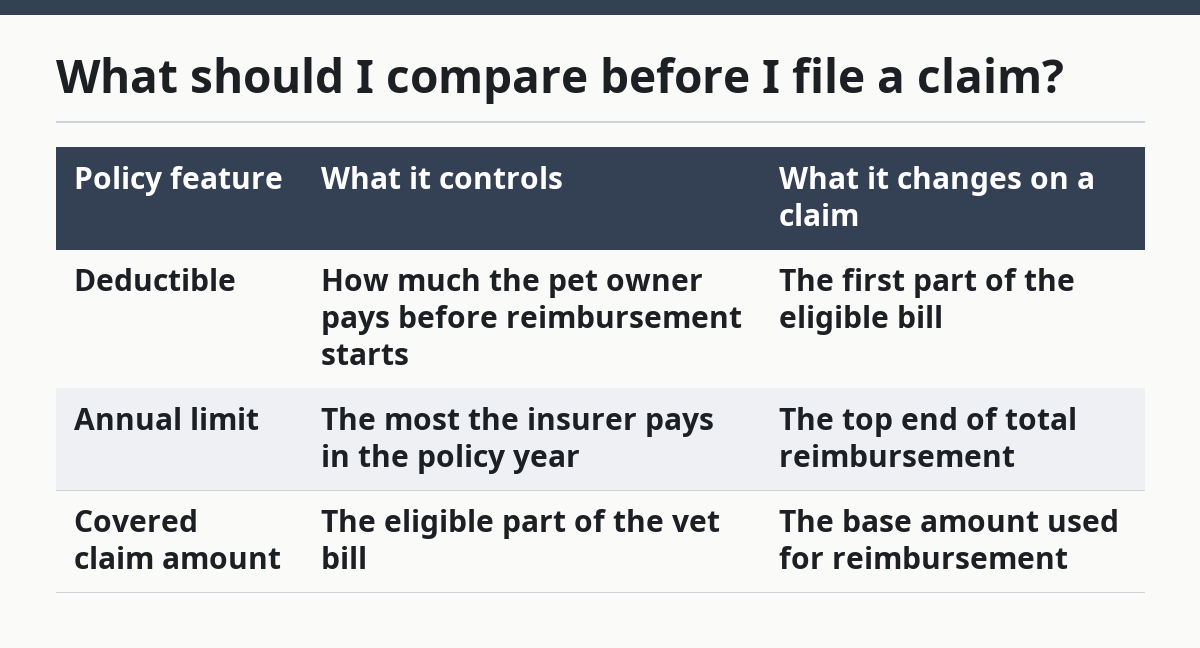
If a claim is large and the annual limit is low, the deductible may matter less than the cap. If the claim is modest and the deductible is high, the deductible may matter more than the cap. That is why the right comparison depends on the size of the bill and the remaining policy balance, not on one feature alone.
What if the annual limit is already used up?
If the annual limit is already used up, the insurer usually pays nothing more for that policy year even if the next bill is for a covered treatment. That is the hard stop built into the policy.
At that point, the remaining cost is typically the pet owner’s responsibility until the policy year resets, unless the contract has another separate benefit or a different limit structure. The annual limit does not refill just because another claim arrives.
This is one reason high-cost treatment needs a careful read of the policy before the next visit. A claim can be fully covered in theory and still produce no reimbursement in practice because the limit balance is gone. The policy year maximum is the ceiling, and once the ceiling is reached, the policy has no room left for more payment in that year.
For readers who want the broader context, the hub on pet insurance policy features and limits explains how annual limits fit with other policy controls. This page is narrower: it answers how the deductible and annual limit interact on claims.
FAQ
Does the deductible reduce the annual limit?
No, the deductible usually does not reduce the annual limit itself. The deductible is typically paid first as the pet owner’s share, and the annual limit is the insurer’s cap on total reimbursement for the policy year. A policy can still run out of annual limit after several paid claims.
What happens when the annual limit is reached?
When the annual limit is reached, the insurer usually stops paying for additional claims in that policy year. Covered vet bills can still happen, but the remaining amount is generally paid by the pet owner unless the contract has some other separate rule. The limit usually resets only when the policy year changes.
Can a deductible and annual limit both apply to the same claim?
Yes, both can apply to the same claim. The deductible is usually handled first, then reimbursement is calculated on the remaining covered amount, and the annual limit can still cap the final payment. That is why one expensive claim can affect what is left for later claims in the same year.
Drafted with AI; not yet reviewed by a person.