Last updated: November 19, 2026
Quick answer: a per-condition limit in pet insurance is the most a pet insurer will pay for one diagnosis, even if the policy’s annual or lifetime limit is higher. This article explains what is a per-condition limit in pet insurance, how the cap works, and where people get tripped up comparing plans.
Key takeaways
- A per-condition limit puts a ceiling on claims tied to one diagnosis, such as arthritis or diabetes.
- It can sit beside an annual maximum or lifetime limit, so one policy can have more than one cap at once.
- The claim payment cap may reset by policy year, by condition, or not at all, depending on the contract.
- A plan with a generous yearly limit can still run out fast if one condition has its own low ceiling.
- This is information, not financial advice; rates, terms, and limits vary by country and insurer, and a qualified adviser can help with your own policy.
What a per-condition limit means in pet insurance
What is a per-condition limit in pet insurance? It is the maximum claim payment cap for each diagnosis, not for the whole policy. If your pet develops one covered condition and keeps returning for follow-up care, the insurer pays only up to that condition’s cap, even if you still have room under the broader plan limit.
Picture this: you’re comparing two pet policies, both with a healthy annual maximum, and one also uses a per-condition limit. The part that matters is not the headline number; it’s how much of that number can be used on one diagnosis before the insurer stops paying.
That’s the whole issue.
A generic article often blurs three different limits together:
- Per-condition limit: one diagnosis, one ceiling.
- Annual limit: all covered claims in one policy year, combined.
- Lifetime limit: all claims for that condition, or sometimes for the policy, across the life of the policy.
If a brochure uses vague language, look for the exact term in the policy wording. A phrase like “condition cap,” “diagnosis cap,” or “maximum payable per illness” may be the same idea, but the exact wording matters because the contract controls the claim. For plain guidance on policy features, this page fits under the broader pet insurance policy features hub.
How per-condition caps work with diagnosis-based claims
A per-condition cap works by grouping claims under the same diagnosis and paying only until that diagnosis reaches its limit. If the condition appears again later, the insurer may still treat it as the same capped bucket, so it is worth checking the policy wording or asking a qualified professional to confirm how your plan handles repeat episodes.
Picture this: your pet has a diagnosis that needs repeat visits, lab work, or medication over several months. The insurer does not usually create a fresh bucket for every visit. It tracks the condition as one line item and applies the cap to that line item until it is used up.
That’s the catch.
Here’s the basic claim flow:
- Check the policy wording for the exact cap type: per-condition, per-incident, or something else. Verify whether the cap resets yearly. A problem appears if the wording is unclear or uses more than one label for the same limit.
- Ask how the insurer defines the diagnosis. Verify whether follow-up care, flare-ups, or related tests count under the same condition. A problem appears if separate visits are split or combined in a way you did not expect.
- Submit the invoice, diagnosis notes, and any required claim form. Verify that the claim is linked to the same condition the insurer has on file. A problem appears if the diagnosis code is missing or inconsistent.
- Check the amount already paid toward that condition. Verify the remaining balance before you assume a new bill will be covered. A problem appears when the cap is nearly gone and the next claim is only partly paid.
- Review whether medication, imaging, surgery, or rehab counts toward the same condition cap. Verify if the policy treats those items separately or as one bundle; if that is unclear, ask the insurer or a qualified adviser. A problem appears when you expect a separate pool and there is none.
- Compare the per-condition cap with the annual limit. Verify which one would bind first. A problem appears if you focus on the larger annual number and miss the smaller diagnosis cap.
- Watch for exclusions tied to pre-existing conditions. Verify whether the insurer classifies a recurring issue as pre-existing after the first signs appear. A problem appears if the policy stops paying because the condition was never eligible in the first place.
The better part is that once you see the structure, the policy math gets easier to read. The harder part is that a plan can look generous on paper and still stop paying early for one expensive diagnosis.
Is a per-condition limit the same as a lifetime limit?
No, a per-condition limit is not the same as a lifetime limit. A per-condition limit can reset, depending on the policy, while a lifetime limit usually means the insurer will not pay beyond the set ceiling for that condition or for the policy overall.
Picture this: you’re reading two policy summaries that both mention “limits,” but one talks about a condition cap and the other talks about a lifetime maximum. Those are not interchangeable. One governs the amount tied to a diagnosis in a given structure; the other governs how long the insurer keeps paying once the ceiling is reached.
Different math, different result.
A few comparisons help:
- A per-condition limit can apply to one diagnosis such as ear infections or cruciate disease.
- A lifetime limit usually lasts for as long as that policy relationship lasts, or for the life of the condition, depending on the contract.
- A claim payment cap may be set by condition, by year, or by incident, and the wording tells you which one is real.
When people treat every cap like the same thing, comparisons get distorted. For a clearer reading, match the cap type to the type of care your pet is likely to need over time and, if needed, confirm the wording with a qualified professional.
Which plans use per-condition caps?
Some pet insurers use per-condition caps, while others rely on annual or lifetime limits instead. The most reliable answer is in the policy wording, because plan design varies by market, insurer, and country.
Picture this: you’re scanning three quote pages and each one says “limit applies,” but none of them says whether the cap is per-condition, per-incident, or annual. That is a warning sign for comparison shopping. The label alone is not enough; you need the policy schedule and the definitions section.
Do not guess.
When you compare plans, check these points:
- Does the policy cap each diagnosis separately?
- Does the cap reset each policy year?
- Does the insurer group chronic problems under one continuing condition?
- Does the plan mention per-incident or per-episode limits instead?
- Is there a separate annual maximum on top of the condition cap?
A plan that uses per-condition caps can suit someone who wants clearer boundaries for a single diagnosis. It can also be a poor fit if you expect one costly problem to keep recurring. The wrong fit is usually not the cap itself — it’s the mismatch between the cap and the type of care your pet may need.
For the mechanical side of policy design, the pet insurance policy features hub is the right place to step back and compare the moving parts without mixing them up.
What should you check before you compare policy limits?
You should check the diagnosis wording, the cap type, the reset rule, and the exclusions before you compare policy limits. Those four items determine how the insurer will actually pay a claim, not just how the brochure reads.
Picture this: you have two quotes in front of you and both look affordable. One has a higher annual limit but a low condition cap; the other has a lower annual limit but no per-condition ceiling. If you stop at the premium, you miss the part that controls the claim.
That is how people get blindsided.
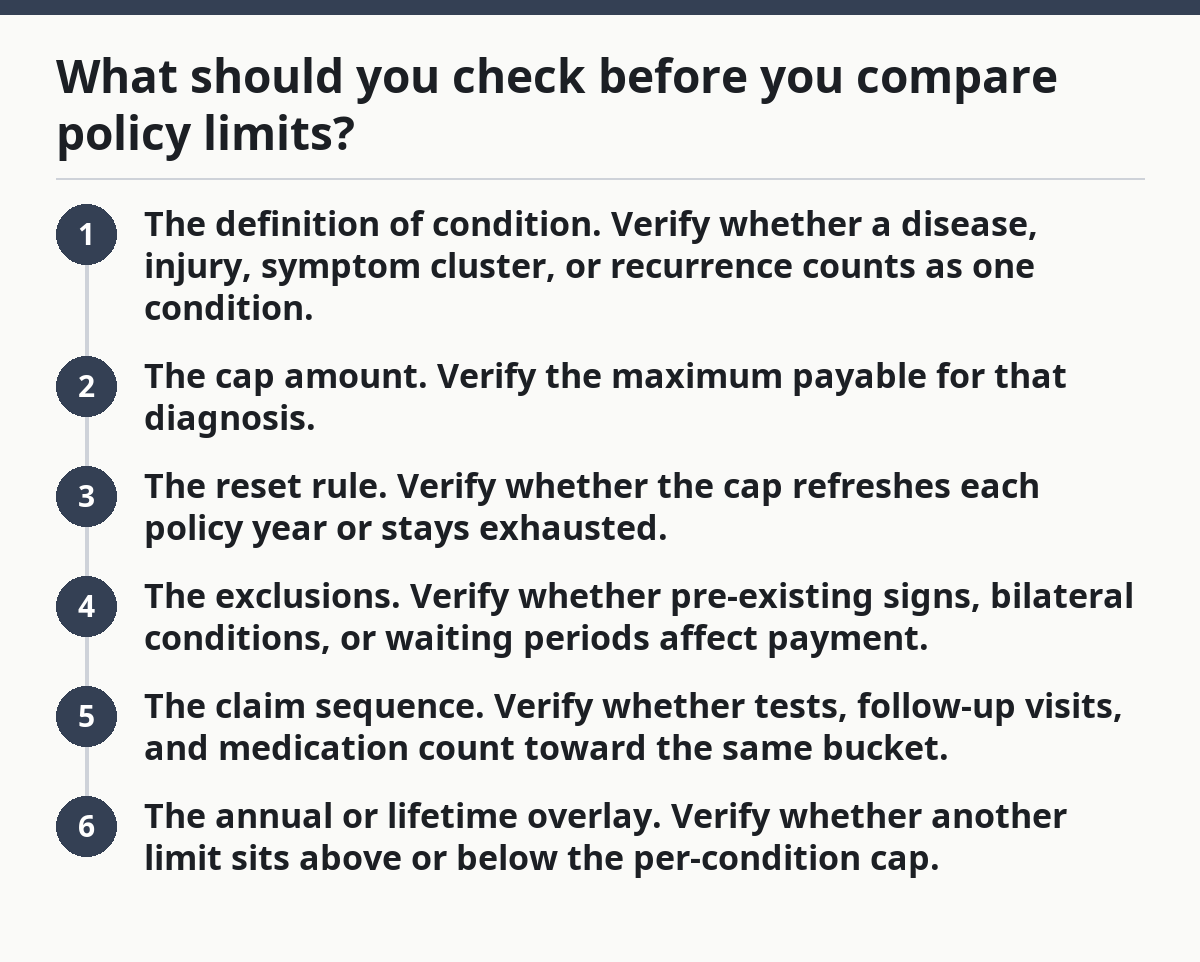
Before you compare, pull these items from the policy documents:
- The definition of condition. Verify whether a disease, injury, symptom cluster, or recurrence counts as one condition.
- The cap amount. Verify the maximum payable for that diagnosis.
- The reset rule. Verify whether the cap refreshes each policy year or stays exhausted.
- The exclusions. Verify whether pre-existing signs, bilateral conditions, or waiting periods affect payment.
- The claim sequence. Verify whether tests, follow-up visits, and medication count toward the same bucket.
- The annual or lifetime overlay. Verify whether another limit sits above or below the per-condition cap.
The truth is, the policy summary is only the start. The definitions page and the claims section do the real work. If those sections are fuzzy, the limit is fuzzy too.
Common mistakes that lead to nasty surprises
A per-condition cap is easy to misunderstand, and the mistakes are predictable. The cost is usually unpaid or partially paid claims, not just paperwork hassle.
- Mistake: Reading the cap as an annual limit. Consequence: you think you have more room than you do. Correct move: check whether the limit attaches to one diagnosis or the whole policy year.
- Mistake: Assuming follow-up visits get a new bucket. Consequence: repeated care drains the same cap. Correct move: ask how the insurer groups ongoing treatment.
- Mistake: Ignoring the diagnosis definition. Consequence: the insurer may place related care under one condition. Correct move: read the definitions section, not just the summary page.
- Mistake: Comparing premiums only. Consequence: a lower-priced plan can have a tighter claim payment cap. Correct move: compare cap type, not just monthly cost.
- Mistake: Forgetting the reset rule. Consequence: an exhausted cap may not refill when you expect it to. Correct move: confirm whether it resets with the policy year or not.
When a per-condition limit is the wrong tool
A per-condition limit is the wrong tool when the policy wording is too vague, when the diagnosis is likely to recur, or when the cap is so low that one claim could use it up quickly. In those cases, the limit can do more harm than help in a comparison.
Picture this: you’re looking at a policy for a pet with a history of ongoing care, and the insurer’s cap is tied to each diagnosis with little explanation. That is exactly when the wording matters most, because one chronic issue can eat through the available balance faster than you expect.
Stop and read closely.
Use caution if any of these apply:
- The policy defines condition loosely: that can pull more care into one bucket than you planned.
- The cap is hard to trace in the documents: that makes the claim math hard to predict.
- The pet has a recurring diagnosis: a single cap may run out on the first major course of treatment.
- The plan mixes several limit types: confusion increases the chance of a bad comparison.
- The insurer uses different wording in different documents: that can create a dispute over what counts as covered.
In those situations, the answer is not to assume the cap is fine. The answer is to slow down, compare the definitions line by line, and, if needed, get a qualified adviser or the insurer to explain the exact contract language for your policy.
A simple way to read the policy math
A good way to read the policy math is to ask three questions in order: what condition is being capped, how much can be paid for that condition, and what other limit can cut in first. That gives you the real ceiling in plain language.
Picture this: you are holding a policy summary and trying to make sense of one diagnosis that could need several visits, tests, and prescriptions. The clean way to think about it is to map the claim to one bucket, then check whether another bucket is smaller.
That’s the comparison.
Use this quick order of review:
- Identify the diagnosis in the policy language.
- Find the per-condition limit attached to it.
- Check whether the cap resets every year.
- Check for an annual or lifetime maximum above it.
- Look for exclusions that would remove care from coverage.
- Read the claims section for how follow-up care is grouped.
- Compare the result with the kind of care your pet is most likely to need.
If the policy still feels hard to decode after that, the document is doing a poor job of explaining itself. A clear contract should let you trace one diagnosis from first visit to final cap without guesswork. If it doesn’t, that is a warning sign, not a quirk.
How does a condition limit affect future claims?
It affects future claims by shrinking or ending payment for the same diagnosis once the cap is used. If the condition comes back, the insurer may still treat it as the same capped issue, so later bills can be reduced, delayed, or denied.
Picture this: your pet has already had one round of care, and a new bill appears months later for the same diagnosis. The insurer does not start from zero unless the policy says it does. The earlier payments matter because they reduce what is left in the cap.
That is the key point.
In practice, a condition limit can change future claims in three ways:
- It can leave only a small amount left for later treatment.
- It can force you to pay out of pocket once the cap is gone.
- It can make a future claim qualify only partly, if the remaining balance covers just a portion of the bill.
That is why the wording around diagnosis-based limits matters so much. It affects not just one claim, but the next one and the one after that.
FAQ
Is a per-condition limit the same as a lifetime limit?
No, it is not the same thing. A per-condition limit caps payment for one diagnosis, while a lifetime limit sets a ceiling that can last much longer or apply across the whole policy, depending on the contract. The policy wording controls which one you have.
Which plans use per-condition caps?
Some pet insurance plans use them, and some do not. The only safe way to know is to check the policy schedule and definitions, because insurers and countries do not use one universal format. If the wording is unclear, ask the insurer to identify the exact cap type in writing.
How does a condition limit affect future claims?
It can reduce or end payment for later claims tied to the same diagnosis. If the insurer treats the later care as part of the same capped condition, the remaining balance is what matters most.
Drafted with AI; not yet reviewed by a person.