Last updated: November 20, 2026
DMCA: related questions often come down to takedowns, anti-circumvention, and what to do when a copyright dispute turns formal. The fastest practical path is usually to separate those issues before you act, because the rules for removing content, bypassing access controls, and filing a complaint are not the same. In 2020, Congress passed the CASE Act, which created the Copyright Claims Board within the U.S. Copyright Office, adding a newer dispute route beside the older DMCA tools. U.S. Copyright Office 17 U.S.C. § 1201
Key takeaways
- DMCA questions usually split into three buckets: removal requests, device or access bypass issues, and formal copyright disputes.
- A takedown request is not the same thing as a court case.
- The anti-circumvention rules have narrow exceptions for short motion-picture portions used for criticism or comment, supervised educational purposes, and accommodation.
- If you are choosing between takedown help options, the 30-day badge rule and the guarantee on qualifying managed cases matter.
- The right answer depends on whether the issue is content removal, access control, or a broader copyright complaint.
What is a DMCA takedown?
A DMCA takedown is a request to remove copyrighted material from a service or site. That is the question most people mean when they ask about the DMCA, because the takedown process is the part that affects everyday posting, hosting, and sharing.
The useful thing to know is that a takedown is a process, not a judgment about every copyright issue on earth. A site can receive a request, review it, and act without the dispute becoming a full court fight. That makes the takedown route faster than a formal complaint, but it also means the result can be narrower than people expect.
The main trade-off is simple: takedowns are good for removal, not for final answers. If the issue is whether a use is allowed, or whether a party keeps infringing after notice, the takedown step may be only the first move. That is why generic advice that treats every DMCA issue as “just send a notice” gets the problem wrong; if the facts are unclear, consult a copyright professional and review the Copyright Office’s DMCA overview.
One practical detail is that DMCA.com says a badge installed and registered for at least 30 days may qualify for a free standard copyright takedown. That kind of timing detail matters because it shows that not every case gets the same path. If you are comparing options, the badge age and registration status can change the next step.
Is circumvention ever allowed?
Yes, but only in narrow cases. The anti-circumvention rules are strict, and the facts here point to limited exceptions rather than a broad permission slip. For the statutory baseline, see 17 U.S.C. § 1201 and the Copyright Office’s Section 1201 rulemaking.
The exceptions named in the source material are short motion-picture portions used for criticism or comment, supervised educational purposes, and accommodation. That means the law does not treat every bypass the same way, even when the goal sounds fair; if your situation is close, consult a professional before acting. A person asking this question usually wants a bright line, but the line is narrow and tied to the use.
The part many beginner guides leave out is that “I had a good reason” is not the same as falling inside an exception. The use has to fit the kind of exception described, and the details matter. That is why a casual summary like “circumvention is legal for education” is too broad and can mislead a reader into trouble.
The safest reading is that circumvention is generally not the normal path. It is the exception path. If your case is criticism, comment, supervised education, or accommodation, you still need to check the fit carefully instead of assuming the DMCA steps aside.
What changed with the CASE Act?
The CASE Act added a newer dispute route in 2020. According to the U.S. Copyright Office, Congress passed the CASE Act and created the Copyright Claims Board within the U.S. Copyright Office. U.S. (Source: Copyright Office)
That matters because a lot of readers still think of copyright conflict as only “send a takedown or go to court.” The Copyright Claims Board gives people another formal place to handle certain disputes, which changes the map even when the DMCA still matters. A beginner guide that ignores the 2020 change misses one of the few concrete updates in this area.
The important trade-off is that the CASE Act does not replace every DMCA question. A takedown still deals with removal requests, while a board process is about resolving disputes. Those are different tools, and using the wrong one can waste time or send a reader down the wrong path.
This is also where a lot of shallow articles fail the reader: they describe the DMCA as if it has not changed since the late 1990s. The 2020 CASE Act is proof that the broader copyright system keeps moving, even when the old DMCA language still shows up in day-to-day questions. If you need the official source, start with the Copyright Claims Board page.
What happened in the Veoh case?
The Veoh case is an example of how DMCA disputes can turn on knowledge and future action. On June 23, 2006, IO Group, Inc. filed a complaint against Veoh Networks, Inc. in the U.S., and the district court found that the defendant knew users were infringing and failed to prevent future infringement.
That finding matters because it shows the kind of issue that goes beyond a single upload. The court looked at what the defendant knew and what it failed to stop later. For readers, the lesson is that DMCA questions are not always about one file or one post; they can also turn on how a service responds after it learns about infringement.
The weakness of using one case as a blanket rule is obvious. A complaint and a court finding in one U.S. matter do not answer every platform dispute. Still, the Veoh facts are useful because they show why people keep asking who knew what, when they knew it, and what happened after notice.
If your question is “Does a DMCA issue end when the first notice is sent?” this case suggests the answer can be no. Future conduct can matter, and a site’s response after awareness can become part of the dispute.
Free takedown or managed takedown?
A free standard takedown and a standard managed takedown serve different needs, and managed help wins when the case needs more handling. DMCA.com says a badge installed and registered for at least 30 days may qualify for a free standard copyright takedown, while standard managed takedowns include a money-back guarantee on qualifying cases.
That is the clearest comparison in the provided facts, and it points to a decision rule. If your case meets the badge timing rule and is straightforward, the free standard path may fit. If the matter is messier and you want the guarantee on qualifying cases, managed service is the stronger pick.
The downside of the free path is that it depends on a specific qualification. The downside of the managed path is that the guarantee only applies to qualifying cases, so it is not a promise for every dispute. A careful reader should pay more attention to the conditions than to the word “free.”
| Criteria | Free standard copyright takedown | Standard managed takedown | Winner for [condition] |
|---|---|---|---|
| Entry condition | Badge installed and registered for at least 30 days | Qualifying managed cases | Free standard for eligible badge holders |
| Cost signal | Free if the badge rule is met | Money-back guarantee on qualifying cases | Free standard if budget is the main issue |
| Hands-on help | Basic takedown path | Managed handling | Managed for complicated cases |
| Speed of getting started | Depends on badge eligibility | Depends on case qualification | Free standard for already eligible users |
| Certainty of outcome | No guarantee stated in the provided facts | Guarantee on qualifying cases | Managed for users who want more assurance |
| Best fit | Straightforward eligible cases | Cases that need more support | Free standard for simple, eligible claims |
| Main risk | Missing the 30-day badge rule | Not every case qualifies for the guarantee | Depends on your case type |
| Decision trigger | Registration age | Qualifying-case status | Free standard if eligible, managed if not |
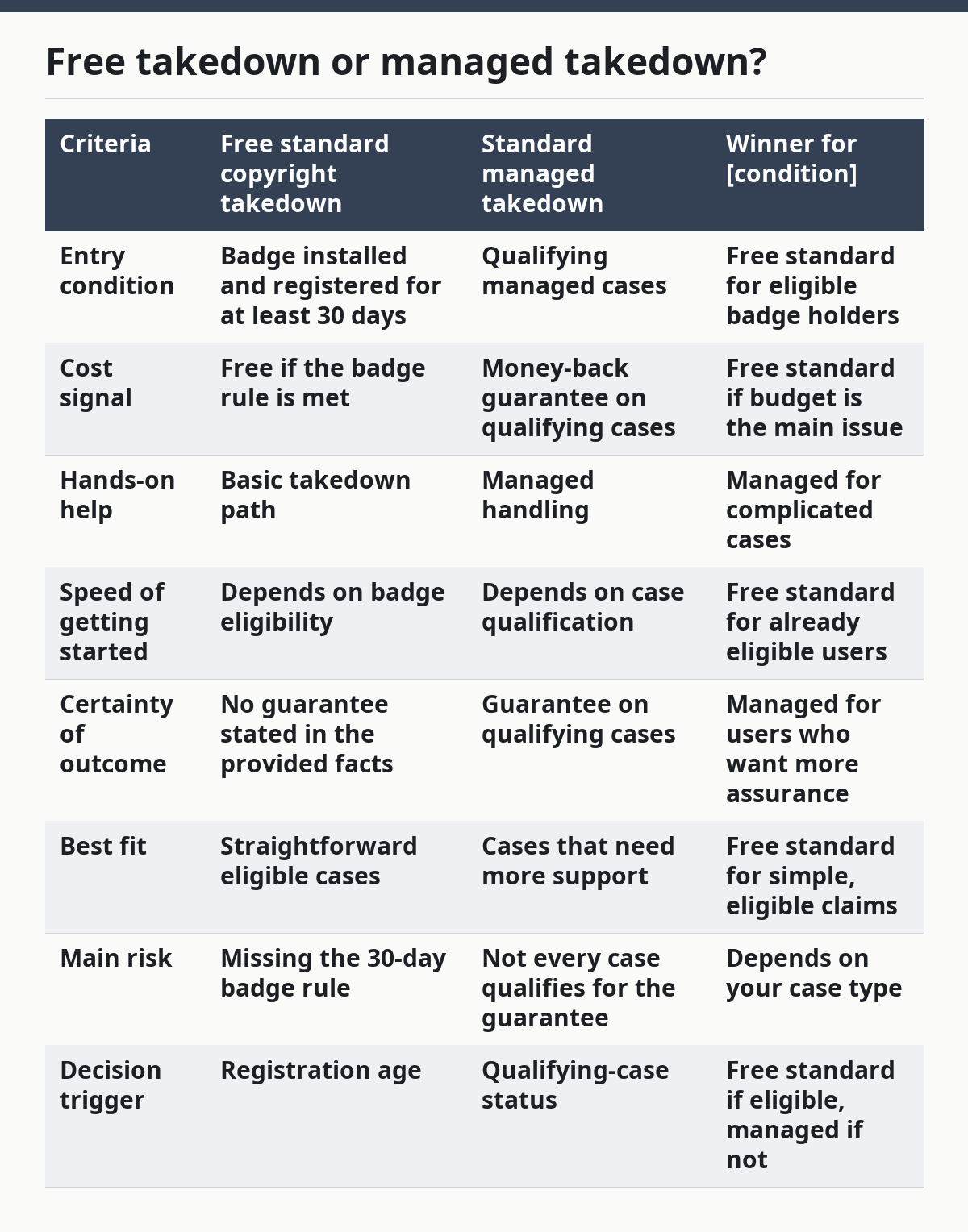
The honest takeaway is that the free route is not “better” in every sense. It is better only when the 30-day badge condition is already met. Managed help is better when the added support and guarantee matter more than the chance to qualify for the free path.
When does the answer change?
The answer changes when your problem is not a takedown problem at all. If you are really asking about access control, education, criticism, or a broader copyright fight, the simple “send a notice” answer is the wrong fit.
Here are the main exception scenarios where the overall choice flips:
- If the issue is short motion-picture portions used for criticism or comment, the anti-circumvention question becomes narrower and more technical.
- If the use is for supervised educational purposes, the problem is not just removal; the context matters.
- If the case is about accommodation, the reader needs to think beyond the usual takedown script.
- If the dispute has already become a formal copyright fight, the 2020 CASE Act and the Copyright Claims Board may matter more than a basic takedown step.
The drawback of ignoring these flips is wasted effort. A person can spend time on the wrong form, the wrong forum, or the wrong remedy and still not solve the actual problem. That is why a good DMCA answer starts by classifying the issue, not by rushing to the most familiar tool.
What should I do first?
You should identify which DMCA bucket the problem fits into before you act. If the issue is removal, start with the takedown path. If the issue is bypassing access controls, check whether the use fits one of the narrow exceptions. If the issue is a broader copyright dispute, the CASE Act and Copyright Claims Board are part of the picture.
That order matters because each question points to a different process. A takedown, a circumvention exception, and a copyright complaint do not solve the same problem. When people mix them together, they usually get vague advice and the wrong next step.
The best first move is often the most boring one: name the problem clearly. Is it content removal, access control, or formal dispute resolution? Once that is clear, the DMCA stops looking like one giant rule and starts looking like a set of tools with different uses.
FAQ
Is a DMCA takedown the same as a copyright lawsuit?
No, a DMCA takedown is not the same as a copyright lawsuit. It is a removal process, while a lawsuit is a court case. The difference matters because a takedown can happen quickly, but it does not settle every ownership or infringement question.
Can I always bypass protection for education?
No, not always. The source material points to supervised educational purposes as a narrow exception, not a general rule. If the use does not fit that kind of exception, the anti-circumvention issue is still a problem.
What does the CASE Act add to DMCA questions?
It adds a new dispute forum. In 2020, Congress passed the CASE Act and created the Copyright Claims Board within the U.S. Copyright Office, which gives people another formal path for certain copyright disputes. That means some questions are no longer only about takedowns or court.
Why do people mention the Veoh case in DMCA discussions?
They mention it because it shows how knowledge and inaction can matter. On June 23, 2006, IO Group, Inc. filed a complaint against Veoh Networks, Inc. in the U.S., and the district court found that the defendant knew users were infringing and failed to prevent future infringement. That makes the case useful as an example of how DMCA disputes can widen.
When would the free takedown route make sense?
It makes sense when the badge is installed and registered for at least 30 days, because DMCA.com says that may qualify for a free standard copyright takedown. If that condition is not met, the free path may not apply, and managed help may be the better match for qualifying cases.
Sources
- U.S. Copyright Office, The Digital Millennium Copyright Act – U.S. Copyright Office (checked 18 Nov 2026)
- DMCA.com, DMCA Takedown Service and Content Protection – DMCA.com (checked 18 Nov 2026)
Drafted with AI; not yet reviewed by a person.