Last updated: November 20, 2026
Quick Answer: Coverage by care setting and provider usually depends on where you get care, who gives it, and whether the plan treats that place or clinician as in-network. In the Coverage by care setting and provider — The Complete Guide, those rules can change your bill by setting, provider, and authorization. I work from the coverage rules that drive prior auth, referrals, site-of-service limits, and provider contracts, so I can tell you where people get surprised.
The sections below settle what counts as a setting, what counts as a provider, and where coverage breaks.
Key takeaways
- The same service can be covered in one place and denied in another.
- Provider network status and care setting can each change your bill.
- Hospitals, ambulatory surgery centers, offices, urgent care, telehealth, and home care are not treated the same way, so check the plan rules with a professional if needed.
- Inpatient care, outpatient care, and post-acute care often use different rules.
- The strongest plans still require you to check network status, prior authorization, and place-of-service rules before treatment, so confirm them with the plan or a professional and check sources like Medicare.gov and CMS.
What “care setting” and “provider” mean in real life
Coverage by care setting and provider means the plan looks at where care happens and who delivers it before it decides what to pay. A procedure in a hospital outpatient department can be handled differently from the same procedure in a physician office or ambulatory surgery center.
Because the setting can change your share of the bill even when the diagnosis is the same, the Coverage by care setting and provider — The Complete Guide focuses on those billing rules. Picture this: you need an MRI, a follow-up visit, and maybe a procedure, and each one can be billed under a different site of care.
The most common care settings are office, urgent care, emergency department, hospital inpatient, hospital outpatient, ambulatory surgery center, skilled nursing facility, home health, and telehealth. A provider can be a physician, advanced practice clinician, hospital, lab, therapy clinic, or facility. The plan may cover one and not the other, or cover both with different cost-sharing.
A generic article gets this wrong by treating “in-network” like a single switch. It is not that simple. A surgeon can be in-network, while the facility is not. A clinic can be covered for a visit, while a procedure in the same building gets billed under a different benefit. That split is where many bills go off the rails.
- Office visit: usually billed as outpatient professional care.
- Facility claim: billed by the place, not the clinician.
- Professional claim: billed by the person or group that treated you.
- Place of service: the code that tells the plan where care happened.
For plan design terms, the National Association of Insurance Commissioners publishes consumer guidance on network coverage, and CMS explains hospital outpatient and inpatient billing under Medicare rules. Those are good reference points because they show that setting matters as much as the service itself.
Why the same service can be covered one way in one setting and another way in another setting
The same service can cost very different amounts depending on setting because plans often pay facility fees, use different deductibles, or apply different prior authorization rules. A colonoscopy, imaging study, infusion, or minor surgery may be covered in multiple places, but not at the same rate.
Now, you might be wondering why the plan cares so much about location. The answer is simple: the bill is not just for the clinician’s time. It can also include the building, nursing staff, supplies, recovery space, and equipment. That is why an outpatient hospital department often costs more than an office or ambulatory surgery center.
Here are the main coverage differences that matter:
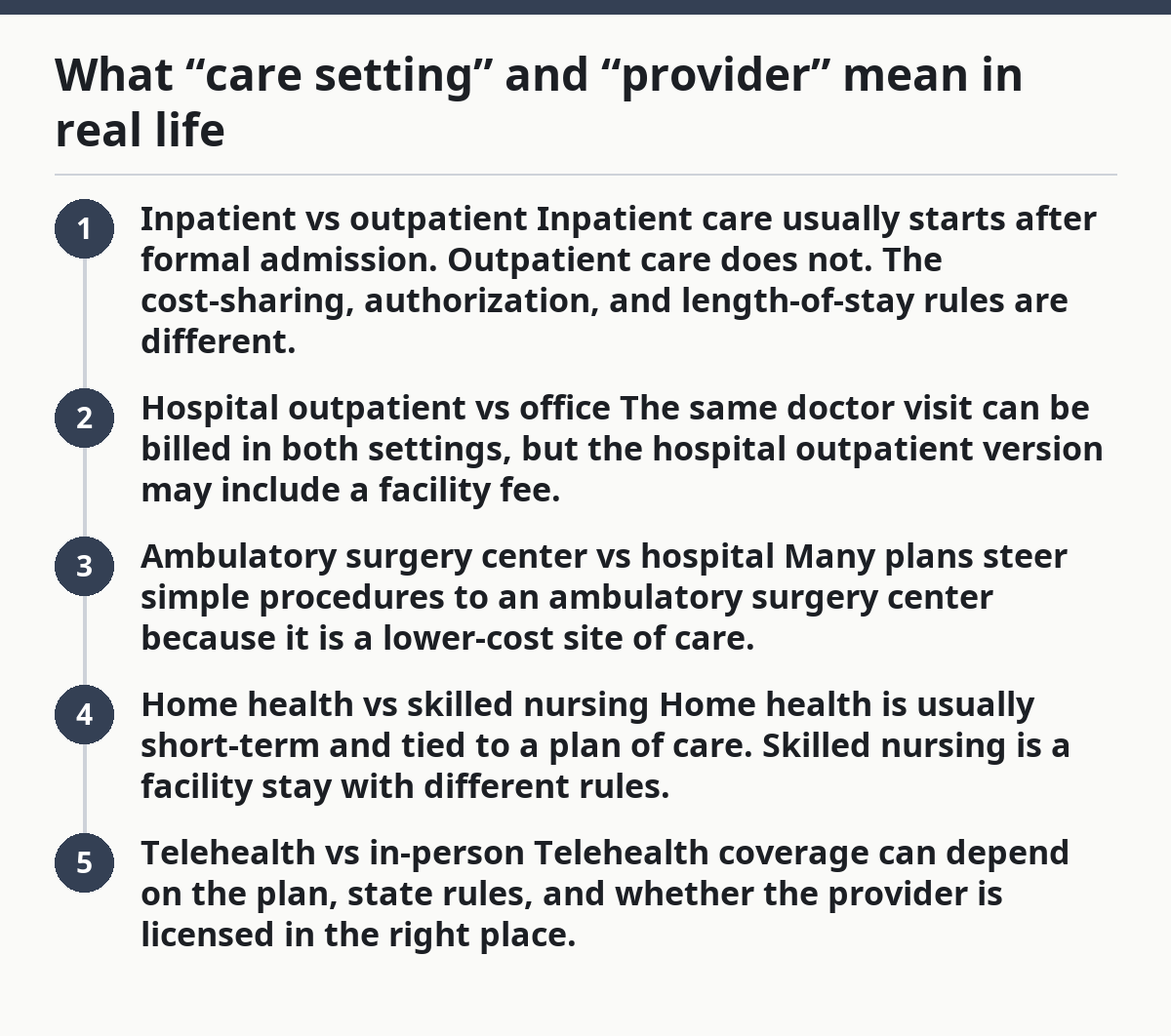
-
Inpatient vs outpatient
Inpatient care usually starts after formal admission. Outpatient care does not. The cost-sharing, authorization, and length-of-stay rules are different. -
Hospital outpatient vs office
The same doctor visit can be billed in both settings, but the hospital outpatient version may include a facility fee. -
Ambulatory surgery center vs hospital
Many plans steer simple procedures to an ambulatory surgery center because it is a lower-cost site of care. -
Home health vs skilled nursing
Home health is usually short-term and tied to a plan of care. Skilled nursing is a facility stay with different rules. -
Telehealth vs in-person
Telehealth coverage can depend on the plan, state rules, and whether the provider is licensed in the right place.
CMS and Medicare Advantage guidance make this split very clear: site of service and place of service affect payment. Private plans often follow similar logic, even if the exact rule set differs.
Which care settings usually change your bill the most?
The hospital outpatient department, emergency room, and skilled nursing facility usually change your bill the most because they bring extra facility charges or tighter coverage rules. Office care and telehealth are often simpler, but they still need network checks.
Because those settings often add separate billing lines, the Coverage by care setting and provider — The Complete Guide gives them special attention. Picture this: you expect a simple specialist visit, then see two lines on the claim — one for the doctor and one for the building. That second line is the part many people miss. It can turn a covered visit into a much bigger out-of-pocket cost than expected.
Hospital inpatient
Inpatient coverage usually applies when you are formally admitted, not just observed overnight. The plan may require authorization, medical necessity review, and a qualifying status change before it pays as inpatient.
- Strength: best for serious illness, surgery, or close monitoring.
- Weakness: the most expensive setting on many plans.
- Common trap: “observation” is not the same as inpatient admission.
Hospital outpatient
Hospital outpatient care is covered when the hospital treats you without admitting you, but a professional should confirm the billing setup because plans can vary. A clinic visit, infusion, imaging test, or procedure can fall here.
- Strength: broad access to hospital equipment and specialists.
- Weakness: facility fees often raise the final bill.
- Common trap: the doctor may be in-network while the hospital billing is not what you expected.
Office-based care
Office care is usually the cleanest coverage path because it often has simpler billing and fewer facility charges. Primary care, routine specialist visits, and many follow-ups fit here.
- Strength: easier to predict.
- Weakness: not every service can be done in an office.
- Common trap: a service moved from office to hospital outpatient can change the bill fast.
Ambulatory surgery center
An ambulatory surgery center is often the better-covered site for straightforward procedures that do not need a hospital stay. Plans like the lower-cost setting, if the procedure fits the center’s capabilities.
- Strength: lower site-of-care burden than a hospital.
- Weakness: not all procedures qualify.
- Common trap: the surgeon may agree, but the plan may still require approval.
Urgent care and emergency care
Urgent care is for problems that need prompt treatment but are not life-threatening, and emergency care is for emergencies, but a professional should confirm the right setting because plans and laws can differ. Coverage usually follows a different rule set.
- Strength: fast access.
- Weakness: emergency billing rules can be harsh if the visit is not truly emergent.
- Common trap: choosing the ER for a non-emergency can trigger a much higher bill.
How provider network status changes coverage
Provider network status changes coverage because plans usually pay more when the clinician, clinic, hospital, or ancillary provider is in network. The same service from an out-of-network provider can bring higher cost-sharing or no coverage at all, depending on the plan type.
When you look at the Coverage by care setting and provider — The Complete Guide, the provider side matters just as much as the site of care. Picture this: you call the office, hear “we take your insurance,” and assume that covers everyone involved. It may not. The physician may be in network, but the anesthesiologist, radiologist, lab, or facility may not be. That is where balance bills and surprise charges start.
The most important provider types are:
- Primary care physicians: often the first covered point of contact.
- Specialists: usually need network checks and may require referrals.
- Ancillary providers: labs, imaging, therapy, anesthesia, and pathology.
- Facilities: hospitals, surgery centers, rehab centers, and skilled nursing facilities.
- Telehealth clinicians: coverage can depend on state licensure and the plan’s virtual care rules.
A plan may treat all of these differently. For example, a specialist office visit may be covered with a modest copay, but the same specialist working in a hospital outpatient department may generate a separate facility bill. That is why “my doctor is covered” is not enough.
Here’s the catch: provider coverage rules vary by plan type. HMO-style plans usually lean harder on in-network care and referrals. PPO-style plans often allow out-of-network care but with lower payment and higher member cost. Medicare Advantage, Medicaid managed care, employer plans, and individual marketplace plans each add their own rules.
The U.S. Department of Labor explains network-based coverage under many employer plans, and Medicare.gov explains how referrals and network care work in many Medicare Advantage plans. Those pages are worth checking because they explain the structure, not just the jargon.
How do I check coverage before I book care?
You check coverage by confirming the setting, the provider, the facility, and the authorization rule before the appointment is made. That means asking the plan and the office the same question from both sides of the bill.
Because the wrong setting can change the claim, the Coverage by care setting and provider — The Complete Guide works best when you verify details first. Picture this: you are about to schedule a scan, surgery, or therapy visit and want to avoid a surprise claim. The fastest way is not guessing from the office name. It is matching the exact service code, site of care, and each billing entity to the plan’s rules.
Use this checklist:
- Ask for the exact provider name and National Provider Identifier, if available.
- Ask for the facility name where care will happen.
- Ask whether the service is billed as office, outpatient hospital, ambulatory surgery center, inpatient, or telehealth.
- Ask whether the service needs prior authorization.
- Ask whether a referral is required.
- Ask whether the lab, anesthesia, imaging, or pathology team is separate from the main provider.
- Call the plan and confirm the service using the same details.
If you can get the CPT or HCPCS code, even better. The code tells the plan what service is being billed, while the setting tells the plan where it happened. Those two pieces together often decide the coverage result.
Also, a five-minute check can save a large bill later. A plan that covers a service in one site may not cover it the same way in another. Use Medicare.gov, CMS, or your plan documents to confirm the rule before you go.
When does coverage by care setting and provider get tricky?
Coverage gets tricky when multiple providers touch the same visit, when the setting changes mid-care, or when the plan uses medical-necessity rules to steer you elsewhere. These are the moments that create the biggest billing confusion.
The truth is, most people think in terms of “the doctor visit,” but claims are often split across several bills. One provider may bill the exam, another bills the facility, another bills the test, and another bills anesthesia. If any one of those falls outside the plan’s rules, the result can be messy.
Common trouble spots
- Emergency room follow-up: the ER may be covered, but the follow-up specialist may not be in network.
- Observation stays: you may think you were admitted, but the plan may treat the stay as outpatient observation.
- Split billing: one encounter produces professional and facility charges.
- Out-of-network ancillary services: a covered hospital can still include a noncovered anesthesiologist or radiologist.
- Post-acute care: rehab, home health, and skilled nursing often need strict medical necessity documentation.
The right question is not just “Is this covered?” It is “Is it covered in this setting, by this provider, with this billing code, under this plan rule?” That is the question that keeps the bill predictable.
What are the biggest exceptions to the usual rule?
The biggest exceptions are emergency care, federal and state surprise-billing protections, and plan-specific exceptions for continuity of care. These can change the answer even when the provider or setting would normally be out of network.
Because emergencies can override normal network choices, the Coverage by care setting and provider — The Complete Guide has to include the exceptions too. Picture this: you go to a hospital you did not choose, or you need urgent treatment from a provider you never met before. In those situations, the usual network rules can bend. The reason is simple: the law and the plan do not want coverage to fail just because you had no practical choice.
Three exception scenarios matter most:
-
Emergency treatment
Emergency services are often covered differently from scheduled care, and prior authorization is usually not required in the same way. -
No real network choice
If a covered service requires an out-of-network ancillary provider at an in-network facility, surprise-billing protections may apply in some cases. -
Continuity of care
Some plans allow temporary continued coverage for ongoing treatment if a provider leaves the network during an active course of care.
There are also setting-specific exceptions. A service that is normally outpatient may be treated differently if the patient has complex medical needs, unsafe discharge risk, or a change in status during treatment. That is why charts and discharge notes matter as much as the insurance card.
The National Association of Insurance Commissioners and CMS both have consumer-facing material on network rules and emergency coverage. Those sources are useful because they show the exceptions, not just the default rule.
The verdict: which coverage path usually works best?
Choose in-network office or ambulatory surgery center care if the service is elective, the plan allows it, and you want the cleanest billing path. Choose hospital-based care if the medical need requires hospital resources, monitoring, or a higher level of support that an office or surgery center cannot provide. Neither if the provider cannot confirm the setting, billing entity, and authorization rule in writing or by recorded plan reference before you go.
That is the practical rule. The lowest-friction coverage usually comes from the simplest setting that can safely handle the service. The most expensive mistakes usually come from assuming that one in-network name covers every bill attached to the visit.
A few real-world examples that show how the rule changes
Coverage by care setting and provider becomes easier to see when the same service is split across two places. A routine visit, a scan, and a procedure can each be covered differently, even when the diagnosis never changes.
Because the billing lines can separate fast, the Coverage by care setting and provider — The Complete Guide is easiest to follow with examples. Picture this: you have a specialist follow-up, then a test, then a procedure. The first may be office care, the second may be hospital outpatient, and the third may need an ambulatory surgery center or inpatient stay. The plan can treat each one as a separate coverage event.
Example 1: Routine follow-up
A specialist office visit is often the simplest claim because it is usually billed as professional care in an office setting. If the specialist is in network and no referral is needed, this is often the cleanest coverage path.
- Watch for: separate charges from labs or imaging.
- Main risk: assuming all same-day services count as one visit.
Example 2: Same procedure, different site
A procedure done in an office can be covered differently from the same procedure done in a hospital outpatient department. The hospital version may add a facility fee and different cost-sharing.
- Watch for: site-of-service rules.
- Main risk: booking the hospital site when the office or ASC would have worked.
Example 3: Post-hospital recovery
After an inpatient stay, coverage for rehab, home health, or skilled nursing depends on medical necessity and the discharge plan. The setting matters because each post-acute option has its own benefit rules.
- Watch for: limits on number of visits or days.
- Main risk: assuming discharge means all follow-up care is automatically covered the same way.
FAQ
Does “in-network” mean everything is covered?
No. In-network status usually helps, but it does not erase deductibles, copays, coinsurance, prior authorization, or site-of-service rules. A provider can be in network while a facility charge, lab, or anesthesia bill still creates extra cost.
Why would the same doctor visit cost more in a hospital?
A hospital visit can include a facility fee in addition to the clinician’s professional fee. That extra billing line is tied to the setting, not just the person who saw you. Office visits often avoid that added charge.
Is an ambulatory surgery center always cheaper?
Not always, but it is often a lower-cost site for procedures that do not need hospital resources. Coverage still depends on whether the plan recognizes the center, the procedure, and any prior authorization rules.
Does telehealth have the same coverage as in-person care?
Not always. Telehealth coverage depends on the plan, the state, and the provider’s licensing and billing setup. Some plans treat it like an office visit; others apply separate rules or limited benefits.
What is the safest way to avoid surprise bills?
Confirm the provider, the facility, the setting, and the authorization status before the appointment. If the service involves labs, anesthesia, imaging, or pathology, check those separately too, because each bill can have its own network status.
Drafted with AI; not yet reviewed by a person.