
Last updated: November 20, 2026
Quick Answer: Claims evidence and paperwork work best when you file one complete claim packet with the required proof, the submission record, and a clean timeline. This guide focuses on that process.
Key Takeaways
- Evidence is the proof that shows what happened, when it happened, and what it cost.
- Keep the form, the documents it asks for, and a clear record of what you sent.
- Make the file easy to review in one pass so the facts are simple to verify.
- Strong evidence answers the basic questions: what happened, when, to whom, and for how much.
Claims fail when the evidence is thin, the paperwork is incomplete, or both. The fix is simple: collect proof fast, match every claim to a document, and keep one clean file from start to finish. In Claims evidence and paperwork — The Complete Guide, the goal is to show what belongs in that file and what usually gets a claim delayed or denied.
What counts as evidence for a claim?

Evidence is anything that proves what happened, when it happened, and what it cost. In most claims, that means a date-stamped record, a clear description, and a document that ties the loss to the claim.
Picture this: you’re staring at a form, trying to prove damage, loss, or payment without overexplaining yourself. You need the kind of proof a reviewer can scan in under a minute and still trust. That usually means records, photos, receipts, reports, or letters — not a long story. The truth is, clean paperwork beats a dramatic explanation every time.
- Photos of damage, with dates if possible
- Receipts, invoices, or bank records
- Repair estimates or replacement quotes
- Medical or incident reports, if the claim calls for them
- Letters, emails, or claim forms that show what was reported and when
A generic article would stop there. The part most people miss is that evidence has to fit the claim type. A home claim needs different proof from a travel claim, and a health claim needs different records from a warranty claim. If you send the wrong kind of proof, the claim may stall even when the event was real.
For government claims, the rules are usually stricter than people expect. A benefits office, insurer, or pension scheme often wants the exact document named in its guidance, not a close substitute. That is why the official instructions matter as much as the event itself. For a good example of how agencies describe required proof, see the U.S. Department of Labor’s evidence standards pages and claim instructions, or the U.K. government’s guidance on making a claim for specific programs.
What paperwork do you need before you file a claim?
You need the claim form, the proof the form asks for, and a record of what you sent. Without those three pieces, a claim is easy to dispute and hard to track.
Picture this: you’re ready to file, but the form asks for dates, reference numbers, signatures, and attachments you haven’t gathered yet. This is where many claims lose days or weeks. A missing page can be enough to bounce the file back to the start. Here’s the catch: the paperwork is not just support for the claim — it is part of the claim.
- The completed claim form or online submission
- Supporting evidence listed in the instructions
- A copy of every page you submit
- Proof of submission, such as a confirmation email, tracking number, or upload receipt
- A note of who you spoke to, when, and what they said
A strong file also includes a timeline. That can be as simple as a dated list of events: loss happened, report filed, estimate received, claim sent, follow-up made. This matters because reviewers often check sequence first. If the dates do not line up, the rest of the file looks shaky.
Then use plain labels like 2026-03-14_receipt or claim-form_signed. That makes later checks faster and cuts down on version mistakes. Not fancy. Effective.
For consumer disputes, the Federal Trade Commission explains that written records help prove what was agreed, what was paid, and what was promised. For benefits, the Social Security Administration and similar agencies say the same thing in different words: send what the form asks for, and keep copies of everything. The Consumer Financial Protection Bureau also tells consumers to keep records of complaints, payments, and follow-up messages when a dispute may need proof later. See the FTC, SSA, and CFPB for those record-keeping basics.
How do you build a claim file that actually works?

You build a claim file by making it easy for a reviewer to confirm the facts in one pass. One claim, one folder, one timeline, one index is the cleanest setup.
Since the folder is doing the heavy lifting, keep the evidence in date order and keep the claim name consistent across every file. Picture this: you’re sorting five emails, three photos, two receipts, and a form that needs a signature. If you scatter those pieces across apps and inboxes, something will go missing. If you keep them together, the claim becomes easier to defend and faster to review. On the flip side, a neat file also helps you spot gaps before anyone else does.
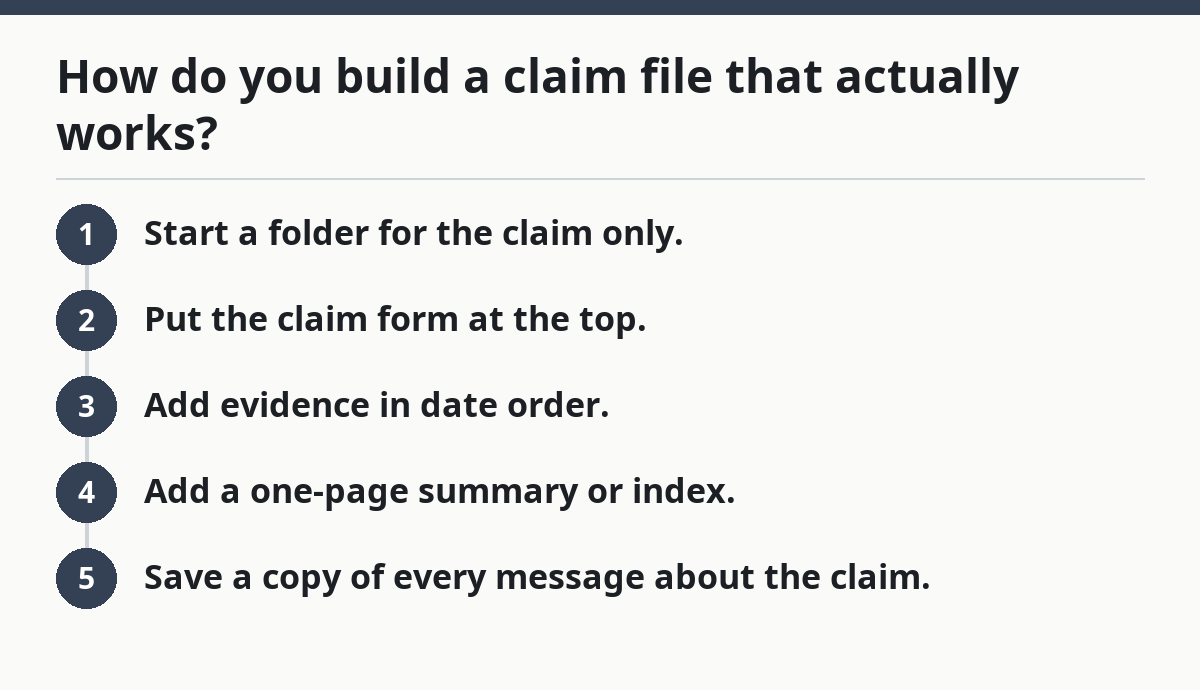
- Start a folder for the claim only.
- Put the claim form at the top.
- Add evidence in date order.
- Add a one-page summary or index.
- Save a copy of every message about the claim.
That index is more useful than most people think. It can be a simple list: item, date, what it proves, and where it came from. A reviewer should not have to guess why a document is there. If a receipt covers the repair cost, say so. If a photo shows the damage before cleanup, label it that way.
I also recommend using the same name for the claim across every file and email. If the insurer, employer, or agency uses a claim number, put it in the file name and subject line. That small habit reduces mix-ups when a file is handled by more than one person.
Therefore, if you need a standards-based reference for record handling, ISO 15489 is a useful benchmark for traceable information management, though most people will never need the full standard. It does not replace the claim instructions, but it gives a solid model for keeping records organized.
What kind of evidence wins and what gets ignored?
The evidence that wins is the evidence that answers a direct question: what happened, when, to whom, and for how much. Loose screenshots and vague notes usually lose out unless they are backed by a better record.
Because of that, the best files use documents that are easy to verify. Picture this: you’re sending a screenshot of a text message, a blurry photo, and a handwritten note. That may show something happened, but it may not show enough to settle the claim. A reviewer wants a document with clear source, date, and relevance. If those three parts are missing, the file looks weaker than it should.
- Best proof: original invoices, official letters, medical notes, police reports, repair estimates
- Good support: clear photos, bank statements, email chains, shipping records
- Weak proof: memory-only notes, undated screenshots, unlabeled images
- Risky proof: edited documents, partial records, or documents that do not match the claim date
Claims often fail when a document answers the wrong question. A receipt proves a purchase. It does not always prove loss. A photo proves appearance. It does not always prove value. A repair bill proves work was done. It does not always prove the original cause of damage. That is why strong claims usually need more than one type of evidence.
There is also a trust problem. If documents are altered, cropped in a misleading way, or missing obvious details, reviewers may reject them outright. That can happen even when the underlying claim is valid. Keep originals where you can, and submit clean copies unless the instructions say otherwise.
For fraud and documentation standards, the National Association of Insurance Commissioners and many state insurance departments publish guidance on proper filing and record retention. They all point in the same direction: keep original records, report facts plainly, and do not try to dress up weak proof. In particular, those agencies stress recordkeeping because the file has to stand up to review later.
Why do claims get delayed even when the facts are right?
Claims get delayed because the paperwork does not let the reviewer say yes quickly. Missing signatures, mismatched dates, and unclear documents are the usual troublemakers.
Since the file has to be checked quickly, even a small mismatch can slow it down. Picture this: you’re certain the event happened, but the file has one date from the receipt, a different date from the email, and no note explaining the gap. That kind of mismatch forces a human to stop and ask questions. A simple claim can turn into a back-and-forth chain of requests. Here’s why.
- The form is incomplete
- A required attachment is missing
- The evidence does not match the claim date
- The file includes unreadable scans or cropped pages
- The claim was sent to the wrong office or address
A lot of people think the answer is to add more material. That can help, but only if the extra material is relevant. Sending ten documents that say the same thing does not fix one missing document that the form specifically asks for. The smarter move is to read the instructions like a checklist and cross off each item.
Another delay source is silence. If the reviewer asks for more information, answer fast and keep the reply short. Include the claim number on every page. If you have to explain a mismatch, explain it once and in plain terms. Long stories do not improve a file that already has a problem.
If the instruction says to send originals, send originals or certified copies. If it says copies are fine, do not send the only copy you have unless you are ready to lose track of it. That small detail saves a lot of trouble later.
What should you keep after the claim is filed?
You should keep everything until the claim is closed and the time to challenge the result has passed. The final decision letter, your submission proof, and every supporting document belong in the permanent file.
After the file is sent, do not clear out the records too soon. Picture this: you’re done filing, so you want to delete the clutter and move on. Don’t do that yet. Claims can reopen, be appealed, or need a second round of proof months later. If you toss the records too early, you may have to rebuild the file from scratch. That is a bad trade.
- Keep the final approval or denial letter.
- Keep proof of filing and delivery.
- Keep copies of all evidence sent.
- Keep notes from calls or emails.
- Keep a record of any appeal or follow-up.
Retention periods vary by claim type. Tax, insurance, employment, housing, and health records each follow different rules. If the claim involves money, benefits, or legal rights, keep the file longer than you think you need to. If a program gives a retention rule, follow that rule instead of guessing.
A paper file is fine, but a digital backup is better. Scan key pages and store them in two places if you can. That way, a lost envelope or a broken phone does not wipe out the whole record. The point is not to build a museum. The point is to keep proof alive long enough to matter.
Which claim mistakes are easiest to avoid?
The easiest mistakes to avoid are the ones that happen before you send anything. Wrong form, wrong date, wrong attachment, wrong address — that set causes more trouble than most people expect.
Before you submit, check every page against the instructions. Picture this: you’re almost done, and you spot one blank box on page two. You think, “I’ll fix it later.” Later is where claims go to die. Small errors are cheap to catch early and expensive to fix after submission. A few minutes of review can save a week of delay.
- Check the claim number on every page
- Match names exactly as they appear on the form
- Make sure dates line up across records
- Confirm every required attachment is included
- Save proof that the claim was sent
Another common mistake is using the wrong level of proof. A statement that sounds strong is not the same as a document that proves the point. If the claim asks for a receipt, a photo alone may not be enough. If it asks for an incident report, a witness note may not replace it. The form controls the proof, not the other way around.
The best habit is boring and effective: read the instructions twice, then check the package once before sending. If anything on the form refers to an attachment, verify that the attachment is actually there. If there is a deadline, submit early enough to fix an upload problem or postal delay. Plain discipline beats last-minute heroics.
What if the claim is denied or challenged?
A denied or challenged claim usually needs a tighter file, not a louder argument. Ask what document is missing, fix that gap, and resend the claim in a cleaner form.
If the denial is based on one missing point, answer that point directly. Picture this: you get a denial letter and feel tempted to argue every point at once. That is rarely the fastest path. Start with the stated reason for denial. If the issue is missing evidence, send the exact proof requested. If the issue is a date mismatch, explain the mismatch with one supporting document. If the issue is eligibility, focus on the rule that applies to your file.
- Read the denial reason line by line
- Match each reason to one response
- Send only the evidence that answers that reason
- Keep your reply short and dated
- Keep a copy of the appeal or reconsideration request
This is where many people overcomplicate things. They add emotional language, long timelines, and extra attachments that do not address the denial point. A reviewer does not need a speech. A reviewer needs a document that closes the gap. If the first file was messy, the second one should be cleaner.
If the case involves an insurer, employer, public agency, or other formal decision-maker, check the appeal deadline before you do anything else. Missing the deadline can be worse than missing a form. The claim may be dead before the real argument ever gets read.
Claims evidence and paperwork: the verdict
Choose a simple paper trail if your claim needs a fast decision and the instructions are clear. Choose a fuller file if the value is high, the facts are disputed, or the reviewer is likely to ask for more proof. Neither if you cannot match the claim type to the exact documents it asks for.
Since every claim file has to answer a reviewer’s questions, keep the evidence organized before you submit it. Picture this: you’re deciding whether to send the bare minimum or build a stronger file. The right answer depends on the claim, but the rule does not change. The file must answer the reviewer’s questions before the reviewer asks them.
A basic claim can work with a short, clean set of documents. A contested claim usually needs more: timeline, original proof, follow-up records, and proof that you sent everything on time. The more important the claim, the more careful the paperwork should be. That is not overkill. It is the difference between a file that sits and a file that moves.
FAQ
What is the most important evidence in a claim?
The most important evidence is the document that directly proves the event the claim is about. That might be a receipt, an incident report, a repair estimate, or an official letter, depending on the claim type. If one document is missing, the claim can still work if the rest of the file clearly fills the gap.
Should I send originals or copies?
Send whatever the instructions ask for, and keep a copy of everything unless the rules say otherwise. If the form says originals are required, follow that exactly and keep a backup scan or photo for yourself. If copies are allowed, a clean copy is usually the safer choice.
How do I know if my paperwork is complete?
Your paperwork is complete when every item listed in the instructions is in the file and every attachment matches the claim date and name. Check the form line by line, then verify that the proof answers the reason for the claim. A short index helps catch missing pages before submission.
What if I do not have one of the required documents?
If you do not have one required document, replace it only if the rules allow a substitute. Some claims accept alternate records, while others do not. The best move is to ask the claims office what they will accept before you send a weak substitute that slows the file down.
How long should I keep claim records?
Keep claim records until the claim is fully closed and any appeal window has passed. If the claim touches money, benefits, or legal rights, keep the file longer than the minimum whenever possible. A scanned backup is worth keeping even after the paper copy is filed away.
Drafted with AI; not yet reviewed by a person.