Last updated: November 19, 2026
Quick Answer: Pet insurance applications usually ask for 6 core details: your pet’s breed, date of birth or estimated age, sex, medical records, microchip number, and spay/neuter status, plus your contact details. This is information, not financial advice; for your own policy and country, a qualified adviser or insurer should confirm the details. The sections below show what each field means, why it’s asked, and where people get tripped up.
Pet insurance basics: what the application is trying to learn
The application for What Pet Information Do Insurers Ask For on an Application? is trying to answer one question: what risk does this pet present, and what can be verified from the record? Insurers use the form to identify the pet, estimate age-related and breed-related risk, and check whether past conditions might affect claims.
This page applies to anyone filling out a pet insurance application for a dog or cat, especially if you already have vet records, a microchip number, and basic contact details ready. It does not cover how enrollment works from quote to active coverage, how to read policy wording, or how to compare quotes line by line. Those are separate jobs.
A clean application usually depends on 6 core data groups: identity, age, breed, sex, medical history, and your own contact details. Miss one, and the insurer may delay the quote or ask for records later. That delay can happen. The problem is guessing.
Key takeaways
- Insurers use application data to identify the pet and price the risk.
- Breed, date of birth, and medical history are the fields that most often shape the quote.
- Microchip number and vet records help confirm identity and past care.
- Spay or neuter status can matter because it changes some health risks and record checks.
- Incomplete or inconsistent answers can slow the application or lead to claim issues later.
What pet information do insurers ask for on an application?
Insurers ask for the pet’s identifying details, health history, and your own contact and billing information. The exact form varies by company and by country, but the same fields show up again and again.
The reason is simple. A claim can only be handled cleanly if the insurer can match the pet on the form to the pet in the medical record, then see what was known before coverage started. If those two stories do not line up, questions follow.
Common fields include:
- Pet’s name
- Breed or breed mix
- Date of birth or estimated age
- Sex
- Spay/neuter status
- Microchip number
- Medical history and prior conditions
- Current vet or veterinarian
- Your address, phone number, and email
- Payment details
The form is not asking for these details out of curiosity. It is building the file that later decides whether a condition is pre-existing, whether an age rule applies, and whether the pet matches the records. That is the spine of the process.
What each field is for
- Breed: helps the insurer group pets by known hereditary and breed-linked conditions.
- Date of birth: helps place the pet in an age band, which may affect eligibility or price.
- Medical records: show what happened before the policy started.
- Veterinarian: gives the insurer a source for records and exam notes.
- Microchip number: helps identify the pet if the chart or owner info changes.
- Spay/neuter status: gives context for certain health and reproductive risks.
Why do they care about breed, date of birth, and sex?
Insurers care because those three details help sort the pet into known risk patterns. Breed can point to common hereditary conditions. Date of birth tells the insurer whether the pet is young, middle-aged, or older. Sex can matter when a condition is linked to reproductive anatomy or certain diseases.
For example, a mixed breed, an estimated birth date, and a sex field are not filler. They help the insurer decide which underwriting rules and age bands to use.
Here’s the catch: “mixed breed” is still a breed answer. If the pet is part of a breed with known issues, the insurer may ask for the dominant breed or for a vet record that supports the mix. If the date of birth is unknown, many forms accept an estimate, but the estimate should match what the vet record says, or the file may need review.
What to expect from these fields
- Breed: purebred or mix, sometimes with a dropdown list.
- Date of birth: exact date if known; if not, an estimated age may be accepted.
- Sex: male or female, sometimes with a note for intact or altered.
- Status changes: if the pet is spayed or neutered later, the insurer may want an update.
Breed and age are often early filters, though they are not the only things that matter. A senior dog and a young cat do not sit in the same risk bucket. That is why the form asks so early.
What medical records do insurers want?
Insurers want enough medical record detail to see what existed before coverage began and what was treated already. According to the American Veterinary Medical Association and major pet insurers, that usually means the most recent exam notes, vaccination history, diagnoses, prescriptions, lab results, and any surgery or specialist records that relate to the pet’s prior care.
The medical record is the part many people underestimate. A form can look short, but the record behind it may be longer than 10 pages. If the insurer asks for records from a specific clinic, they may want notes from a set time period or from the pet’s full file, depending on the policy and the claim type.
A medical record can show:
- prior vomiting, lameness, skin disease, ear infections, or urinary issues
- any chronic condition already on file
- medications given and why
- vaccination dates
- surgeries, injuries, or specialist visits
- whether symptoms were first seen before enrollment
The record matters because insurers use it to decide whether a future claim is tied to an earlier problem. That is the difference between a covered new event and a condition that was already known. Terms like pre-existing condition are common here; that means a problem that showed signs or existed before the policy took effect or during any waiting period, depending on the policy wording.
What a clean record check looks like
- The pet’s name and date of birth match the application.
- The veterinarian listed on the form matches the clinic record.
- The condition dates make sense.
- The notes do not conflict with your answers.
If the record and application disagree, the insurer may ask for clarification. That can slow things down, but it does not always mean a denial.
How to fill out the application step by step
You fill it out by matching the pet’s identity, health history, and owner contact details to the vet record before you submit it. Use the record as your main source.
Picture this: you have the application open, the vet portal on another tab, and your pet’s microchip card in front of you. That is the right setup. Guessing from habit is where people make expensive mistakes later.
- Enter the pet’s full name exactly as used in the vet file. Check for spelling, hyphens, and nicknames. A mismatch can make record matching harder. If the file uses a different name, that is a problem.
- Enter breed or breed mix as listed by the insurer or veterinarian. Use the dropdown if one is provided. Verify that the listed breed matches the supporting record. If you are forcing a wrong category, the quote can be mispriced.
- Use the best available date of birth or age estimate. Enter the exact date if known; if not, use the estimate accepted by the form. Verify that the age fits the vet record. A date that makes the pet too young or too old for the form is a red flag.
- Select sex and spay/neuter status correctly. These are separate fields on many forms. Verify whether the pet is intact, spayed, or neutered. If the status is missing or wrong, the file can be flagged for correction.
- List the microchip number exactly as printed. Transpose digits carefully. Verify the number against the chip paperwork or clinic record. A single wrong digit can break identity matching.
- Provide your current address, phone number, and email. Use the contact details that will stay active for billing and claim notices. Verify that the insurer can reach you without a bounce or returned call. Outdated contact details can delay policy documents.
- Answer the medical questions from the record, not from memory. Include prior symptoms, diagnoses, medications, surgeries, and ongoing care. Verify that the answers line up with the vet notes. If you are unsure, stop and check the chart instead of guessing.
- Name the current veterinarian or clinic if the form asks. Give the clinic name and, if requested, the phone number. Verify the clinic is the one holding the records. If you list the wrong office, the insurer may chase the wrong file.
The best part? Once the application matches the vet file, the rest usually becomes routine. The worst part is an inconsistent form. That can turn one simple application into a back-and-forth that takes days.
When should you stop and get help with the form?
You should stop and get help whenever the application asks for details you cannot verify from the record or when a past condition is unclear. On a money issue like this, the wrong entry can affect price, eligibility, or later claims handling.
Picture this: you hit a question about past limping, an old surgery, or whether a skin issue counts as chronic, and you do not have the notes in front of you. That is the moment to pause. Guessing is not a shortcut.
The vet record conflicts with memory: The insurer will likely trust the chart over a guess — ask the clinic for the exact wording before submitting.
The pet’s age is uncertain by more than a few months: Age bands can affect the quote and eligibility — use the clinic’s estimate or adoption paperwork instead of inventing a date.
The pet has had surgery, chronic medication, or repeated symptoms: Those details may change how the insurer reads the file — gather records before you answer the medical questions.
The microchip number is unreadable or missing: Identity matching can fail — ask the clinic or microchip registry for confirmation.
The breed mix is unclear: A wrong breed label can distort the file — use the veterinarian’s record or the rescue paperwork, not a guess.
The application asks about a condition you do not understand: A term like “bilateral,” “hereditary,” or “congenital” has a specific meaning — get the wording checked before you submit.
This is the point where a qualified adviser, the insurer, or the vet clinic’s records team can save you time. It is better to pause than to create a paper trail that does not match the pet.
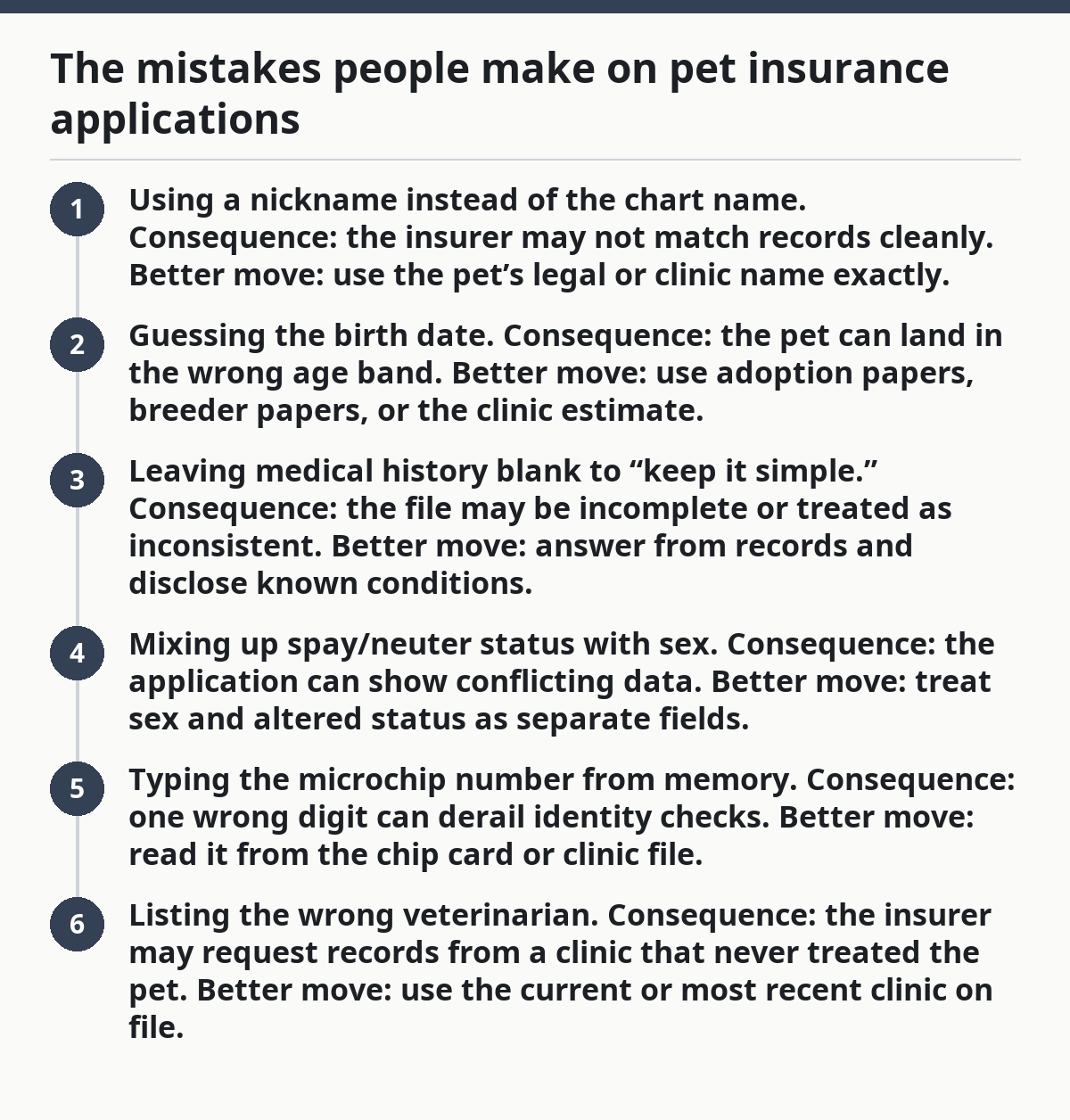
The mistakes people make on pet insurance applications
The biggest mistakes are guessing, leaving blanks, and letting the vet record and the form disagree. Those errors can lead to slower underwriting, a revised quote, or a dispute later when a claim lands.
Picture this: you are rushing, the form is long, and every box looks close enough. That is exactly when errors creep in. Most of them are small on the surface and costly later.
-
Using a nickname instead of the chart name.
Consequence: the insurer may not match records cleanly.
Better move: use the pet’s legal or clinic name exactly. -
Guessing the birth date.
Consequence: the pet can land in the wrong age band.
Better move: use adoption papers, breeder papers, or the clinic estimate. -
Leaving medical history blank to “keep it simple.”
Consequence: the file may be incomplete or treated as inconsistent.
Better move: answer from records and disclose known conditions. -
Mixing up spay/neuter status with sex.
Consequence: the application can show conflicting data.
Better move: treat sex and altered status as separate fields. -
Typing the microchip number from memory.
Consequence: one wrong digit can derail identity checks.
Better move: read it from the chip card or clinic file. -
Listing the wrong veterinarian.
Consequence: the insurer may request records from a clinic that never treated the pet.
Better move: use the current or most recent clinic on file.
These are not dramatic mistakes. That is what makes them common. A form can still submit, and the problem may not show up until the first claim.
What changes in edge cases?
The standard application needs modification when the pet is a rescue, a senior, a mixed breed with no clear paper trail, or a pet with sparse medical records. In those cases, the insurer may rely more heavily on estimated age, adoption records, and the first available clinic notes.
Picture this: you adopted an adult cat with no full history, or you’ve moved and the old clinic is hard to reach. The form still needs answers, but the source of those answers changes. You are building the record from what exists.
Common edge cases include:
- Rescue or shelter pets: The adoption file may be the main source for age and initial status.
- Unknown birth date: An estimated age may be accepted, but it should stay consistent across records.
- No microchip: Some forms allow this, but the insurer may ask for other identity details instead.
- Recent adoption: The insurer may ask for the first exam notes after adoption.
- Multiple clinics: Records may need to come from more than one veterinarian.
- Recent spay/neuter surgery: The status should match the surgery note and date.
The truth is, edge cases are not rare. They just need cleaner sourcing. If the answer is uncertain, the application should reflect that uncertainty rather than pretending it is exact.
Drafted with AI; not yet reviewed by a person.