Last updated: November 19, 2026
Key Takeaways
- A pet can outgrow the insurer’s age rules, which may affect renewal or new enrollment.
- Usually, age does not end active coverage mid-term unless the policy says so.
- The insurer may renew, nonrenew, or change terms at the next policy date.
- The renewal notice shows whether coverage is ending, changing, or continuing.
If your pet ages out of a pet insurance policy, the plan may stop accepting new enrollment, refuse renewal, or keep coverage only under the policy terms already in force. Quick Answer: in most cases, age affects the next renewal date, not the current claim. What Happens If Your Pet Ages Out of a Policy? depends on whether the age limit applies at signup or at renewal. This article breaks down what that means, what to check on a renewal notice, and what happens to senior pet coverage. For a broader primer, see the hub on pet insurance basics.
What “ages out” means in pet insurance
A pet ages out when the insurer’s age-based eligibility rules no longer allow the policy to continue under the same terms. That can mean the company stops issuing new policies for older pets, or it can mean a policy can renew only up to a certain age set in the contract. In many plans, that cutoff is a specific age in the policy form.
The phrase is simple, but the mechanics are not. A pet insurer may use one age rule for new applications and a different one for renewal. That is why the policy terms matter more than the marketing page. If you need a broader primer first, the hub on pet insurance basics is the right place to start.
The key point: age limits are usually a contract issue, not a veterinary label. A pet can be healthy and still hit a plan’s age cutoff.
- Age-based eligibility: the age a pet must meet to enroll.
- Policy continuation: whether an existing policy can keep going at renewal.
- Renewal notice: the letter or email that tells you what changes before the next term starts.
Does age end coverage right away?
No, not usually; age does not erase active coverage mid-term unless the policy terms allow cancellation for that reason. In most policies, the real decision point is renewal, not the day your senior pet crosses a birthday.
For example, a 12-month term may keep running until its end date even if the pet turns 10 during that term. The age rule then shows up at renewal, not halfway through the year.
If you open a renewal notice and see a new age cutoff, a higher premium, or a clause that says the plan will not renew past a certain age, read the contract line by line. The change may affect the next term only. For help comparing terms, see understanding your policy documents.
The practical question is simple: does the insurer still allow the policy to continue after the current term ends? If the answer is no, you may have a gap unless you line up another plan before the current one expires.
Here’s the catch: a policy can end for age even when claims are otherwise in good standing. That is why continuity matters.
- Check the effective date on the renewal notice.
- Check whether the insurer says nonrenewal or termination.
- Check whether the cutoff applies to the pet’s age at renewal or at enrollment.
- Check whether claims from the current term still follow the old policy terms.
What happens when a pet ages out of a policy?
The insurer may decline renewal, restrict future enrollment, or let the policy continue under the existing contract until the next renewal date. The exact result depends on the age limit in the policy terms and on state or country rules that can shape cancellation and renewal practices. For background, see how pet insurance renewal works.
The outcome is usually spelled out in the renewal notice. In 2023, the NAIC’s Pet Insurance Model Act also focused attention on clearer disclosure of exclusions, waiting periods, and renewal terms. That kind of clarity matters because age rules can be easy to miss.
Your senior pet may still be covered today and still lose renewal tomorrow. A 2024 renewal letter can change the picture even when the current term remains active.
The common result is one of three outcomes: the policy renews with adjusted pricing or limits, the policy renews but with new exclusions allowed by the contract, or the policy ends at the next term boundary.
- Renewal continues: the policy stays active into the next term.
- Nonrenewal: the insurer chooses not to extend coverage.
- Policy change: the insurer renews but changes terms allowed by the contract.
What to check in the renewal notice
The renewal notice tells you whether the policy is ending, changing, or continuing. Read it before the renewal date, not after, because the notice often sets the clock for any appeal, shopping, or transfer. If you are comparing options, the page on pet insurance renewal can help.
Look for the exact wording. “We will not renew” means something very different from “your premium is changing” or “your deductible is changing.” The policy terms control the result, and a phone rep’s summary does not override the contract. If the notice is unclear, ask for a written explanation and consider speaking with a licensed insurance professional.
- Renewal date and term length
- Any nonrenewal notice
- Any age clause tied to continuation
- Any change in deductible, reimbursement, or limits
- Any waiting period if you move to a new pet insurer
If the notice is vague, ask for the written reason and the exact clause. Keep the email. Keep the letter. A paper trail matters.
Can a pet insurance company cancel coverage because of age?
Yes, depending on the policy terms and local rules, a pet insurance company may refuse renewal because the pet no longer meets the plan’s age-based eligibility rules. That is different from canceling for nonpayment or fraud, which are separate contract issues. If you are unsure how the language works, review the policy with a licensed insurance professional and compare it with the insurer’s disclosure page.
The age rule is usually tied to underwriting, not to a single claim file. That matters because a company may treat new applicants and existing policyholders differently. In practice, the contract for a new policy can be stricter than the renewal rule on an existing one. For a broader comparison, see what pet insurance covers.
What matters most is the wording in the contract. If the policy says renewal stops at a certain age, the company can point to that clause. If the policy is silent, the insurer may still have state-specific rules that govern what it can do.
- Age limit in the contract
- State or country rules on renewal
- Separate cancellation grounds like unpaid premium
- Written notice requirements in the policy
The truth is, age-based nonrenewal is usually a policy design issue, not a surprise glitch.
What if your pet becomes a senior while covered?
The policy may keep going, but the cost and the rules can change at the next renewal. A senior pet is more likely to be subject to tighter underwriting, more exclusions, or a nonrenewal clause that did not matter when the pet was young.
If your pet is now 9, 10, or older depending on species and breed, and the plan is still active, that does not guarantee the insurer must keep offering the same renewal terms forever. It only means the current term is still in force. For more on older pets, see senior pet insurance.
This is where many owners make a costly assumption: they think a policy that started when the pet was young must continue unchanged for life. That is not how many policies work. Some allow long continuation. Some do not.
If you are reading a renewal notice, the question is not “is my pet old?” The question is “does this policy still allow renewal at this age?”
- Review the age clause before the next term
- Watch for exclusions tied to chronic conditions
- Check whether the insurer allows annual renewal only
- Compare the end date with the pet’s next birthday
When the age limit changes your next move
If the policy will not renew, the next move is to confirm the end date, compare the contract language, and check whether another policy would start with new exclusions or waiting periods. This is where timing matters more than emotion. If needed, compare options on pet insurance quotes.
You may have 45 days, 30 days, or another notice period before the term ends. Use that time to confirm the dates and coverage rules. A short gap can matter if your pet needs ongoing care.
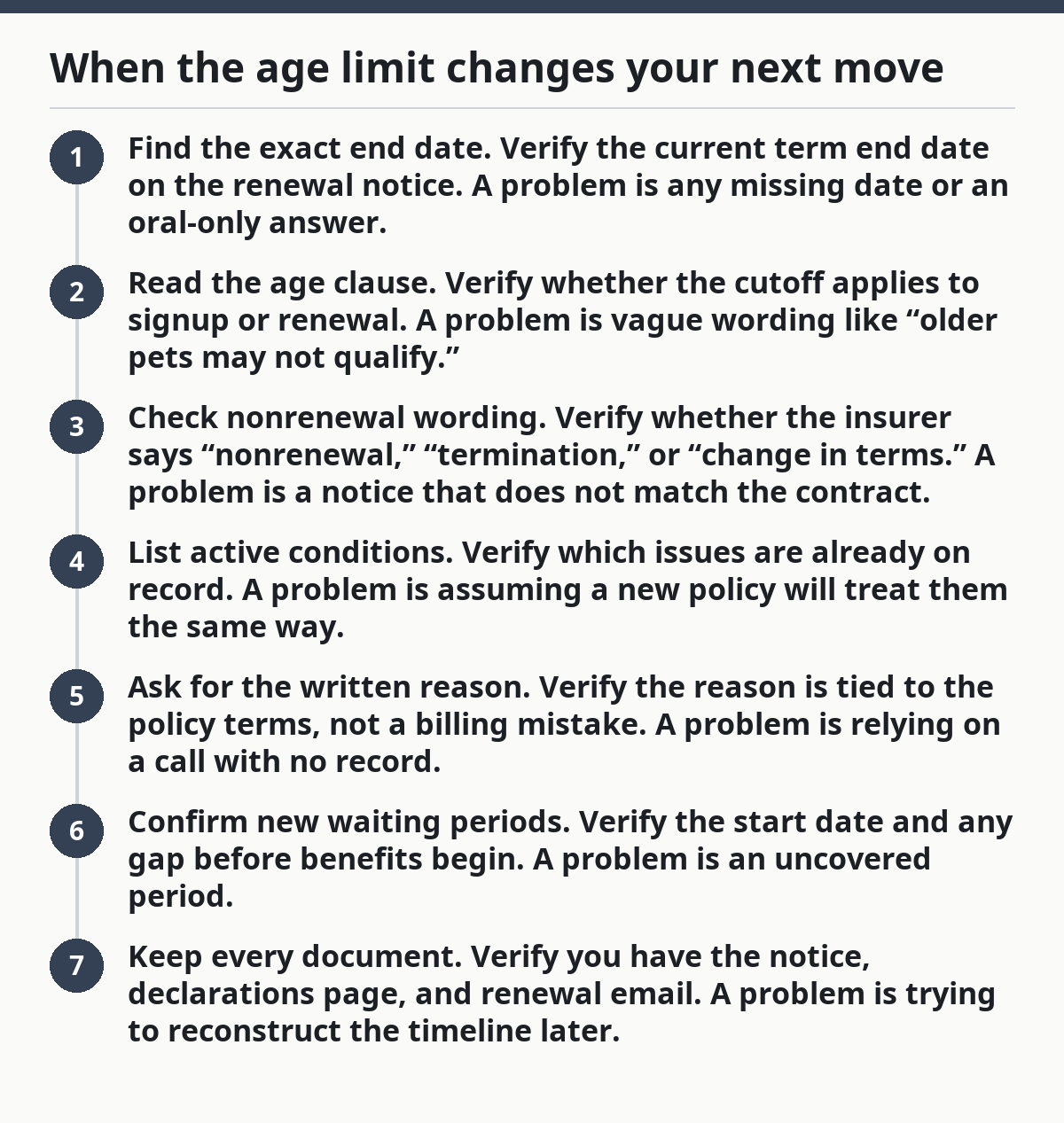
Use this order:
- Find the exact end date. Verify the current term end date on the renewal notice. A problem is any missing date or an oral-only answer.
- Read the age clause. Verify whether the cutoff applies to signup or renewal. A problem is vague wording like “older pets may not qualify.”
- Check nonrenewal wording. Verify whether the insurer says “nonrenewal,” “termination,” or “change in terms.” A problem is a notice that does not match the contract.
- List active conditions. Verify which issues are already on record. A problem is assuming a new policy will treat them the same way.
- Ask for the written reason. Verify the reason is tied to the policy terms, not a billing mistake. A problem is relying on a call with no record.
- Confirm new waiting periods. Verify the start date and any gap before benefits begin. A problem is an uncovered period.
- Keep every document. Verify you have the notice, declarations page, and renewal email. A problem is trying to reconstruct the timeline later.
If the insurer confirms renewal and the age clause does not bar continuation, the policy can keep running under its current contract rules.
Common mistakes people make with age limits
The biggest mistake is assuming “aged out” always means immediate cancellation. It often means the policy cannot renew, while the current term still runs until its end date. That difference can be the gap between orderly planning and a coverage lapse.
If you toss the renewal notice aside because the pet is still insured today, the term can end before you act. Then the nonrenewal was already set in motion. That is a paperwork problem, not a surprise problem.
Here are the errors I see most often:
- Ignoring the renewal notice. The consequence is a missed deadline or no time to compare policies. The fix is to read the notice as soon as it arrives.
- Confusing age at signup with age at renewal. The consequence is thinking a plan will accept a pet when it will not. The fix is to check both clauses separately.
- Assuming the phone script beats the policy. The consequence is acting on incomplete information. The fix is to get the written terms.
- Missing waiting periods on a new plan. The consequence is a coverage gap after the old policy ends. The fix is to align dates before the current term closes.
- Assuming all senior pet coverage works the same way. The consequence is wrong expectations about exclusions or renewal. The fix is to compare the actual policy language, not the brochure.
That last one matters most. Senior pet coverage is not one thing; it is a bundle of contract terms.
When the standard renewal rule does not apply
Sometimes the age limit is not the real issue, and the policy changes for another reason. A move across state lines, a change in underwriting rules, or a product redesign can affect continuation even if the pet has not reached the stated age ceiling.
For instance, your renewal notice may arrive with a new policy form number, a different deductible structure, or a revised exclusion list. That can happen even when the pet is below the old age limit. The question then becomes whether the insurer is offering a true renewal or a new contract.
A few edge cases need extra attention:
- Policy redesign at renewal. The company may replace old terms with new ones. Verify whether prior conditions stay covered.
- Breed or species differences. A plan may use different age rules for dogs and cats, or different underwriting standards for certain breeds.
- State-specific language. Renewal rights and notice periods can vary by location. The rules are not universal.
- Short policy term changes. A monthly or annual term can shift the timing of nonrenewal notice. Check the dates, not the assumptions.
If the notice is unclear, ask for the full policy form number and the exact section that controls renewal. That is the cleanest way to avoid a bad read.
What a good outcome looks like
A good outcome is not always “the policy stays forever.” It is a clear answer before the current term ends, no surprise gap, and written confirmation of what happens next.
If you know the end date, you know whether the pet insurer will renew, and you know whether any new policy would start fresh, you can plan around the contract instead of reacting after the fact.
A bad outcome is the opposite: no written notice, no clear age clause, and no time to arrange a backup. That is where people lose continuity.
The result is best when the renewal notice gives you enough time to act and the policy language is clear enough to trust.
Can a pet insurance company cancel coverage because of age?
Yes, if the policy terms and local rules allow nonrenewal or age-based eligibility limits. The key difference is that age often affects renewal, not an in-force claim right away. Read the renewal notice and the contract section on continuation to see which rule applies to your policy. If anything is unclear, consult a licensed insurance professional.
Do age limits apply at signup or renewal?
They can apply at either point, and many insurers use different rules for each one. A pet may be too old to enroll as a new customer but still allowed to renew an existing policy for a time. The policy terms should say which age test the insurer uses.
What happens when a pet becomes a senior?
A pet becoming a senior does not automatically end coverage. It may change the price, the renewal terms, or the insurer’s decision about future continuation. The exact result depends on the age-based eligibility rule in the policy and any nonrenewal language in the renewal notice.
Drafted with AI; not yet reviewed by a person.