Last updated: November 19, 2026
Quick Answer: 2 things drive pet insurance setup most often — your pet’s age/health details and the policy’s waiting periods. In Pet Insurance Policy Setup & Eligibility — The Complete Guide, those two factors usually determine whether the application moves forward, whether a condition is excluded, or whether the insurer declines the policy. If they line up, the application can move; if they don’t, the insurer may exclude a condition or decline the policy. This guide shows what gets approved, what gets delayed, and what to check before you submit anything.
Key Takeaways
- Eligibility is mostly about timing and records, not luck.
- A pet can be covered and still have a condition excluded from the start.
- Waiting periods can matter more than the monthly premium.
- Breeds, age, prior symptoms, and vet notes can change the policy outcome.
- The wrong setup choice can leave you paying for a plan that won’t help with the problem you care about.
This is information, not financial advice. Rates, limits, and eligibility rules vary by country and insurer, and a qualified adviser should be consulted for your own situation.
What actually determines eligibility for pet insurance?
Eligibility depends on age, species, location, medical history, and timing. If your pet fits the insurer’s basic rules, the application can be accepted; if not, the insurer may exclude an issue, postpone coverage, or deny the policy.
Picture this: you’re filling out a quote form for a dog with a recent limp, and the site is asking for dates, vet visits, and current symptoms. That’s not busywork. It’s how the insurer decides whether the limp is a pre-existing condition, whether a waiting period applies, or whether the policy can be issued at all.
The usual gatekeepers are plain enough:
- Age limits: Many insurers set minimum and maximum enrollment ages.
- Species: Dogs and cats are standard; exotic pets often need a different product.
- Zip code or country: Coverage is tied to where the insurer operates.
- Medical history: Past symptoms, treatment, and diagnosis matter, so consult a professional and check the policy wording.
- Microchip or ID: Some policies or discounts ask for identification.
- Spay/neuter status: Some plans ask, though it may affect price more than eligibility.
- Vaccination or wellness records: Some insurers request them for underwriting or claims, but requirements vary by plan and region.
The truth is, the policy setup date matters as much as the pet’s health. If a symptom appeared before the effective date, the insurer may treat it differently from a new injury after the waiting period, so consult a professional and review the policy language. A clean application does not erase old vet notes.
For a broad rule set, the U.S. Federal Trade Commission’s consumer guidance on pet insurance is a solid starting point, and the NADAC discussions from veterinary groups often help explain terminology. If you’re outside the U.S., the local insurance regulator or consumer protection agency matters more than a general website. For policy language and consumer disclosure basics, the National Association of Insurance Commissioners is also a useful reference.
Quick check: If your pet has ever had the problem you’re trying to insure, you’re not just checking eligibility — you’re checking how the insurer will classify that history.
How do waiting periods change what you’re covered for?
Waiting periods can turn an accepted policy into partial coverage for the first days or weeks. If your pet gets sick during that window, the claim may be denied even though the policy is active.
Picture this: you enroll your cat on Monday because the vet mentioned urinary trouble on Friday. The policy may exist on paper, but the clock on illness coverage may still be running. If the issue appears before the waiting period ends, the claim often lands in the excluded bucket.
That’s why the setup question is not only “Am I eligible?” but also “When does each part of the policy start?” Common setup points include:
- Accident waiting period
- Illness waiting period
- Orthopedic or ligament waiting period
- Dental waiting period
- Preventive care add-on start date
The mechanics are simple. The insurer uses waiting periods to separate new events from known or emerging ones. That protects the risk pool, but it also means the first month of a policy is often the least forgiving time to buy.
Here’s the catch: waiting periods can differ by insurer, by state, and by plan. A 14-day illness wait on one policy does not tell you anything about the accident wait on another. You need the schedule in writing before you rely on it.
- Ask for the policy’s effective date in writing.
- Ask for the accident, illness, and orthopedic waiting periods separately.
- Check whether the clock starts on the purchase date or the approval date.
- Read whether bilateral conditions are treated as one problem; if the wording is unclear, consult a professional and review the policy text.
- Save the wording that describes what starts immediately and what does not.
That last point matters. A claim dispute often starts with one sentence in the policy packet, not with the premium price.
For a neutral source on consumer insurance reading habits, the National Association of Insurance Commissioners has plain-language consumer material on policy language and disclosures. Not glamorous. Very useful.
Quick check: If your pet needs care this week, the waiting period dates are more important than the quote page.
If your pet has a pre-existing condition, here’s what changes
A pre-existing condition usually changes the policy from “full medical coverage” to coverage with exclusions. If the issue was present before the policy started — even as symptoms rather than a diagnosis — the insurer may not cover it.
Picture this: you’re trying to insure a dog with recurring ear infections, and the vet record shows repeated scratch marks, smell, and treatment notes over several months. Even if the insurer accepts the application, those notes can put that ear problem outside the new-policy safety net, so consult a professional and compare the records against the policy language.
The key is how the insurer defines “pre-existing.” Some use a strict diagnosis rule. Others look at symptoms, vet visits, prescriptions, or a condition on one side of the body and then extend the exclusion to the other side. That last part is why bilateral language matters.
If you’re dealing with a condition already on record, then the setup steps look different:
- Pull the last 12 months of vet records, or longer if the insurer asks for it.
- List every symptom, date, medication, and follow-up tied to the condition.
- Ask the insurer how it defines “pre-existing” and “curable” conditions.
- Ask whether a symptom-free period can reset the condition’s status.
- Get the exclusion language before the policy starts, not after a claim is denied.
That symptom-free period can be the hinge. Some insurers may stop treating a past issue as active after a set time with no signs or treatment; others won’t, so consult a professional and check the policy wording. The terms differ, and there is no universal standard.
A generic article would tell you to “read the fine print.” That’s weak advice here. The better move is to find the exact phrases around:
- pre-existing
- bilateral
- curable
- chronic
- recurring
- symptom-free period
One more thing: a vet note that says “monitor” can still matter. So can a phone call logged in the clinic record. If the insurer asks for records, assume it will read them closely.
For official consumer guidance, the North American Pet Health Insurance Association explains common terms used in pet insurance policies. It’s not a guarantee of how every carrier writes coverage, but it helps you spot the traps.
Quick check: If your pet has had the same problem twice, you should assume the insurer will ask whether it is chronic, recurring, or already excluded.
What should you prepare before applying?
You should prepare medical records, ID details, and a clean timeline before you apply. The more precise your dates and symptoms are, the less likely the insurer is to misclassify a condition or delay the policy setup.
Picture this: you’re at the quote stage, and the form wants your pet’s birth date, breed, sex, microchip number, and the last vet visit. If you scramble for the answers, you’re more likely to miss something that later shows up in a claim review.
A solid application pack usually includes:
- Pet’s exact age or birth date
- Breed or mix as accurately as you can state it
- Sex and neuter status
- Microchip number if available
- Vet clinic contact details
- Last 12 months of medical records
- Vaccination history
- Medication list
- Dates of any injuries, vomiting, diarrhea, limping, skin issues, or ear infections
If the pet has seen more than one clinic, ask for records from all of them. A claim file can become messy fast when one clinic has part of the story and the other has the rest.
The setup process also benefits from one simple document: a timeline. Write down, in order, when the symptoms started, when they stopped, when treatment began, and whether the vet called it resolved. That timeline can help you answer the insurer’s questions without guessing.
Therefore, this is not busywork if you do it once and keep the file. The next policy change, renewal, or claim review becomes easier because the facts are already sorted.
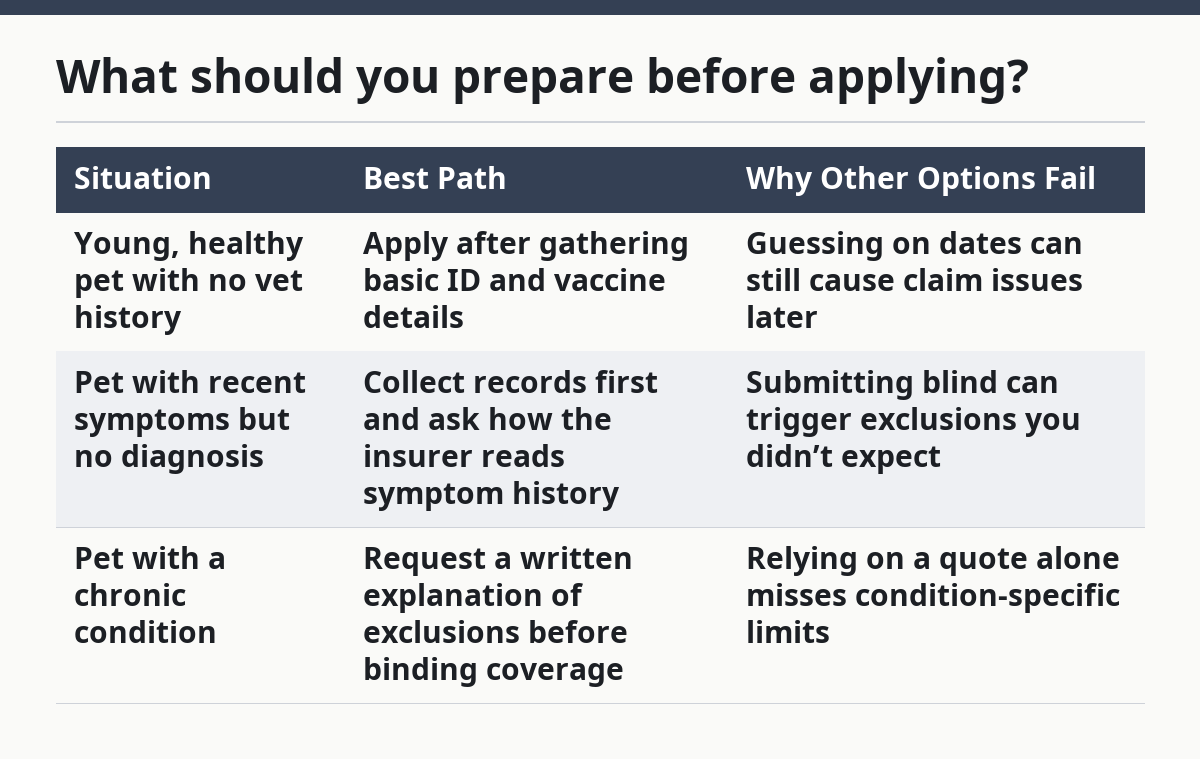
A quick table helps show where setup gets easier and where it gets harder.
| Situation | Best Path | Why Other Options Fail |
|---|---|---|
| Young, healthy pet with no vet history | Apply after gathering basic ID and vaccine details | Guessing on dates can still cause claim issues later |
| Pet with recent symptoms but no diagnosis | Collect records first and ask how the insurer reads symptom history | Submitting blind can trigger exclusions you didn’t expect |
| Pet with a chronic condition | Request a written explanation of exclusions before binding coverage | Relying on a quote alone misses condition-specific limits |
Quick check: If you can’t explain your pet’s last 12 months of care in order, the application is not ready yet.
How do breed, age, and size affect setup?
Breed, age, and size can change price, limits, and acceptance rules, even when the policy is technically available. If your pet falls into a higher-risk group, the insurer may still offer coverage, but the setup can come with narrower terms.
Picture this: you’re insuring a large dog breed with a history of orthopedic problems in the breed line. The insurer may not reject the pet outright, but it may care a lot about the knee, hip, or spine history, especially if the pet is older.
This is where generic advice fails. A kitten and a senior dog do not need the same setup path. A flat-faced breed can bring breathing, eye, or dental concerns into the application. A giant breed may get a harder look on joint issues. A toy breed may raise different dental questions.
The decision tree is simple:
- Young pet: Focus on early enrollment before symptoms appear.
- Older pet: Expect stricter scrutiny and more exclusions.
- Breed with known hereditary risks: Expect detailed medical questions.
- Very large or very small pet: Watch for orthopedic or dental language.
On the flip side, size alone does not decide everything. A big dog with no vet record may be easier to insure than a small dog with repeated skin flare-ups. The record matters more than the silhouette.
If your pet is older, ask whether the policy has:
- a maximum enrollment age
- a deductible structure that changes with age
- condition-specific exclusions based on prior history
- renewal rules that could shift as the pet ages
A policy can look fine at signup and still become a poor fit later if the insurer has strict age-based enrollment rules. That is why setup is not just “fill out form, pay premium.” It’s a matching exercise between the pet’s profile and the policy’s actual limits.
For a standards angle, some policy materials borrow concepts from veterinary record-keeping and medical history disclosure used across the industry. The form may be simple, but the file behind it is not.
Quick check: If your pet is older than the insurer’s comfort zone or has a breed-linked risk, read the enrollment rules before you compare price.
When does a policy get declined instead of excluded?
A policy is more likely to be declined when the insurer sees too much current risk, missing records, or a mismatch with eligibility rules. If the issue is limited to one body part or one diagnosis, the result may be an exclusion instead of a denial.
Picture this: you apply for coverage while your pet is actively being treated for a problem, and the records are incomplete. The insurer may not want to issue a policy until it understands whether the issue is acute, chronic, recurring, or unresolved.
There are a few common setup failures:
-
Active symptoms at application
If the pet is mid-treatment, the insurer may pause, exclude, or deny depending on the policy. -
Inconsistent history
If your answer says “no prior ear issues” but the vet record lists three visits, the policy can come under review. -
Age outside the enrollment band
Some insurers simply won’t issue a policy above a certain age or below a minimum age. -
Species mismatch
Dog and cat policies are not interchangeable with rabbit, bird, reptile, or exotic coverage. -
Location mismatch
A policy may require the pet to live in a covered region, not just visit there.
The best path is to treat denial risk as a paperwork problem first. Get the records, fix the timeline, and ask the insurer to clarify whether the condition is excluded or whether the application itself is not eligible.
- Check the plan’s age and species rules.
- Compare your answers against the vet record line by line.
- Ask whether current treatment blocks approval.
- Ask whether the insurer can issue the policy with an exclusion instead.
- Keep the final decision in writing.
That final step matters because verbal explanations are easy to forget and hard to prove.
The truth is, some pet owners want a simple yes/no answer. The system does not work that way. A policy can be approved for one problem set and useless for the exact issue you were trying to cover.
Quick check: If your pet is actively sick, the question is not just “Can I get insured?” but “Will the insurer write the policy with exclusions or refuse it altogether?”
Edge cases where the normal advice breaks down
The normal advice breaks down when the pet’s history, policy terms, or timing do not fit the standard pattern. In those cases, the setup question changes from “How do I apply?” to “What part of the policy is actually available?”
Picture this: you’re dealing with a pet whose chart looks normal at first glance, but one old note, one gap in coverage, or one recent treatment changes the whole result. That is where insurance setup gets tricky.
| Situation | What changes | What to do instead |
|---|---|---|
| A symptom came and went before any diagnosis | The insurer may still call it pre-existing | Ask how symptom history is judged, not just diagnoses |
| The pet switched vets and records are split | Missing context can make the timeline look incomplete | Request full records from every clinic before applying |
| The issue is on one side of the body only | Some policies extend exclusions to the other side too | Ask for bilateral wording in plain language |
| The pet is covered after a gap in insurance | New waiting periods may apply again | Confirm whether the prior coverage counts or resets the clock |
| The pet lives in one place but travels often | Location rules may change whether the policy can stay active | Check residency requirements and claim geography |
| The pet is already mid-treatment | The policy may be issued with a narrower exclusion or denied | Get the current treatment plan in writing before quoting |
One hard example is a pet with a skin issue that flares, clears, and returns. Some insurers will treat that as one recurring condition, even if the gaps between flare-ups look long to you. Another is a pet with one eye issue and a later issue in the other eye. Depending on policy wording, the second eye can be tied to the first exclusion.
A gap in coverage can also trip you up. If you let a policy lapse and then reapply, the new policy may act like a fresh start with fresh waiting periods. That is not universal, but it is common enough to check every time.
Because of that, the better move is to stop thinking in slogans. Think in records, dates, and policy language. That is how you protect yourself from a claim surprise later.
Quick check: If the pet’s story is not clean or linear, assume the insurer will need more records and more clarification than the quote page suggests.
What should you do before you click “buy”?
You should verify the effective date, waiting periods, exclusions, and record requirements before you bind the policy. If any one of those is vague, the setup is not complete yet.
Picture this: the quote looks fine, the monthly cost seems manageable, and you’re one click from binding coverage. That is exactly when people skip the boring part — and exactly when the claim file later gets harder.
Use this final setup pass:
- Confirm the pet’s age, breed, and sex are entered correctly.
- Compare your answers against the vet record, not memory.
- Check the effective date and each waiting period separately.
- Read the exclusion section for pre-existing, chronic, and bilateral conditions.
- Ask whether wellness care is included or sold as a separate add-on.
- Save the policy wording, declarations page, and confirmation email.
If the insurer offers multiple plan types, read the structure rather than the marketing copy. Deductible, reimbursement percentage, and annual limit all shape how the policy behaves. A plan with a lower premium can still be a poor fit if the deductible is too high for your cash flow or the coverage exclusions are too broad.
Here’s the catch: the right setup is not always the cheapest monthly payment. It is the policy that matches your pet’s actual record and your ability to handle a claim the policy will truly pay.
If the insurer’s language is vague, ask for clarification in writing. That is not overcautious. It is normal. And if the policy terms are still unclear after that, the setup is not ready.
Quick check: If you cannot explain the policy’s start date, waiting periods, and exclusions in one minute, don’t bind it yet.
FAQ
Can I get pet insurance if my pet already has a condition?
Yes, you may still be able to get a policy, but the condition is often excluded or limited. The insurer will usually look at symptoms, treatment history, and vet records, not just the diagnosis label.
Does a vet visit before I apply count as a pre-existing condition?
It can. A visit for symptoms, testing, or treatment may be enough for the insurer to treat that issue as pre-existing, even if no final diagnosis was written down.
Do waiting periods apply right away after I pay?
Usually, yes, but the exact start date depends on the policy wording. Some insurers start the clock on the purchase date, while others use the effective date or approval date.
Is it better to insure a puppy or wait until the dog is older?
Earlier enrollment usually gives you a cleaner history to work from, but age rules vary by insurer and country. The main issue is that once symptoms show up, they can affect coverage later.
What if I move to another state or country after buying the policy?
That can change whether the policy stays active or whether you need a different plan. Check the residency and geography rules before you move, and tell the insurer as soon as the address changes.
Drafted with AI; not yet reviewed by a person.