Last updated: November 19, 2026
Key Takeaways
- A pet insurance premium is the policy price, not the vet bill.
- Monthly payments split the yearly policy cost into 12 parts; annual premiums are paid upfront.
- Insurers raise or lower premiums when expected claim risk or claim costs change.
- Premiums can shift at renewal because pricing rules and risk change over time.
A pet insurance premium is the regular amount you pay to keep a pet insurance policy active, usually monthly or annually. In What Is a Pet Insurance Premium and What Moves It Up or Down?, that bill can go up or down based on things like pet age, deductible, reimbursement rate, annual limit, and policy price. This page explains how that bill works, what changes it, and what it is often confused with.
What a pet insurance premium actually pays for
A pet insurance premium is the amount that buys the policy itself, not the vet bill. You pay it to keep coverage open for future claims, and the insurer uses it to price the risk of your pet getting sick or hurt.
Picture this: you have a quote in front of you and one line says premium, while the rest of the page shows deductible, reimbursement rate, and annual limit. The premium is the recurring policy payment; the other terms change how claims are handled after you pay the vet.
- Premium: the fee to keep the policy active.
- Deductible: the amount you pay before reimbursement starts.
- Reimbursement rate: the share the insurer pays after the deductible.
- Annual limit: the most the policy will pay in a policy year.
If you want the wider pricing picture, the hub on Pet Insurance Pricing and Cost Control sits above this page and covers the bigger cost questions.
Many people call every number on the quote “the premium.” It leads to bad comparisons. A lower premium can still pair with a higher deductible or a lower reimbursement rate, and that changes the real value of the policy. For background on how insurers explain premiums and deductibles, see the National Association of Insurance Commissioners consumer guidance.
How does a monthly premium differ from an annual premium?
A monthly premium is just the policy price broken into 12 payments, while an annual premium is the same coverage paid in one lump sum for the year. The underlying policy terms can be the same either way.
Picture this: you’re looking at two quotes that seem different, but one is billed monthly and the other yearly. The billing schedule changes cash flow, not the core coverage terms. That matters if you budget month to month, because a lower monthly amount can still add up to a larger annual outlay if the insurer charges a payment load.
Here’s the catch:
- The monthly premium is easier to fit into a budget.
- The annual premium can be simpler because it avoids 12 separate payments.
- The insurer may offer the same policy both ways, or may price payment plans differently.
- The coverage itself does not become “better” just because you pay monthly.
A lot of beginners compare only the monthly number. That misses the point. You need to check the full year’s cost, the deductible, the reimbursement rate, and the annual limit together before you can tell whether one policy is actually cheaper.
If the policy has a monthly payment option, verify whether the insurer adds a fee for installments. If the annual total is not shown, ask for it in writing. If the quote only shows a low monthly figure and hides the yearly total, that’s a warning sign for comparison work.
What moves a pet insurance premium up or down?
A pet insurance premium moves up or down when the insurer thinks the chance or cost of claims will change. The biggest drivers are pet age, breed, species, location, coverage level, and claim history rules, though insurers do not all use the same formula.
Picture this: you’re shopping for a quote and wondering why two pets in the same house don’t cost the same to insure. One is older, one is younger, one is a cat, one is a large dog, and each profile changes expected claim cost. That is why the premium is not a flat number.
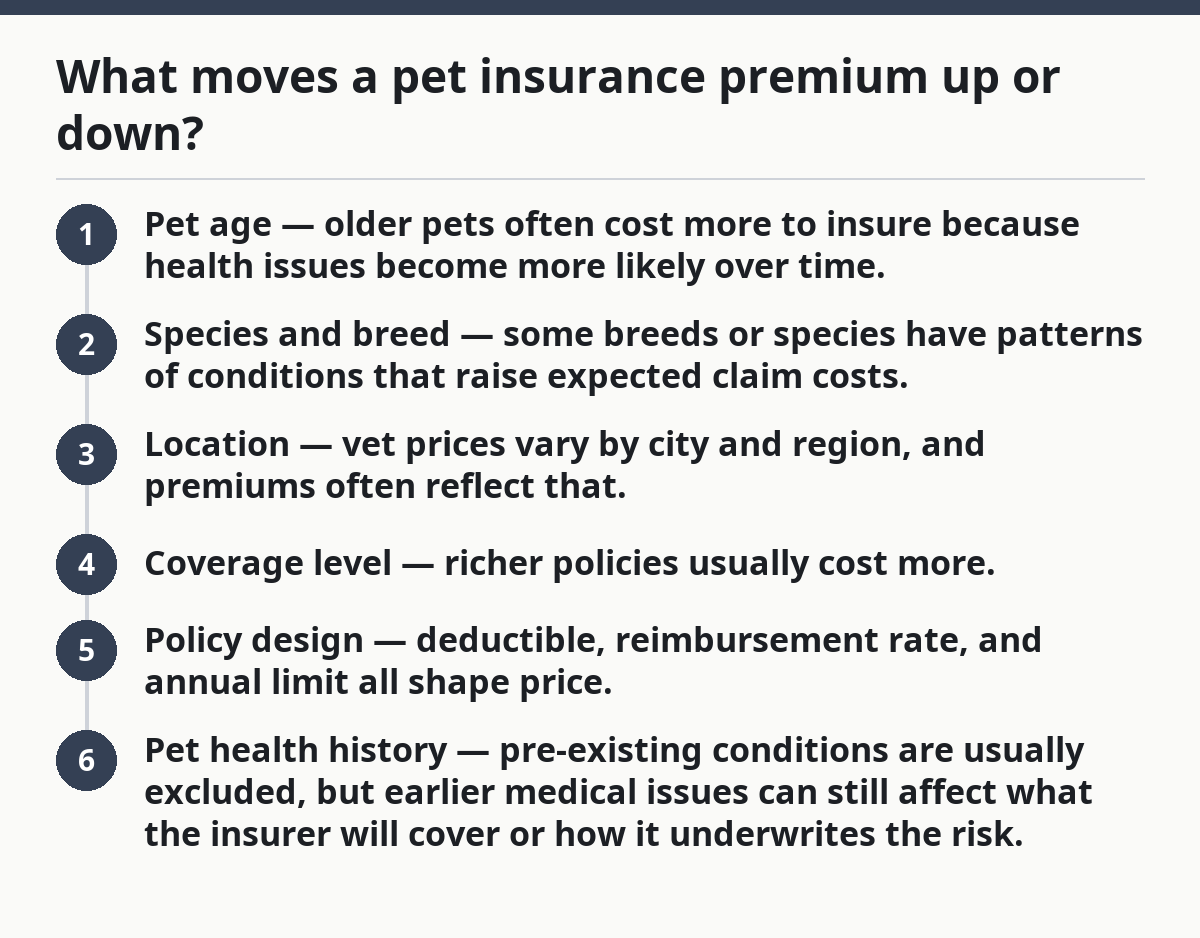
Common rating factors include:
- Pet age — older pets often cost more to insure because health issues become more likely over time.
- Species and breed — some breeds or species have patterns of conditions that raise expected claim costs.
- Location — vet prices vary by city and region, and premiums often reflect that.
- Coverage level — richer policies usually cost more.
- Policy design — deductible, reimbursement rate, and annual limit all shape price.
- Pet health history — pre-existing conditions are usually excluded, but earlier medical issues can still affect what the insurer will cover or how it underwrites the risk.
The best part is that you can usually see several of these factors in the quote, even if the insurer does not spell out the exact formula. That gives you a way to spot why one policy is higher than another.
What does not usually change the premium on its own? A routine vet visit after the policy starts, if it does not turn into a covered claim issue. What can change it over time is the pet aging into a higher-risk bracket, a policy renewal adjustment, or a change in the insurer’s pricing rules. Rates, limits, and underwriting rules differ by country and insurer, so the exact trigger is not universal.
For pricing details tied to a specific quote, check the insurer’s own disclosure page or a national insurance regulator’s consumer guidance if one is available in your country. For general pricing context, the North American Pet Health Insurance Association publishes market information and consumer education.
Why do premiums change over time?
Premiums change over time because risk and pricing rules change, and pet insurance is usually renewed. A quote you got last year is not a promise for next year, even if your pet stays on the same plan.
Picture this: you renew a policy after 12 months and the number on the bill is different. That can happen even if you made no claim. The insurer may reprice the policy because your pet is older, because veterinary costs in your area moved, or because the company revised its rating model.
The first thing to verify is whether the change is from age rating or from a broader policy price update. Some insurers raise rates as pets get older. Others also adjust pricing across the whole book of business, which means many customers see a change at once.
Common reasons for a higher renewal premium:
- Your pet moved into a higher age band.
- Veterinary inflation in your area pushed claim costs up.
- The insurer changed its rates.
- You changed coverage choices at renewal.
- Your claim history triggered a different pricing structure, where that is allowed by local rules.
Common reasons a premium may go down:
- You lowered coverage features.
- You switched to a higher deductible or lower reimbursement structure, where the insurer prices that way.
- The insurer changed its pricing rules.
- In some markets, a promotional or introductory rate ended and then a different structure took over; the real comparison is the renewal offer, not the first bill.
The truth is, renewal is where many people first notice that “cheap” and “stable” are not the same thing. A low starting premium can rise later, so the useful question is not only “What is the premium now?” but “How is this policy likely to behave at renewal?”
What is the premium confused with most often?
The premium is most often confused with the deductible, and that mistake wrecks comparison shopping. The premium is the payment to keep the policy active; the deductible is the amount you pay before the insurer starts reimbursing covered costs.
Picture this: a quote shows a low premium, and you assume the policy is cheaper. Then you notice the deductible is high, the reimbursement rate is low, or the annual limit is tight. Now the cheap-looking quote is not so simple.
Common mix-ups:
- Premium vs. deductible: one is ongoing payment, the other is a claim threshold.
- Premium vs. reimbursement rate: one is what you pay the insurer, the other is what the insurer pays you back.
- Premium vs. annual limit: one is the policy fee, the other is the cap on payouts.
- Premium vs. total out-of-pocket cost: not the same thing at all.
If you only remember one line, make it this: the premium is the price of the policy, not the price of care. The rest of the policy terms decide how much of a claim gets reimbursed.
That distinction matters because a policy with a lower premium can still cost more when the vet bill arrives. A higher premium may buy a better reimbursement structure or a higher annual limit. Neither is automatically better. The right comparison is the full policy design, not one line on the quote.
What should you check before you compare quotes?
You should check the premium alongside four policy terms: deductible, reimbursement rate, annual limit, and exclusions. A premium on its own tells you almost nothing about how the policy will behave when you file a claim.
Picture this: you’re holding two quotes that are $20 apart on the monthly line, and both look similar at first glance. The difference may sit in the deductible, the reimbursement rate, or the annual limit. That’s where the real comparison lives.
Use this order:
- Confirm the billing schedule — monthly or annual.
- Read the deductible — per year, per condition, or per incident, depending on the policy.
- Check the reimbursement rate — common structures vary, and the exact percentage changes your claim payout.
- Look at the annual limit — a lower cap can make a cheaper premium less useful for expensive care.
- Review exclusions and waiting periods — these can limit what you can claim even after paying the premium.
- Check age-based pricing rules — if the pet is close to an age bracket change, the premium may rise soon.
- Ask how renewal pricing works — the first-year premium may not match later years.
Do not compare two policies only by monthly payment. That is the most common mistake people make, and it leads to bad policy picks. The whole point is to see what the premium buys.
For more on how these pieces fit into the broader pricing picture, the main hub on Pet Insurance Pricing and Cost Control is the right next stop.
When does a higher premium make sense, and when doesn’t it?
A higher premium can make sense when it buys a better claim structure, but it does not make sense if the policy still excludes the care you expect to use. The premium has to match the coverage you actually need.
Picture this: you have a senior pet, or a breed with a higher likelihood of ongoing care, and the quote is not cheap. A higher premium may reflect that reality. The number alone is not a verdict. What matters is whether the policy terms fit the pet and your budget.
A higher premium may be easier to justify when:
- The annual limit is materially higher.
- The reimbursement rate is stronger.
- The deductible is easier for you to absorb.
- The insurer’s renewal pattern is clearer.
- The policy covers the type of care you are most likely to use.
A higher premium is hard to justify when:
- The policy still excludes the condition you care about.
- The annual limit is too low to help with a major bill.
- The waiting periods are long and the coverage window is narrow.
- The quote is high because of a feature you do not need.
Here’s the catch: a premium should be judged in context, not in isolation. A low premium can be a trap if it leaves too much of the bill on you later. A high premium can still be poor value if the rest of the policy is thin.
Rates, terms, and consumer protections vary by country and insurer, and a qualified adviser or licensed insurance professional should be consulted for your own situation if the numbers are close or the policy terms are hard to compare.
Common mistakes people make with premiums
A pet insurance premium is easy to misunderstand, and that creates expensive mistakes. The most common errors are simple, but they change the real cost of coverage.
Picture this: you are trying to save money, so you pick the lowest monthly number on the page. That can be the wrong move if it hides a weak deductible structure, a low annual limit, or a renewal jump later.
Common mistakes and what they cost:
- Treating the premium like the whole policy — you miss the deductible and reimbursement rate, and the quote looks cheaper than it is.
- Comparing monthly amounts only — you ignore the annual total, and a “cheap” plan costs more over 12 months.
- Forgetting age effects — you underestimate renewal increases as the pet gets older.
- Skipping the annual limit — you may end up with a policy that runs out when claims get large.
- Assuming all insurers price the same way — you compare unlike products and draw the wrong conclusion.
The correct alternative is to compare the premium with the rest of the policy terms in the same quote. If one insurer gives a clear annual total and another only shows a monthly fee, ask both for the same billing view before you judge price.
A sensible premium is not the lowest premium. It’s the one that matches the coverage design you can actually use.
FAQ
Why do premiums change over time?
Premiums change over time because the insurer’s view of risk changes and because the policy is renewed. Your pet is older at renewal, vet costs may have changed, and the company may adjust its pricing model. The exact rule depends on the insurer and the country.
What makes one quote more expensive than another?
One quote can cost more because of pet age, breed, location, coverage level, deductible, reimbursement rate, or annual limit. Insurers also differ in how they price the same pet. A more expensive quote is not automatically better; it may simply include more coverage or a different pricing formula.
Is the premium the same as the deductible?
No, the premium is not the same as the deductible. The premium is the payment you make to keep the policy active, while the deductible is the amount you pay before the insurer starts reimbursing covered claims. They affect cost in different ways and should never be mixed up.
Can two pets on the same plan have different premiums?
Yes, two pets on the same plan can have different premiums if the insurer prices by age, breed, species, or location. One pet may also move into a different pricing band sooner than the other. The plan name can be the same while the quoted premium differs.
Drafted with AI; not yet reviewed by a person.