Last updated: November 19, 2026
Quick Answer: Most pet insurance claims are paid in a few days to a few weeks, but timing depends on the insurer, the records you submit, and whether the claim needs manual review. This guide to Pet Insurance Claims, Claims Problems, and Reimbursement Timing — The Complete Guide shows what slows reimbursement, how to file a clean claim, and what to do when the insurer asks for more proof.
Key Takeaways
- A claim is usually decided from your invoice, medical record, and policy rules — not just the vet bill.
- Slow reimbursement often comes from missing records, an unclear diagnosis date, or a condition the policy treats as pre-existing; if you’re unsure, consult your insurer, vet, or another qualified professional, since policy terms vary by insurer and country.
- The fastest claims are often the ones that match the policy wording on waiting periods, deductibles, co-insurance, and itemized charges, though every policy still needs its own review.
- If the insurer says the case needs review, the fix is usually documentation, not a new visit.
- This is information, not financial advice; policy terms vary by insurer, country, and renewal date, so a qualified adviser can help with your own situation.
Who this guide applies to, and what it assumes you already have
This guide applies to pet owners who already have an active policy, a vet visit, and a bill or invoice to submit for Pet Insurance Claims, Problems, and Reimbursement Timing. It assumes you can log into the insurer’s portal, read a claim form, and get basic records from your clinic in PDF or image form.
It also assumes you know the pet’s policy start date, the date of the vet visit, and the name of the condition being claimed. If you don’t have those yet, stop there. A claim filed without the right dates, codes, or records often gets delayed on the first review.
This is for routine reimbursement claims, not for disputes over coverage limits, cancellation, or legal claims after a serious incident. If the insurer has denied a large claim, or the pet’s treatment is tied to a pre-existing condition, the file may need help from the clinic or a qualified adviser; if the situation is unclear, consult a professional. That’s not a loophole — it’s how policy review works.
Here’s the catch: pet insurance is a money workflow, but the insurer decides from medical wording. A claim that seems obvious to you may still fail if the record lacks the right sequence of events, according to the policy and the insurer’s review process.
- You need: itemized invoice, visit date, diagnosis or assessment, and proof the policy was active.
- You should also have: receipts for payment if your insurer requires them.
- You may need: medical notes, lab results, imaging reports, or a referral letter.
- If the clinic only gives a summary, ask for the full record for the claim period.
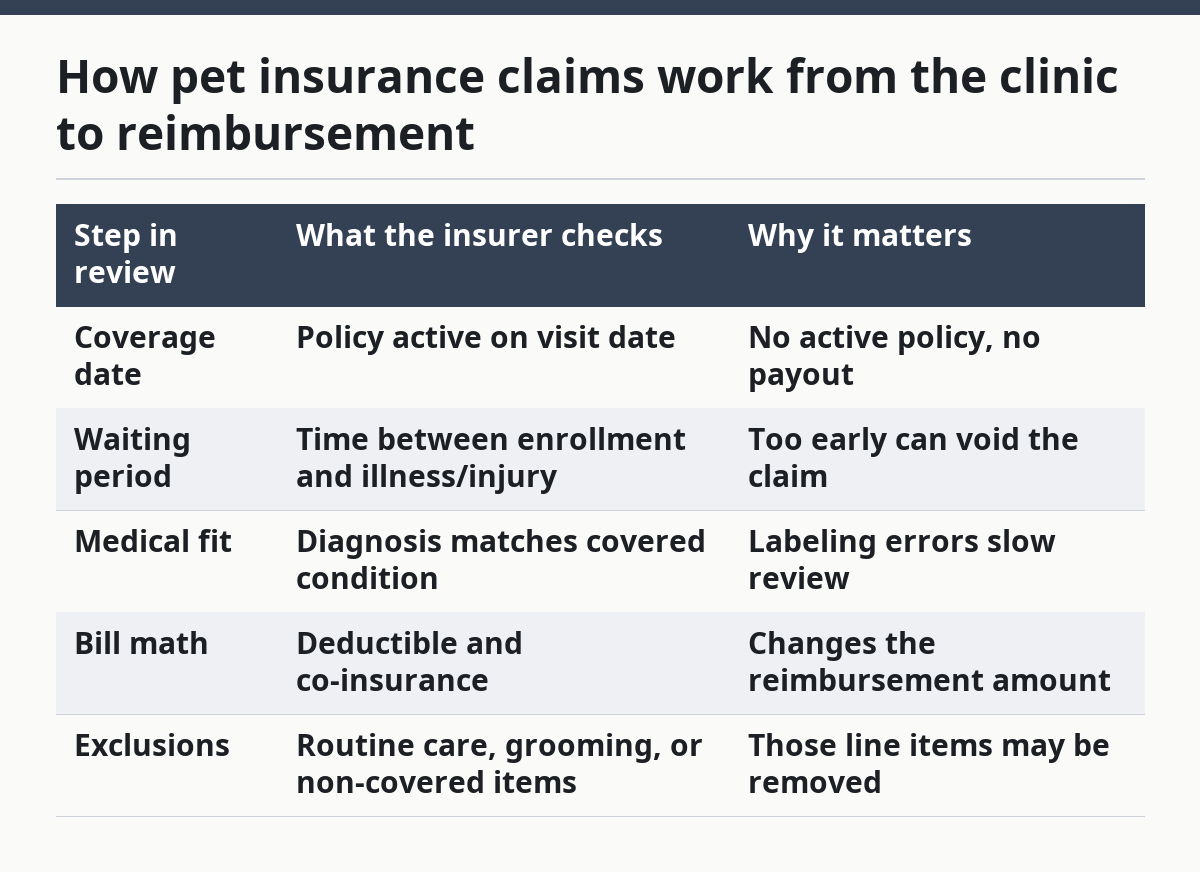
How pet insurance claims work from the clinic to reimbursement
A pet insurance claim is paid after the insurer checks whether the visit is covered, what part is reimbursable, and whether the bill falls after the deductible and within the policy terms. The insurer is not paying the clinic’s full invoice by default; it is paying the covered share.
Picture this: you’ve just left the vet with a paper invoice, a digital discharge note, and a pet that still needs follow-up care. The claim turns those records into a reimbursement decision, and every missing detail adds another round of review.
Most policies use a few common terms. A deductible is the amount you pay before reimbursement starts. Co-insurance is the share you still pay after the deductible, such as 20% or 30%, depending on the policy wording. A waiting period is the time after enrollment before certain conditions become eligible.
The insurer usually checks four things in order, though a claims professional or the insurer’s own process may treat them differently:
- Was the policy active on the date of treatment?
- Did the waiting period already pass for this condition?
- Is the condition new, or could it be pre-existing?
- Is the charge listed in the policy as covered, partially covered, or excluded?
| Step in review | What the insurer checks | Why it matters |
|---|---|---|
| Coverage date | Policy active on visit date | No active policy, no payout |
| Waiting period | Time between enrollment and illness/injury | Too early can void the claim |
| Medical fit | Diagnosis matches covered condition | Labeling errors slow review |
| Bill math | Deductible and co-insurance | Changes the reimbursement amount |
| Exclusions | Routine care, grooming, or non-covered items | Those line items may be removed |
A clean claim does not need a long explanation. It needs the right files, in the right order, with the same date and diagnosis across the invoice, records, and claim form.
How to file a claim without creating a delay
You file a stronger claim by matching the invoice, the medical record, and the policy wording before you submit anything. That sounds basic, but it is the point where most delays start.
Picture this: you have 15 minutes before the portal times out, and the clinic emailed you a PDF that looks readable on your screen. The claim may still stall if the insurer can’t see the diagnosis date, the vet’s initials, or the charge breakdown.
Use this order:
- Confirm the claim date range. Match the visit date and any follow-up dates to the policy active period. Verify that the service date is inside coverage, and check for a problem if the invoice mixes covered and non-covered dates on one bill.
- Pull the exact invoice. Use the itemized bill, not a receipt summary. Verify that each charge has a service name, date, and amount. A flat total with no line items often triggers a request for more detail.
- Get the medical record for the same visit. Ask for the assessment, diagnosis, and treatment notes tied to the claim date. Verify the notes mention the same condition as the invoice. If the record uses a different term, the claim may get flagged for review.
- Check the policy language on waiting periods and exclusions. Look for the waiting period length, pre-existing condition rules, and any exclusions for dental, exam fees, or chronic care. Verify that the claimed service is actually listed as eligible. If it is excluded, the insurer may remove it without warning.
- Submit one clear diagnosis story. The form, invoice, and medical notes should tell the same story in the same order. Verify that the onset date and visit date do not conflict. A mismatch between “started yesterday” and a note that says “ongoing for months” is a common problem.
- Include proof the bill was paid if required. Some insurers reimburse only after payment, while others process from the invoice alone. Verify the payment rule in your policy and attach the card slip, receipt, or paid stamp if needed. Missing payment proof is a frequent delay point.
- Upload legible files. Use PDF or a clear image with the whole page visible. Verify that the file opens on another device before you hit submit. Blurry photos, cropped corners, and unreadable totals often cause a manual review.
- Save the submission record. Keep the confirmation number, upload date, and claim ID. Verify that the insurer generated a reference number. If you never get one, the claim may not have gone through, even if the portal looked finished.
On the flip side, do not attach five extra pages just to seem thorough. A clean 3-page claim packet usually beats a 17-page upload full of unrelated vet history. Too much noise can slow the claim as much as too little proof.
Why claims get delayed or denied
Claims get delayed or denied when the insurer cannot match the bill to the policy rules fast enough. That usually means one of three things: the file is incomplete, the condition looks pre-existing, or the charge itself is not covered.
Picture this: you expected reimbursement in a few business days, but the claim status says “pending additional information.” The insurer is not always stalling; sometimes the file really does need one missing note, one clearer diagnosis, or one corrected date.
The most common problems are predictable:
- Missing records: No itemized invoice, no treatment notes, or no receipt for payment if required.
- Date mismatch: The claim form says one date, the invoice another, and the medical record a third.
- Pre-existing condition questions: The insurer sees earlier symptoms, old notes, or repeat visits for the same problem.
- Non-covered item: Nail trims, vaccines, routine dental cleaning, and exam fees may be excluded depending on the policy.
- Unreadable uploads: Blurry scans, cut-off pages, or screenshots with hidden text fields.
- Policy timing issue: The treatment happened during a waiting period or after a lapse in coverage.
A denial is not always the end of the road, but the fix depends on the reason. If the insurer denies the claim because the condition is excluded, more paperwork usually won’t change the answer. If the issue is a missing note, the clinic can often send the record the insurer needs. If the denial is large or the wording is unclear, consult a professional who can help you read the policy and the claim decision.
The mistake people make is treating every delay as if it were the insurer’s fault. Sometimes it is. Often it’s a documentation gap. That difference matters because the solution is different.
How long reimbursement usually takes
Reimbursement usually takes anywhere from a few days to a few weeks, depending on the insurer, claim volume, and whether the file needs manual review. Country, payment method, and policy type all matter, so there is no universal timeline.
Picture this: you’ve already paid the vet, and now the reimbursement clock matters because cash flow is tight. The claim is not just paperwork anymore — it affects whether you can cover the next visit without stress.
A faster claim usually has these traits:
- The invoice is itemized.
- The diagnosis is clear.
- The policy is active and past any waiting period.
- The insurer can read every file on the first pass.
- No one needs to call the clinic for extra notes.
A slower claim often has one of these traits:
- The insurer needs medical history back to the first symptom.
- The bill includes multiple services with mixed coverage.
- The case touches chronic disease, orthopedics, or dental work.
- The claim was filed near a holiday, weekend, or high-volume period.
- The clinic is slow to send records.
You can often speed the process by checking the claim status 48 to 72 hours after submission and responding the same day if the insurer requests more documents. That won’t force approval, but it can stop a small issue from becoming a long delay.
What to do if the insurer asks for more information
You answer the request with the exact document they asked for, not with a fresh pile of unrelated files. A targeted reply is the fastest way to get a claim moving again.
Picture this: the claim portal says “additional medical records required,” and you’re not sure whether to resend the invoice or call the clinic. Start with the request text. Insurers usually ask for one of a few specific items, and sending the wrong one wastes time.
Use this order:
- Read the request line by line.
- Match it to the missing item, not the whole claim.
- Ask the clinic for the exact note, test result, or progress record named by the insurer.
- Upload only the requested file unless the insurer asks for more.
- Keep the claim ID in every email or message.
- Save the date and time of your reply.
A request for “medical notes” is not the same as a request for “full history.” If the insurer wants notes from the first visit for the condition, sending a vaccine record won’t help. If they ask for proof of payment, a balance summary may also miss the point.
If the insurer asks for a pre-existing condition review, the file may need earlier records. That means the condition could have shown signs before the policy start date, even if it wasn’t diagnosed yet. The issue is not just the name of the diagnosis; it’s the timeline.
When the standard claim process does not apply
The standard claim process does not fit every case, and some situations need extra documentation from the start. That’s not failure; it’s the normal shape of certain claims.
Picture this: the case involves surgery, chronic medication, a referral to a specialist, or a condition that has shown up more than once. The usual one-page upload may not be enough, because the insurer is reading the full history, not just the latest bill.
Multiple visits for the same issue: This can look like one ongoing condition rather than separate claims — ask the clinic for a timeline and submit dates clearly.
Chronic disease management: Long-term treatment often gets reviewed against the first symptom date and earlier notes — include the full record set tied to the condition.
Orthopedic or dental claims: These often face stricter review because they can overlap with pre-existing problems — attach specialist notes or imaging if the insurer requests them.
Emergency care away from your usual clinic: A different hospital may use different forms or billing codes — verify the invoice names the pet, the visit date, and the treating doctor.
Claims spanning two policy periods: If treatment started before renewal and continued after it, the insurer may split review by date — file the dates separately if the policy allows it.
Claims involving third-party payment: If someone else paid the bill, the insurer may want proof of who is owed reimbursement — include the correct payer details.
These cases often take longer because the insurer needs to map the treatment timeline. The answer is usually better paperwork, not pressure. If the policy language is unclear, the claim may need a formal appeal or a call with the insurer’s claims team.
The mistakes that cost people time and money
The biggest claim mistakes are boring, repeatable, and expensive in the form of delays. They are easy to avoid once you know what to look for.
Picture this: you think the claim is complete, but the insurer rejects it for a detail that took 30 seconds to fix. That is the real cost — not just the payout delay, but the extra back-and-forth when the pet may need another appointment soon.
-
Submitting a summary instead of an itemized invoice.
Cost: The insurer can’t separate covered and non-covered items.
Fix: Ask the clinic for a line-by-line bill with service dates. -
Ignoring the waiting period.
Cost: The claim can be denied even if the treatment was needed.
Fix: Check the policy start date and the waiting period for the condition before you submit. -
Mixing up diagnosis and symptoms.
Cost: The insurer may think the condition changed, or that the story doesn’t match.
Fix: Use the same wording across the form and the medical note whenever possible. -
Uploading blurry photos of paper records.
Cost: Manual review, file resubmission, or a request for clearer copies.
Fix: Scan to PDF or photograph in bright light with all four corners visible. -
Waiting too long to file.
Cost: Some policies have a claim submission deadline, and old records are harder to find.
Fix: Submit soon after the visit and keep the confirmation number. -
Assuming every charge is covered.
Cost: Surprise partial reimbursement when exam fees, taxes, or routine care are excluded.
Fix: Read the coverage list before you expect a payout.
Most claim problems are paperwork problems. That’s good news, because paperwork can usually be fixed faster than a medical record can be rewritten.
What a good claim result looks like
A good claim result is a clear decision, a correct reimbursement amount, and no open questions about what was paid. It may not be instant, but it should be understandable.
Picture this: you open the claim decision and can see exactly what was covered, what was excluded, and why the final amount changed from the vet bill. That is what “good” looks like — not maximum payment, just a decision that tracks the policy.
Look for these signs:
- The insurer names the claim ID and visit date.
- The decision explains the deductible and co-insurance if they apply.
- Any excluded item is listed, not hidden.
- The payment method and timing are clear.
- The claim status changes from pending to approved or denied without endless loops.
If the explanation is vague, ask for the breakdown in writing. A short request for the calculation can reveal whether the issue is a policy exclusion, a math error, or a missing record. That matters if you need to file an appeal or correct a claim later.
For reference, some pet insurers provide claim tracking through a portal, app, or email updates. The feature is useful, but the status label alone is not enough. “In review” can mean a 24-hour wait or a full medical audit.
Frequently asked questions
Why is my pet insurance claim taking so long?
Your pet insurance claim is usually taking long because the insurer needs more information, not because the claim is automatically in trouble. Missing medical notes, a blurry invoice, or a condition that may be pre-existing can all slow the review.
If the portal shows “pending,” check whether the insurer asked for records from the vet. A same-day reply usually helps more than repeated calls.
What documents do I need for a pet insurance claim?
You usually need an itemized invoice, the visit date, the diagnosis or assessment, and sometimes proof of payment. Some insurers also want the medical record, lab results, or referral notes if the case is complex.
The safest approach is to match the documents to the policy’s claim list. If the insurer asks for one specific record, send that file first.
Can a pet insurance claim be denied because of a pre-existing condition?
Yes, a claim can be denied if the insurer decides the condition existed before coverage began or during the waiting period. That can happen even when the formal diagnosis came later.
The record that matters is often the earliest sign, not just the official diagnosis date. If the insurer questions it, the clinic record usually becomes the deciding document.
Do I need to pay the vet before I get reimbursed?
Sometimes yes, sometimes no, depending on the insurer and policy terms. Many plans reimburse after you pay the bill, while some payment systems or direct-settlement setups work differently.
Check the claim instructions before you leave the clinic if possible. If the policy requires proof of payment, keep the receipt or card slip.
What should I do if my claim is denied?
A denial should be read against the reason given, not treated as a generic no. If the issue is missing paperwork, send the document the insurer asked for. If the claim was denied for an exclusion or pre-existing condition, you may need the clinic record and a formal appeal path.
Keep everything in writing and save the claim ID. A clear paper trail makes the next step much easier to sort out.
Drafted with AI; not yet reviewed by a person.