Last updated: November 19, 2026
Quick Answer: A pending pet insurance claim usually means the insurer has your file, but the review is not finished yet. In many cases, the status is still open because the insurer is checking records, dates, or coverage terms.
A pending pet insurance claim usually means the insurer has your file, but it isn’t finished with review yet. This guide explains the most common reasons why your pet insurance claim shows pending, what the claim status means on the portal dashboard, and what to check next.
Key takeaways
- Pending is a review status, not a final yes or no.
- Missing medical records or policy documents are the most common hold-ups.
- A claim can stay pending while an adjuster checks dates, diagnoses, and coverage terms; if you are unsure, consult a professional or the insurer.
- The fastest fix is often to respond to the insurer’s request with complete records, but timing depends on the claim.
- This is information, not financial advice; for your own situation, a qualified adviser can help with money or coverage questions.
What pending means on a pet insurance claim
Pending means the insurer has not finished the review stage yet. It is not the same as approved, paid, or denied, and it often shows up while the file waits for a documentation review or a medical history check.
Picture this: you open the portal dashboard after uploading the vet bill, and the status still says pending. You’re not looking at a dead end — you’re looking at a file that still needs a human or system check. That check may be routine. It may also mean the claim needs one more record before it can move on.
The key terms are simple. The claim status is the label you see in the portal. The adjuster is the person or team reviewing the file. Policy documents set the coverage rules. Medical records from the clinic help the insurer confirm what happened and when.
Here’s the catch: pending can mean different things at different insurers, but it usually points to one of four things — the file is incomplete, the records are still being gathered, the medical history needs a check, or the claim is waiting in a queue. For background on claim handling, see the NAIC consumer guidance on pet insurance and state regulation.
Why does my pet insurance claim show pending?

Your claim shows pending because the insurer still needs to verify something before it can finish the file. That usually means missing paperwork, a date mismatch, a coverage check, or a routine medical review. The exact reason depends on the claim and the insurer.
Picture this: you submitted a claim for a $450 vet visit, and the portal still says pending after a few days. The insurer may already have the invoice, but not the itemized notes, the exam date, or the full chart. Without those, the adjuster can’t match the claim to the policy rules.
The most common reasons are below, in the order I see them most often:
- Missing medical records: the insurer has the bill but not the chart notes or diagnosis.
- Policy review: the claim is being checked against the waiting period, exclusions, or reimbursement terms in the policy documents.
- Medical history check: the insurer is comparing the current issue with earlier vet visits to see if it is new or pre-existing.
- Information mismatch: the pet name, date of service, invoice total, or provider details do not line up.
- Claim queue: the file is complete, but it is still waiting for an adjuster to review it.
Not all pending claims need the same fix. A missing invoice is a fast paperwork problem. A medical history check takes longer because the insurer may need prior records from a clinic that keeps charts for 3 to 7 years, depending on the practice and local rules.
What to check before you wait it out
You should check the portal dashboard, your upload history, and your policy documents before you assume the delay is normal. A 10-minute review now can save a week of back-and-forth.
Because the file is still open, start by comparing the claim form, the vet invoice, and the policy language side by side. That paper trail usually shows whether the hold is about missing records or a coverage question.
Use this checklist:
- Open the claim status page and look for a note or request. Verify whether the insurer asked for records, not just a status label. If there’s no note, that can signal a queue delay.
- Check the upload log for every file you sent. Verify the vet invoice, medical records, and claim form all show as received. A file name alone is not proof the attachment went through.
- Match the service date on the invoice with the date you entered on the claim. Verify they are identical. A one-day mismatch can trigger a hold.
- Read the policy documents for waiting periods, exclusions, and any reimbursement limits that apply to this type of visit. If the event falls outside coverage, the claim may stay pending while it is reviewed.
- Compare the pet details: name, species, breed, age, and policy number. Verify the claim uses the same information as the policy. A spelling error can slow the file.
- Look for prior-condition questions in the request. Verify whether the insurer wants older medical records. If yes, the file is likely in medical history review.
- Save every message from the portal dashboard and your email. Verify you can show the date and time of each response. If you need a follow-up call, that record matters.
If one item is off, fix that first. If everything matches and the claim still sits pending, the problem is usually on the insurer’s side of the queue.
What usually happens next

Most pending claims move into one of three outcomes: approved for payment, returned for more documents, or held longer for review. That next step depends on what the adjuster finds in the file.
Once the requested records are in, the status may still lag for a short time. Some systems update only after the adjuster closes a task, and that can lag behind the actual review by a business day or more.
A normal next sequence looks like this:
- The insurer reviews the file against the policy documents.
- The adjuster checks the medical records and invoice details.
- The claim status changes to approved, more info needed, or still pending.
- If payment is approved, the portal dashboard usually shows the reimbursement step next.
Pending often means the claim is still alive. It has not been rejected just because it hasn’t moved yet. The bad part is that a silent claim can sit too long if nobody answers a request for records.
When a pending claim is a warning sign
A pending claim needs attention when the insurer has asked for something specific, the status has not changed after a reasonable review period, or the file has been reopened more than once.
Picture this: the claim has been pending for days, and the portal shows no note, no request, and no update. That may just be a backlog — or it may mean the file is stuck because the insurer cannot match the records it has.
The insurer asked for medical records: this means the file is waiting on documentation, not a final decision — send the requested records or ask the clinic to send them directly.
The policy number is missing or wrong: the claim may be attached to the wrong account — correct the number and resubmit through the portal dashboard.
The invoice lacks diagnosis details: the adjuster may not be able to connect the visit to a covered event — request an itemized invoice and exam notes from the clinic.
The claim has sat unchanged for a long time: this can point to a backlog or a stuck file — contact the insurer and ask what exact item is still needed.
The visit may be tied to a pre-existing condition: the claim can stay pending while the insurer compares older records — be ready to supply past medical records if asked.
On the other hand, a short pending status with a clear request is usually just paperwork. That’s a fixable delay.
Common mistakes that keep a claim pending
The claim often stays pending because the paperwork is incomplete, not because the insurer is ignoring it. Small mismatches can stall the file just as easily as missing records.
Picture this: you uploaded the bill, then assumed the rest would follow on its own. The insurer can’t guess the diagnosis, the exam date, or whether the visit matches the policy terms. It needs the documents in the format it asked for.
Common mistakes:
- Sending only the invoice: the claim may need chart notes too. The fix is to request full medical records from the clinic.
- Using the wrong date of service: that can trigger a manual check. The fix is to match the exact date on every form.
- Uploading blurry scans: unreadable pages slow review. The fix is to rescan at a higher resolution or use PDF files.
- Skipping the portal message: the insurer may have asked for one document you missed. The fix is to read the latest status update before resubmitting.
- Assuming “pending” means approved in progress: that can lead you to wait too long. The fix is to treat pending as unfinished, not approved, and to confirm with the insurer if needed.
- Not checking prior records: if the insurer is reviewing medical history, a missing chart from 6 months ago can hold the claim. The fix is to gather those records early.
A clean file still may take time. A messy one almost always takes longer, especially when the insurer needs a second look.
What to do if the claim still sits pending
You should contact the insurer if the claim status has not changed, the request is unclear, or the portal dashboard gives you no next step. A direct question usually gets more useful information than waiting in silence.
Because the file is still open, ask what exact item is holding it up and whether the insurer needs anything from you or the clinic. That keeps the follow-up focused and short.
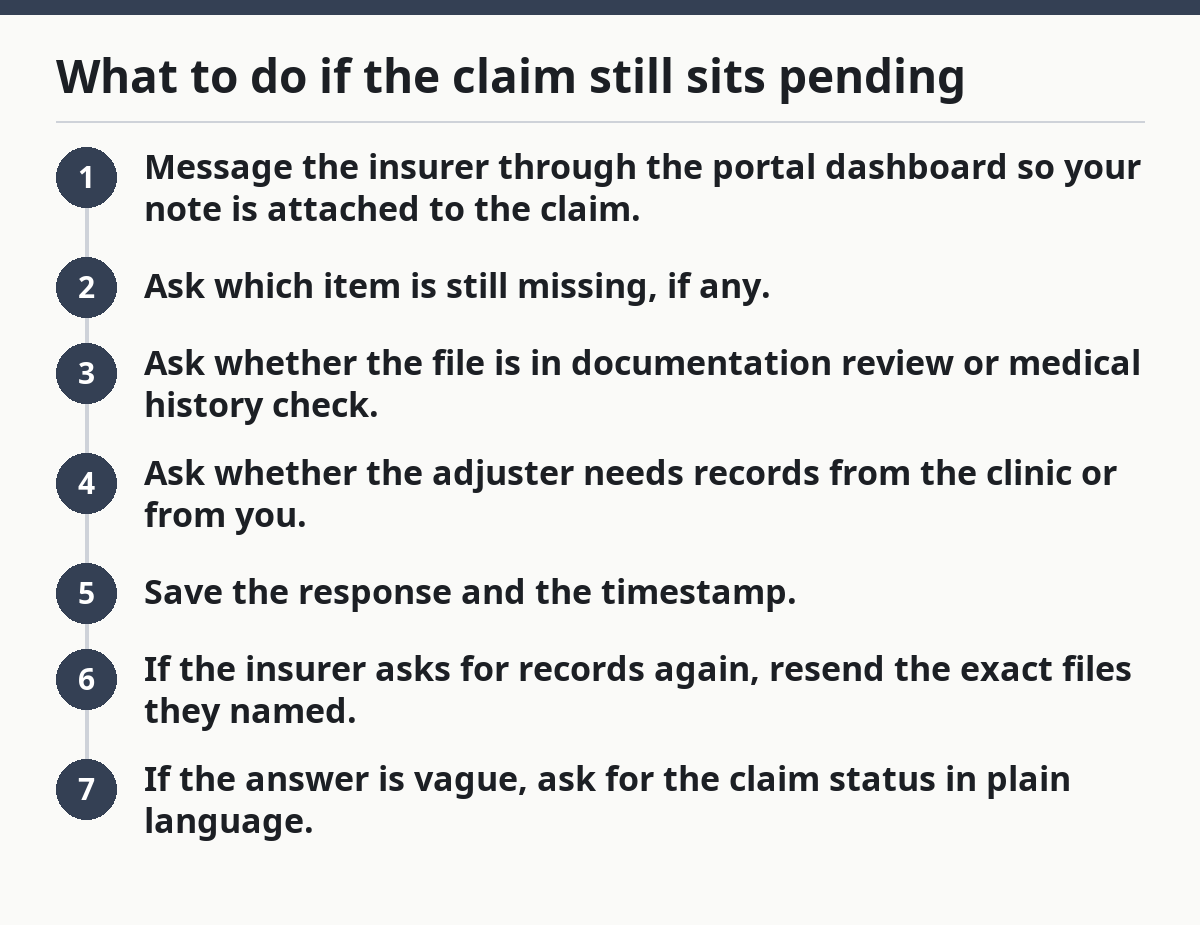
Use this order:
- Message the insurer through the portal dashboard so your note is attached to the claim.
- Ask which item is still missing, if any.
- Ask whether the file is in documentation review or medical history check.
- Ask whether the adjuster needs records from the clinic or from you.
- Save the response and the timestamp.
- If the insurer asks for records again, resend the exact files they named.
- If the answer is vague, ask for the claim status in plain language.
If you want the bigger picture, the hub page on the pet insurance claims and reimbursement workflow can help you place this step in the larger sequence. You can also review the pet insurance claims process and pet insurance reimbursement guide for related steps.
Pending claim questions people ask most
You are usually asking one of three things: what pending means, how long it can last, or whether it means approval is coming. Those are different questions, and each one has a different answer.
Picture this: you want a straight answer before you call the insurer again. Start with the meaning, then check the timeline, then check whether the status says anything about approval.
What does pending mean on a pet insurance claim?
Pending means the insurer has not finished reviewing the claim. It usually means the file is waiting on documents, a coverage check, or a medical records review.
How long can a claim stay pending?
A claim can stay pending as long as the insurer needs to complete its review, and that timing varies by company, claim type, and document status. If the portal dashboard gives no update after you’ve sent everything requested, contact the insurer and ask what is still missing.
Does pending mean my claim was approved?
No, pending does not mean the claim was approved. It means the review is still open, and the final result has not been issued yet.
What does pending mean on a pet insurance claim?
Pending means the insurer has received the claim but has not finished its review. The claim may be waiting on medical records, a policy check, or a note from the adjuster. It is not a final decision, and it does not by itself mean the claim will be paid or denied.
How long can a claim stay pending?
A claim can stay pending until the insurer finishes its review and gets any needed records. The exact timing varies by insurer and by how complete the file is. If the claim sits unchanged and the portal dashboard shows no request, contact the insurer and ask what is still holding it.
Does pending mean my claim was approved?
No, pending does not mean your claim was approved. It means the review is still open and the insurer has not issued a final claim status. Approval, request for more information, and denial are different outcomes, and pending sits before those final steps.
Drafted with AI; not yet reviewed by a person.