Last updated: November 19, 2026
Quick Answer: for most pet owners, the best emergency and urgent pet coverage decision is the policy that lets you get treatment fast, document the visit cleanly, and still fit the plan’s emergency rules; in practice, that means checking waiting periods, exclusions, deductible, reimbursement rate, and annual limit before a crisis. If the pet may be in immediate danger, get to the nearest emergency hospital first and sort the paperwork second. Emergency and Urgent Pet Coverage Decisions: The Complete Guide is about making that choice without risking the pet’s health.
Key takeaways
- Emergency coverage is usually decided by three things: whether the condition was sudden, whether treatment was medically necessary, and whether the policy was active before symptoms started.
- The safest move in a true emergency is usually to prioritize stabilizing care first and collect records, invoices, and discharge notes for the claim as soon as the pet is stable; if in doubt, consult a veterinarian and review the policy or insurer guidance.
- Pre-existing condition language, waiting periods, and “observing symptoms” clauses are where many claims get denied.
- Urgent care is not the same as emergency care, and some policies treat them differently for reimbursement or triage.
- If a vet advises same-day treatment, do not wait for pre-authorization unless the insurer specifically requires it and the pet is stable; if there is any doubt, consult the clinic, the insurer, or both.
- The worst mistake is often delaying care to save money, then finding out the condition is excluded or the pet worsened.
- For help interpreting a policy, consult a licensed insurance professional, your veterinarian, or your state insurance department.
What counts as an emergency vs. urgent pet problem?
An emergency is a life-threatening or rapidly worsening condition that needs immediate veterinary care, while an urgent problem needs prompt same-day or next-day care but is not usually unstable in the next few minutes. The difference matters because many policies cover emergency treatment more clearly than convenience visits, and a claim often turns on how the condition was documented in the medical record.
A practical way to separate the two is by risk and speed. Trouble breathing, uncontrolled bleeding, collapse, repeated vomiting with weakness, seizures, a blocked urinary tract, or suspected poisoning are emergencies. A limping dog, a torn nail that is bleeding but controlled, a cat with mild eye discharge, or a pet with sudden but stable vomiting may be urgent rather than emergency. The line is not perfect, and a veterinarian’s triage note usually matters more than the owner’s label.
Insurance companies often read the same episode through a claims lens. They ask: did the pet show symptoms before the policy’s coverage date, did the issue qualify as accidental injury or sudden illness, and was immediate treatment reasonable? If the record shows a pet had “intermittent limping for 3 weeks” and then “sudden worsening today,” the insurer may treat part of the event as pre-existing or chronic. If the record shows “hit by car, 10:40 p.m.” that is easier to frame as an emergency.
This is why timing matters. The first visit note, the triage sheet, and the discharge summary often do more for a claim than the invoice alone. If the condition is serious enough to need oxygen, IV fluids, pain control, surgery, or overnight hospitalization, make sure those terms appear in the record. That gives the insurer a clearer basis to see the treatment as medically necessary rather than elective.
How does pet insurance decide what to cover in an emergency?
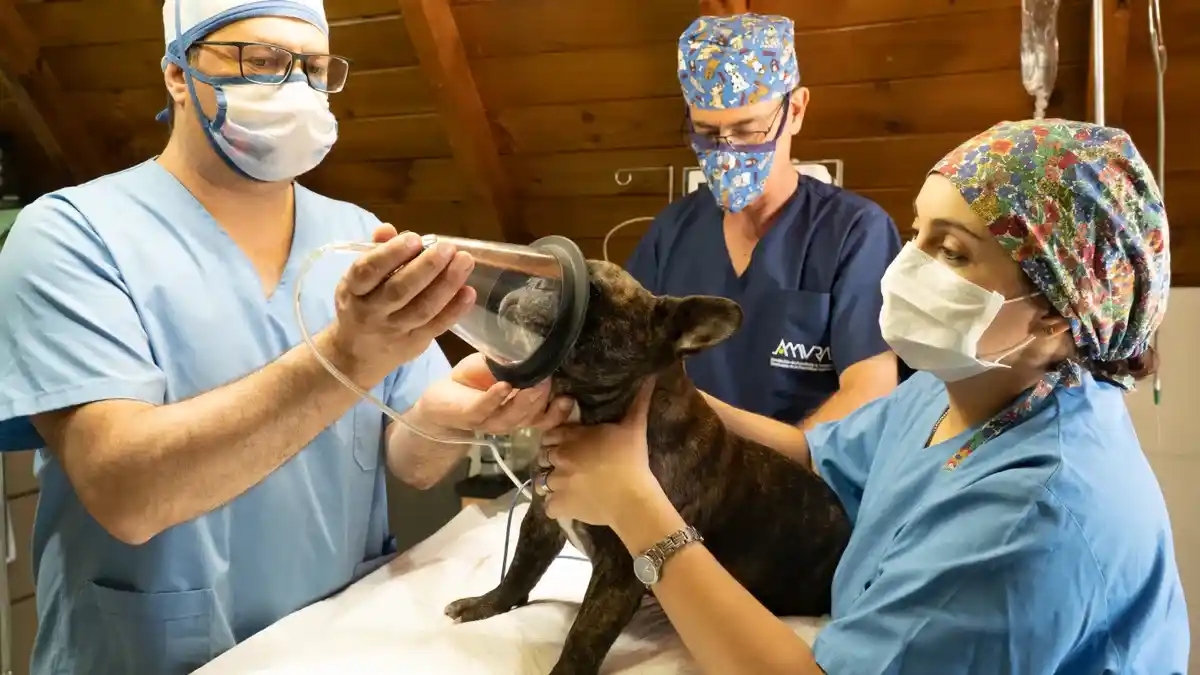
Pet insurance usually covers an emergency when the policy was active before the incident, the problem was not excluded, and the treatment was medically necessary for a sudden injury or illness. The claim then gets tested against the policy wording, not against how frightening the situation felt in the moment.
The main filters are straightforward, even if the language is not:
- Waiting period: Many policies have a gap between purchase and when coverage starts. A 14-day or 15-day waiting period is common for illness in many plans, while accidents may begin sooner, but the exact term depends on the insurer.
- Pre-existing condition: If signs of the problem appeared before enrollment or during the waiting period, the insurer may deny related costs later.
- Deductible and reimbursement: The insurer pays only after the deductible is met, then reimburses a percentage of eligible costs.
- Annual limit: If the policy has a cap, a large emergency can use it up quickly.
- Exclusions: Hereditary, congenital, bilateral, dental, behavioral, breeding-related, or elective issues may be limited or excluded depending on the plan.
A generic article often skips a key reality: insurers do not just decide whether the pet was “sick.” They decide whether the episode fits the plan’s definition of a covered event. A dog that vomits once and later needs surgery for a foreign body may be covered if the episode was sudden and the record supports it. A cat with recurring urinary signs over months may face a harder claim because the insurer can treat it as ongoing.
The strongest claims usually have clean chronology. Symptom onset, exam findings, diagnostics, treatment, and discharge instructions should all line up. If the story changes from one note to the next, the insurer may ask for more records or deny part of the bill. That does not mean the claim is doomed; it means the file needs to be explained carefully.
For the policy language itself, the clearest reference point is the NAIC Pet Insurance Model Act and Model Regulation, which many state frameworks draw from in some form. The exact consumer protections vary by state, so policyholders should check their state insurance department and the policy booklet rather than assume every plan uses the same definitions.
What should I do first if my pet needs emergency care?
You should get the pet to care first, then document everything for the claim. If the pet is unstable, waiting for an insurer’s answer can cost more than the deductible ever would.
The first hour matters. Call the nearest emergency hospital or urgent care clinic and say exactly what is happening: trouble breathing, seizure, bloat, trauma, active bleeding, toxin exposure, inability to urinate, or a cat that is hiding and not eating with sudden lethargy. Those phrases help triage staff decide whether the pet needs immediate stabilization or can safely wait.
While heading to the clinic, gather the basics:
- policy number and insurer name
- time symptoms started, if known
- any photos of injuries, vomit, stool, or toxins
- a list of medications, supplements, and known conditions
- payment card or deposit method, because emergency hospitals often require a deposit before full discharge
If the pet is conscious and the vet advises transport, follow that advice. Do not give medication from old prescriptions unless a veterinarian tells you to do so. A human pain reliever that seems harmless can be dangerous for cats and dogs, and a mistaken dose can create a second emergency that the claim may not cover.
If the pet is insured, ask the clinic for itemized invoices, the medical record, and the discharge summary. Those three documents often matter more than the receipt. A claim adjuster may also want radiology reports, lab results, or a referral note from the primary vet.
A useful detail many owners miss: if the condition started before midnight and treatment continued after midnight, the claim is still usually about the same episode. The date split does not reset coverage. What matters is whether the event began while the policy was in force and outside any waiting period.
What documents make or break an emergency claim?
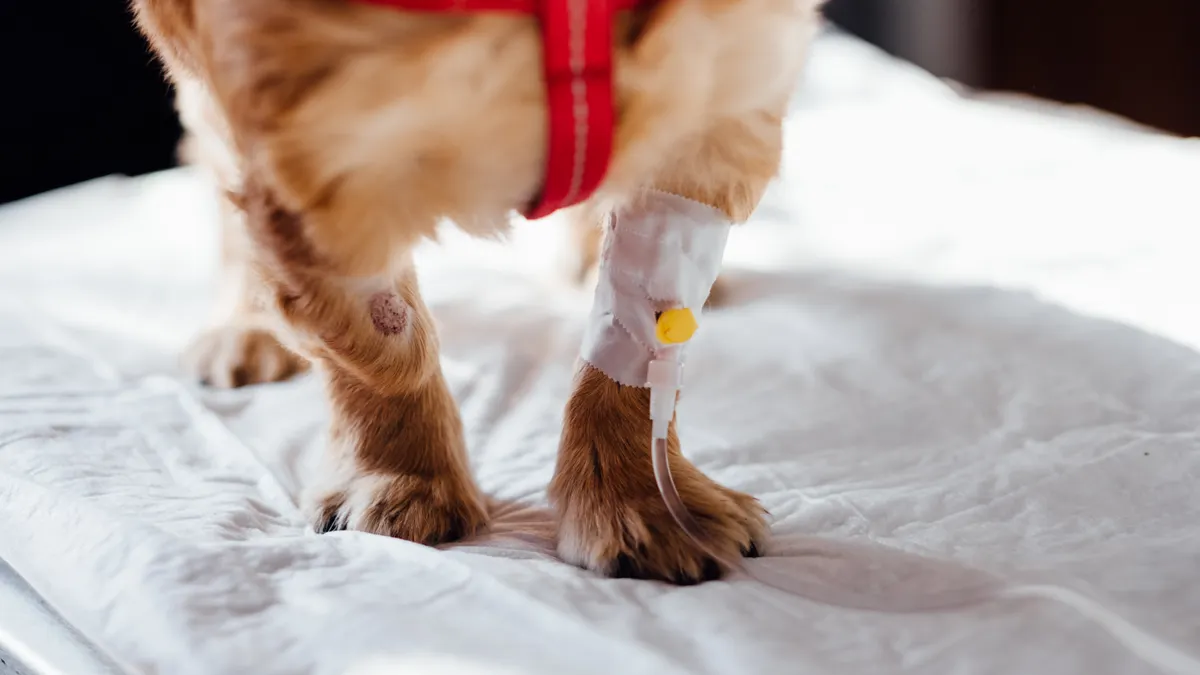
The medical record makes or breaks most emergency claims, not the invoice alone. A bill shows what was charged; the record explains why the pet needed those charges.
The most useful documents are:
- the emergency hospital’s triage sheet
- the exam notes
- lab results and imaging reports
- surgical notes, if any
- the discharge summary
- the itemized invoice
- referral notes from the primary vet, if the case was transferred
The record should show a clean chain: symptom onset, exam findings, diagnosis, treatment, and outcome. If the veterinarian writes “acute onset” or “sudden collapse,” that language supports emergency coverage far better than a vague description like “owner reports not acting right.” If the pet had a known issue before, the record should separate the old problem from the new event when possible.
This is where many claims get complicated. Suppose a dog with mild arthritis suddenly stops using a back leg. The insurer may question whether the visit was for a new injury or for a flare of a chronic issue. A good record might show x-rays, orthopedic exam findings, and a clear statement that the new lameness was consistent with a recent cruciate injury rather than a long-standing degenerative problem. The more precise the exam, the cleaner the claim.
Keep every page. Even one missing lab sheet can slow a claim, because the adjuster may need to verify why anesthesia, hospitalization, or medication was used. If the insurer asks for more detail, answer quickly. Delays can stretch a claim from days into weeks.
How much can urgent and emergency pet coverage decisions cost?
The cost depends on the clinic, the city, the time of day, and how severe the case is. A same-day urgent visit usually costs less than a true emergency visit that includes oxygen, IV catheters, imaging, surgery, or overnight hospitalization, and the gap can be large.
Here is a practical cost framework for typical pet emergency situations:
| Service level | What it may include | Typical cost range |
|---|---|---|
| Urgent care exam | Same-day exam, brief treatment, basic meds | Lower four figures or less in many cases |
| Emergency exam/triage | After-hours exam, stabilization | Often more than urgent care |
| Diagnostics | X-rays, ultrasound, bloodwork, urinalysis | Adds several hundred dollars or more |
| Stabilization | IV fluids, oxygen, injectable meds | Can move quickly into higher-cost territory |
| Hospitalization | Overnight monitoring, repeated treatment | Often the most expensive part |
| Surgery | Foreign body removal, wound repair, fracture work | Can be substantial depending on complexity |
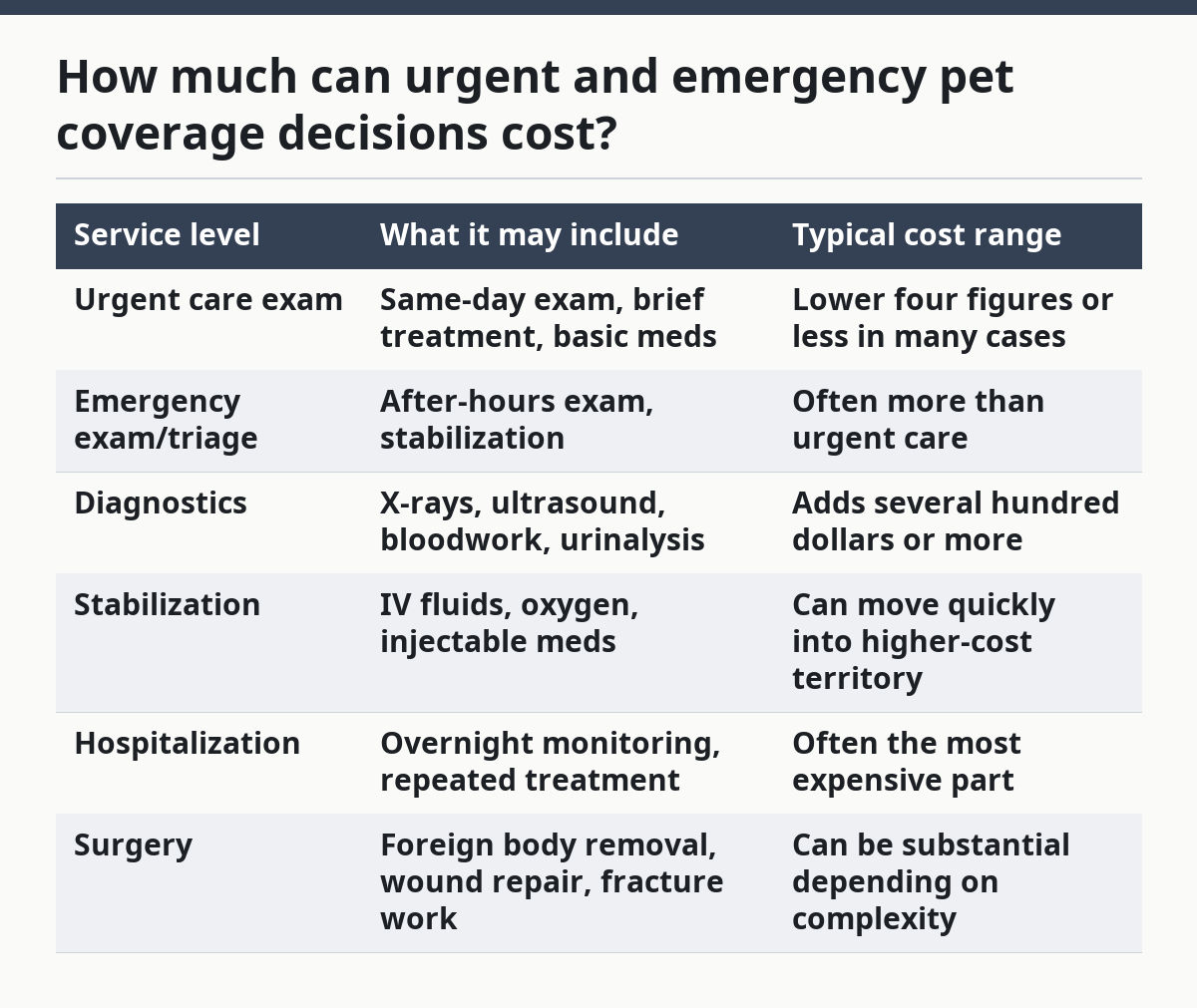
Exact prices vary too much to quote as universal figures without a location, but the structure is consistent: the more minutes, machines, and monitoring involved, the more the bill rises. A seizure case that stops after one dose of medication is not the same as a toxic exposure that needs repeated treatment and hospitalization. A cat with a urinary blockage can start as an urgent exam and become a major emergency within hours.
Insurance changes the math, but not instantly. If a policy has a $500 deductible and 80% reimbursement after the deductible, the owner still pays the upfront bill first unless the hospital offers direct pay or the insurer has a special arrangement. Many plans reimburse after the claim is processed, not at checkout.
That creates a real trade-off. A rich policy can soften a large emergency bill, but it does not remove the need to fund the visit in the moment. A plan with a lower monthly premium may leave the owner paying more on the front end. The right answer depends on whether the household can absorb a sudden $1,000, $3,000, or larger charge without delaying care.
Which policy features matter most in an emergency?
The most important policy features in an emergency are the waiting period, the deductible structure, the reimbursement rate, the annual cap, and the exclusions list. Those five items decide how much of the crisis the policy can actually absorb.
A strong emergency-ready policy usually has:
- a short accident waiting period
- clear coverage for diagnostics and hospitalization
- a deductible the household can realistically meet
- reimbursement terms the owner can understand before the emergency happens
- a limit high enough to handle a serious surgery or multi-day stay
A weak policy may look affordable but fail at the worst moment. A low monthly premium with a high deductible and a low annual limit can leave the owner paying nearly everything in a major emergency. Some policies also restrict hereditary or chronic conditions in a way that surprises people after the first claim. That matters because many “sudden” events have a chronic piece underneath them.
A careful reader should also watch for exam-fee language. Some plans cover treatment but not the emergency exam fee itself. That may sound small until an after-hours visit already includes triage, radiographs, and medication. If the plan excludes the exam fee, the owner still pays the first step in every emergency.
There is one more hard truth: a policy that reimburses 90% after deductible is not automatically better than a policy that reimburses 80% with broader definitions. If the broader plan is less likely to deny a claim for an ambiguous episode, that flexibility can matter more than the headline percentage. The cheapest policy is not the safest choice when the pet’s condition is complex or the pet is older.
This is also where the “who this is not for” answer matters. A policy focused on accidents and sudden illness is not the right tool for someone trying to insure a pet with a known chronic condition and expecting full coverage from day one. For that situation, the policy booklet, the exclusion list, and the veterinarian’s documentation matter far more than marketing language.
How do I avoid claim denials after an emergency?
You avoid many denials by documenting the event as it happens, reading the exclusions before the first claim, and not waiting until the pet is already sick to learn the policy rules. The denial usually starts much earlier than the rejection letter.
The most common avoidable problems are:
- Delayed enrollment. If the policy starts after symptoms began, the claim can fail even if the pet looks fine now.
- Unclear symptom history. If the owner tells one clinic “started today” and another “has been going on for weeks,” the insurer may focus on the inconsistency.
- Missing records. An invoice without the medical notes can leave the claim under-supported.
- Ignoring waiting periods. A condition that appears during the waiting window may be excluded.
- Assuming all urgent care is emergency care. Some clinics are urgent care only, some are emergency hospitals, and billing can differ.
- No itemized bill. A lump sum tells the insurer too little.
The cleanest habit is to ask the clinic for documentation before leaving. If the pet is stable enough, request the discharge summary and itemized invoice the same day. Save emails, photos, and portal messages. If the insurer asks for the date symptoms began, answer with the best known time frame rather than a guess.
A claim can also be hurt by over-explaining. The owner does not need to write a long narrative. A short, factual summary is better: “Onset was around 8 p.m. on 14 May. Pet had repeated vomiting, became weak, and was seen at emergency hospital at 11:15 p.m. Diagnostics and IV fluids were provided.” That style helps the adjuster line up the file.
If the policy denies the claim, ask for the exact clause used and the records reviewed. Then compare the denial reason to the veterinarian’s notes. Sometimes the issue is a coding mistake or missing document rather than a true exclusion. If the insurer offers an appeal process, use it promptly and stay factual.
For legal or financial disputes, a state insurance department, consumer assistance office, or licensed insurance professional may be useful. The owner should not rely on a general article when the policy language and state rules control the result.
Should I use urgent care, emergency care, or my regular vet?
You should use the facility that can safely handle the pet’s condition fastest, and that is not always the cheapest one. If the pet is stable and the problem is same-day but not life-threatening, urgent care or the regular vet may be the better first stop. If the pet may deteriorate within minutes or hours, emergency care is the correct choice.
The regular vet is often the best option for non-crashing problems during office hours. A primary clinic knows the pet’s history, vaccines, chronic issues, and prior imaging. That can help with a claim too, because a clear medical history can separate a new problem from an old one. But if the clinic cannot see the pet until the next day and the pet is worsening now, waiting is a bad bargain.
Urgent care sits in the middle. It is useful for same-day issues that need attention without full emergency-hospital resources. The limit is that not every urgent clinic can handle oxygen therapy, advanced imaging, blood transfusions, or overnight monitoring. If the pet’s condition may need those services, going directly to a full emergency hospital can save time.
A useful rule is this: if you are asking whether the pet can safely wait until morning, call a veterinarian and describe the symptoms. If the answer sounds like “no, not safe,” treat it as an emergency and go now. If the answer is “same-day but stable,” urgent care may be enough. Insurance should follow the medical need, not the other way around.
This decision also affects the claim path. A referral from the regular vet, or a note that the primary clinic advised emergency transfer, can support the urgency of the case. If the pet is seen first at urgent care and then transferred to emergency, keep both records. The two visits may each be part of the same covered episode.
What coverage decision is smartest before an emergency happens?
The smartest decision is to buy or keep a policy that can handle a sudden, expensive episode without forcing a dangerous delay in care. That means reading the waiting periods, exclusions, reimbursement rules, and annual limits before the pet gets hurt.
A practical pre-emergency checklist looks like this:
- confirm the accident and illness waiting periods
- understand whether exam fees are covered
- check if there is a limit on emergency or hospitalization care
- save the insurer’s claim instructions in a phone note
- know the nearest 24-hour emergency hospital and the nearest urgent care clinic
- ask the regular vet for referral procedures, if available
The best time to do this is when the pet is healthy. That is when the owner can compare policy language calmly and decide whether a plan is worth the premium. After the pet is already vomiting, limping, bleeding, or collapsing, the choices shrink fast.
A plain truth belongs here: pet insurance is not a substitute for an emergency fund. Even strong coverage may reimburse later, not pay at checkout. A household that can handle the first bill is in a much better position than one that depends on every claim being approved immediately.
The right emergency coverage decision is not the policy with the flashiest advertisement. It is the policy that matches the pet’s real risks, the family’s cash flow, and the nearest veterinary options. For a young, healthy pet, that may mean broad accident-and-illness coverage with moderate limits. For an older pet or one with known medical issues, the answer may be a plan that is still useful for new injuries but is understood honestly as limited for chronic care.
What a pet owner should remember when the clock is ticking
The emergency decision has two tracks: medical and financial. The medical track comes first every time. The financial track matters, but it should never slow down lifesaving care.
The ideal sequence is simple. Get the pet triaged, keep the records, notify the insurer if the policy requires it, and submit the claim with a clean timeline. If the policy is solid, the file is clear, and the event is truly sudden, the chances of reimbursement are much better than if the owner waits, guesses, or omits details.
The hard part is accepting that insurance can help without making the emergency cheap. A pet that needs surgery, monitoring, or repeated diagnostics can still produce a painful bill. That is not a failure of the policy alone; it is the nature of emergency medicine. The value of coverage is that it gives the owner a better chance to say yes to treatment when the pet needs it most.
What if the insurer says the problem was pre-existing?
The insurer will usually point to earlier symptoms, prior records, or a diagnosis that started before the policy date or waiting period. A clean appeal uses the veterinarian’s notes, not emotion, to show whether the new event was separate from the old one. If the condition truly began earlier, the policy may still cover unrelated emergency care tied to the same visit.
Can I wait for approval before taking my pet to the emergency hospital?
No, not if the pet may be unstable or deteriorating. Emergency treatment should come first, because waiting for approval can make the medical outcome worse and does not guarantee reimbursement. If the pet is stable enough, call the insurer later and ask about claim steps, but do not use that call to delay care.
Is urgent care usually covered the same way as emergency care?
Not always. Some policies treat urgent care as covered treatment if it is medically necessary, while others care more about the diagnosis and the medical record than the clinic label. The safest move is to check the policy wording and save the records that explain why the visit could not wait.
What documents should I ask for before I leave the clinic?
Ask for the itemized invoice, the discharge summary, and any diagnostic reports that are already ready. If possible, get the triage note or the emergency record summary too. Those papers help the claim move faster and reduce the chance of a denial based on missing information.
Should I choose a policy mainly for emergencies?
Yes, if the main worry is being able to afford a sudden crisis. That said, the policy still needs a reasonable deductible, a useful reimbursement rate, and enough annual limit to cover real emergency costs. A policy that looks cheap but fails at the hospital desk is the wrong kind of bargain.
Drafted with AI; not yet reviewed by a person.