Last updated: November 19, 2026
Quick Answer: most pet insurance claim breakdowns can be checked in 4 steps—match the invoice, confirm the covered items, apply the deductible, and verify the reimbursement rate. A pet insurance claim breakdown tells you exactly how the insurer moved from your vet invoice to the final payment or denial. The math usually comes down to covered charges, deductible, reimbursement rate, and any charge adjustments. The steps below will show you how to check each line without guessing. If you’re looking for the broader process, see the Pet Insurance Claims and Payments hub or the pet insurance glossary.
Key Takeaways
- Start with the vet’s invoice and match every line to the insurer’s claim breakdown.
- Check which services were covered, which were excluded, and which charges were reduced.
- The payment formula usually depends on the deductible, reimbursement rate, and policy limits in the benefit schedule.
- A partial payment does not always mean an error; sometimes it means the claim included mixed covered and non-covered items.
- This is information, not financial advice; if your policy wording is unclear, a qualified adviser or the insurer’s claims team can help with your specific situation.
If you need a bigger picture of how claims fit into the rest of the process, the Pet Insurance Claims and Payments hub sits one level up.
What this claim breakdown is for, and what you need in front of you
This claim breakdown is for reading an approved or partly denied claim breakdown line by line, not filing a new claim. It assumes you have the invoice from the vet, the insurer’s claim form or claim summary, and the benefit schedule from the policy. If you only have a denial code and no payment worksheet, this page won’t explain the code itself.
Picture this: you’re staring at three pages of terms, service codes, and dollar amounts, and you only want to know why the payment is lower than the bill. That’s the job here. I’ll show you how to match the line items, spot the deduction points, and tell a normal reduction from a bad calculation.
This is not financial advice, and policy rules vary by country, carrier, and plan year. If the wording in your policy is unclear or your claim involves an exclusion, waiting period, or coordination with another payer, a qualified adviser or the insurer’s claims team should handle the interpretation for your situation.
How to read a pet insurance claim breakdown line by line
You read a pet insurance claim breakdown by tracing one charge at a time from the invoice to the insurer’s calculation, then checking which amounts were covered, adjusted, or excluded. The goal is to verify the payment formula, not to guess at it.
Picture this: the insurer has sent a worksheet with columns for billed amount, allowed amount, deductible, coinsurance, and payment. You’re going to follow each row in the same order the insurer used, so the math stays visible instead of hidden in a lump sum.
- Match the invoice line to the claim line. Start with the vet invoice and find the same service, date, and fee on the claim breakdown. Verify the description, service date, and amount billed; if a line is missing or duplicated, that is a problem.
- Check the covered-service flag. Look for wording that says the item is covered, partially covered, or not covered under the policy. Verify whether the service sits inside the benefit schedule; if the claim sheet treats a covered item as excluded, that is a problem. If the wording is unclear, consult your insurer’s claims team or a qualified adviser and compare it with the policy wording or the benefit schedule guide.
- Find the allowed amount. Some insurers reduce the billed charge to an allowed amount before doing the rest of the math. Verify whether the allowed amount matches the insurer’s listed charge adjustment; if the allowed amount is $0 for a service you expected to count, that is a problem.
- Apply the deductible. The deductible is the amount you pay before reimbursement begins, and it may be annual or per condition depending on the plan. Verify whether the deductible was already met and how much of it was applied on this claim; if the deductible is charged twice for the same covered episode, that is a problem.
- Apply the reimbursement rate. The reimbursement rate is the percentage the plan pays after the deductible, such as 70%, 80%, or another plan-specific level. Verify that the rate used on the worksheet matches the benefit schedule; if the insurer uses a different rate than the policy shows, that is a problem.
- Check the policy limit. The benefit schedule may cap payment per year, per incident, or per condition. Verify whether the claim hit a limit before the full amount could be paid; if the worksheet shows a cap but your policy does not, that is a problem.
- Review non-covered services. Items such as exam fees, grooming, boarding, or other exclusions may appear on the invoice but not count toward payment, depending on the policy. Verify which lines were excluded and why; if a non-covered service was included in the reimbursement math, that is a problem.
- Recalculate the final payment. Use the insurer’s own numbers: allowed amount minus deductible, then multiplied by the reimbursement rate, then reduced by any remaining limit. Verify the final check amount or direct deposit against the worksheet; if the total is off by even a small amount, ask for the calculation detail.
A clean breakdown should show the same service at least twice: once on the invoice and once on the insurer’s worksheet. If the insurer groups several charges together, note the group total and compare it with the source lines one by one. That is where most confusion starts.
What each line item usually means
A pet insurance claim breakdown usually uses the same core labels: billed charge, allowed amount, deductible, reimbursement rate, excluded charge, and payment. The names vary, but the logic is the same. You are checking how each label changes the dollar amount.
Picture this: one line says “office visit,” another says “lab work,” and a third says “not covered.” That mix can make the claim look wrong when it is really just split into covered and uncovered pieces. Once you know the role of each line, the worksheet stops looking like code.
- Billed charge: the amount on the vet’s invoice before any insurance math.
- Allowed amount: the part the insurer accepts for payment calculation after any adjustment.
- Deductible: the amount that comes off before reimbursement starts.
- Reimbursement rate: the percentage the insurer applies after the deductible.
- Non-covered charge: a service the policy excludes, so it does not get paid.
- Payment amount: the final figure the insurer sends after all reductions.
The catch is that some policies reimburse only on certain items inside a visit, not the whole invoice. A $400 invoice can contain a covered test, an excluded exam fee, and a non-covered nail trim. The breakdown should show each line separately or explain how it grouped them.
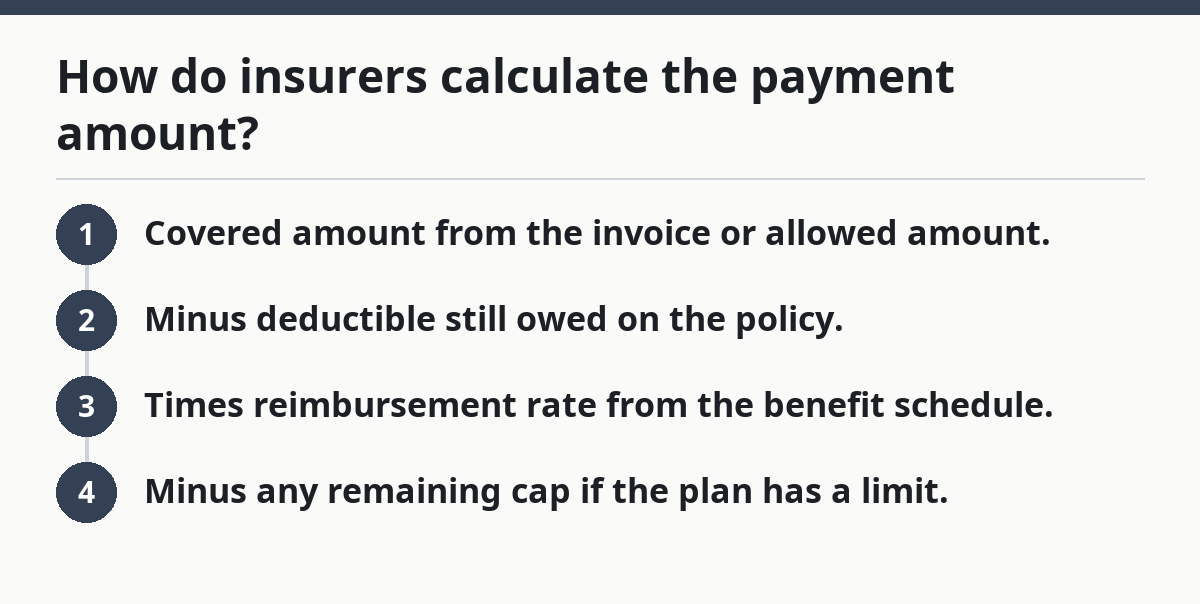
How do insurers calculate the payment amount?
Insurers usually calculate the payment amount by taking the covered charge, subtracting any deductible that still applies, and then multiplying the remainder by the reimbursement rate. After that, they reduce the result for any policy limit or excluded item.
Picture this: the worksheet shows a covered charge of one amount, a deductible balance of another, and a percentage in the benefit schedule. You are not trying to reinvent the insurer’s system; you are checking that the same formula was used on every covered line and that the numbers match the policy terms.
Here’s the structure to look for:
- Covered amount from the invoice or allowed amount.
- Minus deductible still owed on the policy.
- Times reimbursement rate from the benefit schedule.
- Minus any remaining cap if the plan has a limit.
If the insurer uses a different base amount than the invoice, ask what charge adjustment applied. Some plans calculate on the allowed amount, not the full billed charge. That distinction can change the result a lot, especially on higher-cost visits.
What to check before you decide the breakdown is wrong
A pet insurance breakdown is often correct even when it looks small, because exclusions, limits, and deductibles can shrink the payment fast. The first job is to compare the insurer’s worksheet with the policy wording, not with your memory of what “should” be covered.
Picture this: you think the insurer missed a charge, but the line was actually marked as non-covered in the benefit schedule. Or the deductible was already partly met on an earlier claim from the same policy year. Those details change the answer.
Check these items first:
- Benefit schedule: confirm the reimbursement rate, annual limit, and deductible type.
- Invoice dates: verify the service date falls inside the policy period.
- Covered-services list: check whether the item is inside or outside the policy scope.
- Claim form details: make sure the pet, condition, and dates are entered correctly.
- Charge adjustments: see whether the insurer reduced the billed amount before payment.
If the worksheet and the policy still do not line up after those checks, ask the insurer for the claim calculation detail in writing. That is better than guessing from a single summary line, and it is often the fastest way to see whether the breakdown is correct.
When this approach stops working
This line-by-line method stops working when the breakdown is missing, when the policy wording is unclear, or when another payer changes the order of payment. In those cases, the right move is to ask the insurer for the full calculation or get qualified help with the policy interpretation.
Picture this: you have a denial, a partial payment, and a worksheet with no clear labels. You can still spot obvious errors, but you cannot safely infer the rest. That is where the limits of self-reading show up.
The breakdown does not list the invoice lines: you cannot verify which service got reduced — request a line-item worksheet from the insurer.
The deductible type is unclear: you cannot tell whether the plan uses annual or per-condition math — check the policy wording before recalculating.
The claim mixes covered and non-covered items: the payment may be correct even if the total looks low — separate the excluded charges first.
The insurer applied a cap: the worksheet may be correct but incomplete to you — look for the remaining limit on the benefit schedule.
A second payer is involved: the payment order may change the result — ask for the coordination rules that apply to your policy.
If any of those situations apply, the breakdown is no longer a simple reading exercise. The math may still be explainable, but it needs the policy language in front of it.
The mistakes people make with claim breakdowns
People usually misread claim breakdowns in the same few ways, and each one leads to the wrong reaction. The fix is usually a better comparison, not a new assumption.
Picture this: you spot a low payment and assume the insurer ignored the whole invoice. In many cases, the insurer only paid the covered portion, applied the deductible, and then stopped at the plan limit. That is annoying, but it is not the same as an error.
-
Comparing the payment to the full invoice.
This makes covered and non-covered charges look mixed up. Compare only the covered lines and the allowed amount. -
Ignoring the deductible balance.
This makes the payment look too small. Check how much deductible was already used earlier in the policy year. -
Missing the reimbursement rate.
A 70% plan and an 80% plan will pay different amounts on the same claim. Match the rate to the benefit schedule. -
Assuming every vet charge is covered.
Exam fees, wellness items, and other exclusions can stay on the invoice but off the payment. Read the covered-services list line by line. -
Not checking service dates.
A visit that falls outside the policy period will not pay, even if the diagnosis is covered. Verify the date first. -
Overlooking a policy cap.
If the annual limit is used up, the breakdown may be mathematically right and still disappointing. Look for a limit line before you call it a mistake.
What a good claim breakdown looks like
A good claim breakdown is clear enough that you can trace one invoice line to one payment result without guessing. The worksheet should show the covered amount, the deductible applied, the reimbursement rate, and the final payment in a way that matches the benefit schedule.
Picture this: you can point to every dollar and say where it went. The charge adjustment is visible, the excluded items are labeled, and the final amount adds up. That is a clean claim breakdown.
A strong breakdown usually has these signs:
- each service line is named clearly
- the covered amount is separate from the excluded amount
- the deductible balance is shown or explainable
- the reimbursement rate matches the policy
- the payment total can be recalculated from the page
If you cannot follow the chain from invoice to payment in under 10 minutes, the paperwork is probably too vague. Ask for the calculation detail, because a simple summary is not enough when the payment looks off.
What does each line on a claim mean?
Each line on a claim shows one service, one adjustment, or one payment step. The billed amount comes from the invoice, the allowed amount comes from the insurer’s rules, and the payment line shows what was actually reimbursed.
The key is to read the lines in order, not as separate mysteries. A line marked “not covered” can explain why a visit was only partly paid, while a deductible line shows what the policyholder still had to absorb.
How do insurers calculate the payment amount?
Insurers usually calculate payment by starting with the covered charge, subtracting the deductible that still applies, and then applying the reimbursement rate from the benefit schedule. If the policy has a limit, they stop when that cap is reached.
The result can be lower than the invoice because the insurer may not pay every charge on the bill. Non-covered services, charge adjustments, and policy limits all affect the final amount.
Why was only part of the bill covered?
Only part of the bill was covered because the rest of the invoice likely fell outside the policy terms, hit the deductible, or ran into a limit. Mixed invoices are common, especially when a vet visit includes both treatment and excluded extras. If the wording is unclear, consult your insurer’s claims team or a qualified adviser and compare the invoice with the policy wording.
The fastest way to confirm is to separate the invoice into covered and non-covered items, then compare that split with the claim breakdown and benefit schedule.
Drafted with AI; not yet reviewed by a person.