Last updated: November 19, 2026
Quick answer: pet insurance usually can cover an after-hours veterinary visit, but the clock alone does not decide coverage. The medical reason for the visit, the clinic’s policy, and the insurer’s policy language matter more than whether you arrived at 7 p.m., 11 p.m., or on a Sunday.
Key Takeaways
- Often yes, if the condition is covered; the visit time alone usually is not the deciding factor.
- Night, weekend, and holiday charges can change the bill because clinics may bill them separately.
- Check the wording for veterinary fees, surcharge exclusions, and any emergency or urgent-care limits.
- Claims are often reviewed line by line, so one line can be covered while another is not.
In short: an after-hours vet visit can be covered if the plan would cover the condition, but extra fees such as a night clinic fee, weekend appointment surcharge, or holiday emergency charge may be handled differently by different insurers. This is information, not financial advice; for your own policy and claim situation, a qualified adviser or your insurer’s claims team should confirm the details.
What this answer applies to
This applies to a pet owner trying to figure out whether the timing of the visit changes pet insurance coverage, especially when a veterinary clinic bills differently after normal office hours. It assumes you already have a policy, or you are reading the policy wording before a visit, and that you want to know what part of the bill may be reimbursed.
It does not assume the visit is an emergency, because timing and urgency are not the same thing. A 24-hour hospital, a regular veterinary clinic with evening hours, and a same-day weekend appointment can all produce different charges. The same policy may treat the vet bill, the after-hours fee, and the office-hours policy as separate pieces of the claim, so consult a professional or your insurer for your own case.
A generic article often gets this wrong by speaking as if “after-hours” were one category. It is not. A 6 p.m. appointment in a clinic that stays open late is not the same as a 2 a.m. emergency hospital visit, and a holiday surcharge is not the same as a standard consultation fee.
If you want the broader picture of how emergency coverage fits together, the hub on pet insurance emergency coverage is the right place to start, then come back here for the timing question.
Does pet insurance cover an after-hours vet visit?
Yes, often it can, but the visit time itself is usually not the deciding factor.
Most pet insurance policies look at what happened to the pet and whether the treatment fits the plan’s covered conditions, exclusions, deductible, and reimbursement rules. Most policies do this, but you should consult a professional or check your policy wording for your own claim. That means an after-hours vet visit may be covered if the underlying problem is covered. A broken leg at 9 p.m. is not treated differently just because the front desk is closed at 5 p.m. A sore paw at 8 a.m. is not automatically covered just because it happens during office hours.
The catch is that insurers may handle separate line items differently. The examination fee, diagnostic tests, medication, and procedure charges may be treated differently from an after-hours fee or holiday surcharge, but consult a professional or the insurer because policy wording controls. Some policies reimburse the whole eligible invoice; others reimburse the covered treatment but exclude certain administrative or premium timing charges. The wording matters more than the day of the week.
The cleanest way to think about it is this: pet insurance usually follows the medical event, not the calendar. The calendar can still change the price of the visit, and that price change can affect how much is paid back.
Why the timing of the visit can change the bill
The timing of the visit can change the bill because veterinary clinics often add separate charges for nights, weekends, and holidays.
A veterinary clinic may have one fee structure for regular office hours and another for after-hours care. That can show up as a night clinic fee, a weekend appointment surcharge, or a holiday emergency charge. Those charges are not the same thing as treatment. They reflect staffing, access, and operating hours.
Here is the practical problem: insurance is usually built to cover veterinary care, not every fee attached to that care. If the policy defines “covered veterinary expenses” narrowly, the after-hours portion may be excluded even when the exam and treatment are covered. If the policy uses broader language, the whole invoice may be eligible, subject to deductible and reimbursement terms.
A reader should also watch for office hours policies that change what counts as a “scheduled visit.” A 6 p.m. appointment booked in advance may be billed differently from an unscheduled walk-in at 10 p.m. Some clinics run a daytime practice and a separate emergency service under the same roof. That distinction matters because the invoice may bundle ordinary care with premium timing charges.
The main point is simple: timing can change the cost, and cost structure can change reimbursement. Timing alone does not create coverage, and it does not always remove it either.
What to check on your policy before the visit
You should check the policy wording for covered veterinary fees, exclusions for surcharges, and any separate limit on emergency or urgent care charges.
Start with the declarations page and the benefits section, then read the definitions section. Terms such as “veterinary fee,” “emergency treatment,” “additional charges,” and “out-of-hours service” can carry specific meanings. A policy may sound broad in marketing language and narrow in the contract language.
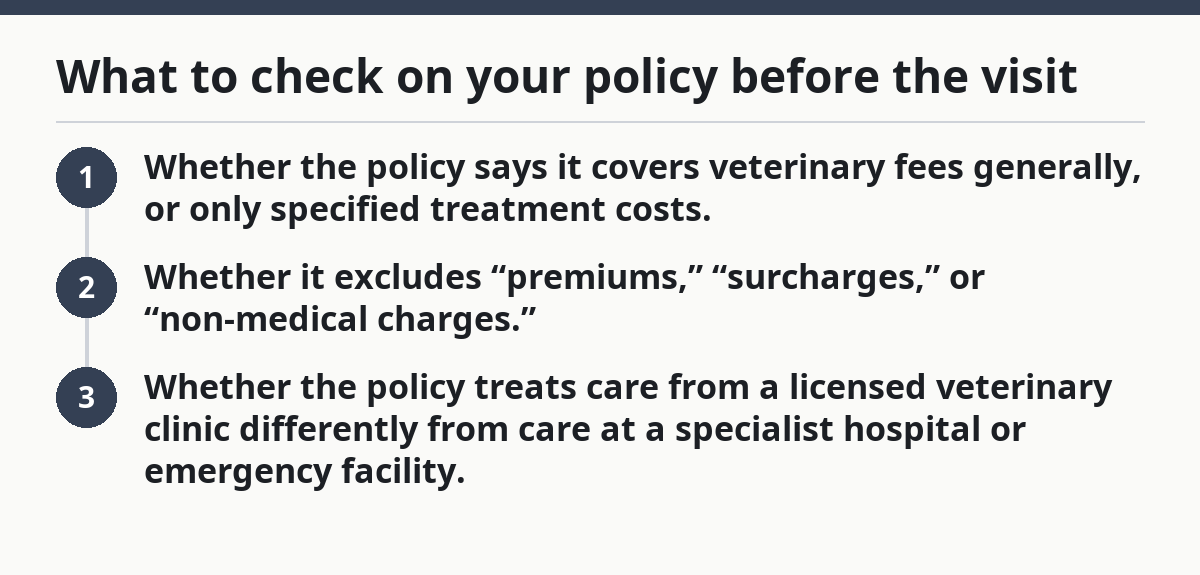
Pay attention to three lines in particular:
- Whether the policy says it covers veterinary fees generally, or only specified treatment costs.
- Whether it excludes “premiums,” “surcharges,” or “non-medical charges.”
- Whether the policy treats care from a licensed veterinary clinic differently from care at a specialist hospital or emergency facility.
If the policy is not clear, the safest assumption is not that the surcharge will be reimbursed. Ask the insurer to identify how it handles after-hours fees, weekend appointment fees, and holiday surcharge amounts before the bill is large.
This is also where geography matters. Insurance terms vary by country, and some regions regulate policy wording more tightly than others. A term that is common in one market may not appear in another. A qualified adviser or the insurer’s licensed support staff should confirm how the policy works in your jurisdiction.
How the claim usually maps to the invoice
The claim usually maps to the invoice line by line, with some lines eligible and others not.
A typical invoice from a veterinary clinic may include the consultation, a triage fee, diagnostics, medication, and a separate after-hours fee. The insurer then compares each charge against the policy terms. If the treatment is covered, the consult and treatment lines may be eligible. If the policy excludes premium timing charges, the after-hours fee may be left out even though the medical care is approved.
Here is the practical process to follow:
- Ask the clinic for an itemized invoice with each charge listed separately. Verify that the after-hours fee, weekend appointment fee, or holiday surcharge is shown on its own line. If the bill is a single lump sum, that is a problem because you cannot tell what the insurer may exclude.
- Check the appointment type against the clinic’s office hours policy. Verify whether it was a scheduled evening visit, a weekend slot, or a true emergency-hours visit. If the clinic labels it one way and the bill labels it another, that mismatch can delay review.
- Read the policy’s definition of covered veterinary expenses. Verify whether it includes consultation fees and diagnostics, or only treatment costs. If the wording is vague, that is a warning sign that the timing fee may be disputed.
- Look for exclusions tied to “convenience,” “premiums,” “surcharges,” or “out-of-hours services.” Verify whether the policy names these charges directly. If it does, the insurer has likely reserved the right to exclude them.
- Check whether the plan has separate rules for emergency care, urgent care, and specialist care. Verify which category the clinic placed the visit in. If the clinic is a 24-hour hospital but the policy covers only standard practice fees, the classification matters.
- Confirm whether your deductible has already been met for the policy period. Verify the claim date, not just the visit date. If the deductible has not been met, a covered visit may still produce little or no reimbursement.
- Save the invoice, medical notes, and any referral or triage paperwork. Verify that the insurer can match the diagnosis to the bill. If the records are incomplete, the claim may be delayed or partially declined.
- Ask the insurer, in writing if possible, how it treats the after-hours line item. Verify the answer before you submit if the bill is large. If support gives a different answer from the policy wording, the policy text usually controls.
The goal is not to guess whether “after-hours” is covered. The goal is to separate the covered care from the timing surcharge and see which part the insurer will review.
When the standard answer does not apply
The standard answer does not apply when the invoice bundles several different services into one charge, when the clinic is a separate emergency hospital, or when the policy has a specific exclusion for timing-related fees.
Bundle billing with one flat emergency charge: This hides the after-hours fee inside a single amount — ask for a line-item invoice before filing the claim. If the clinic will not split the charge, the insurer may reimburse only part of it, or may need extra documentation.
Holiday or overnight care billed under a special facility code: This may be treated differently from a normal consultation — confirm whether the code is classed as medical care or a premium service. A holiday surcharge can be excluded even when the exam is eligible.
Policy language excludes “additional fees” or “convenience charges”: The visit may still be covered, but the timing charge may not be — expect a smaller reimbursement than the total bill. If the wording is explicit, arguing the clock rarely helps.
The visit was booked as a routine weekend appointment, not urgent care: The insurer may still cover the veterinary treatment, but the clinic’s weekend surcharge may be treated as a non-medical add-on — verify the invoice detail. A Saturday 10 a.m. slot can still carry a premium.
The clinic is outside the insurer’s network rules, if the policy uses them: Coverage can be affected by provider type, even if the pet was seen after hours — check whether the plan requires a licensed veterinary clinic or specialist authorization. This is more common in structured plans with stricter claim rules.
The policy has a waiting period or pre-existing condition issue: The timing of the visit will not fix that — the claim can still be declined for a separate policy reason. If the underlying condition is excluded, the after-hours clock does not change the result.
These are the situations where a general yes-or-no answer is not enough. The invoice structure and the policy wording matter more than the hour on the wall.
Common mistakes that reduce reimbursement
The most common mistake is assuming that an after-hours charge and a covered treatment are the same thing. They are not. The consequence is a surprise denial or a smaller payment than expected. The better approach is to separate the medical line items from the timing surcharge.
Another mistake is letting the clinic write a vague invoice. If the bill only says “ER visit” or “night service,” the insurer may ask for more detail. The consequence is delay. The better approach is to ask for itemized charges, including the exam, drugs, tests, and any holiday surcharge.
A third mistake is reading only the marketing page of the policy. That page may say “covers vet visits,” while the contract excludes extra fees. The consequence is disappointment at claim time. The better approach is to search the policy wording for exclusions and definitions, even if the text is dry.
A fourth mistake is treating a weekend appointment as automatically covered because it was not a true emergency. That is not how the policy works. The consequence is confusion over whether the insurer is rejecting the treatment or only the timing fee. The better approach is to ask which specific charge is under review.
A fifth mistake is waiting until the invoice arrives to ask questions. By then, the visit has already happened and the clinic’s billing codes may be fixed. The consequence is less room to correct errors. The better approach is to ask the insurer or clinic before the bill is finalized if the visit is planned.
What a useful answer looks like in real life
A useful answer is specific enough to separate the visit from the bill.
If the pet is seen at 9:30 p.m. on a weekday at a veterinary clinic that charges a night clinic fee, the right question is not “Is after-hours care covered?” The right question is “Does this policy reimburse the exam and treatment, and does it exclude the night fee?” That is the difference between a meaningful claim review and a vague guess.
If the visit happens on a Sunday morning and the clinic labels it a weekend appointment, the same logic applies. The visit time may trigger a surcharge, but the medical care still follows the policy’s normal coverage rules.
If the visit happens on a public holiday and the bill includes a holiday surcharge, that line item deserves special attention. Holiday charges are often where the policy wording matters most, because the fee is tied to timing rather than medicine.
For a broader explanation of how these categories fit together, the pet insurance emergency coverage hub is the right companion page. This page stays focused on the timing question so the bigger emergency rules do not blur the answer.
FAQ
Are weekend vet visits covered by pet insurance?
Often, yes, if the policy covers the underlying treatment. Weekend timing alone usually does not decide coverage. The tougher question is whether the insurer will reimburse a weekend appointment surcharge or only the medical portion of the invoice. That depends on the policy wording and the clinic’s billing setup.
Are after-hours fees reimbursed by pet insurance?
Sometimes, but not always. Many policies cover veterinary treatment while excluding extra timing charges such as a night clinic fee or holiday surcharge. The itemized invoice matters here. If the after-hours amount is separated from the exam and treatment, the insurer can review it more precisely.
Does the time of day affect coverage?
Usually, the time of day affects the bill more than the eligibility of the treatment. A 2 p.m. visit and a 10 p.m. visit may both be eligible if the condition is covered. The difference is that after-hours timing can trigger extra fees, and those fees may be treated differently by the insurer.
Drafted with AI; not yet reviewed by a person.