Last updated: November 19, 2026
Quick answer: yes, you can often insure multiple pets under one account, but many insurers still issue separate policies for each pet. In practice, that means the answer to Can You Insure Multiple Pets Under One Policy or Account? is often “one account, more than one policy.”
Key Takeaways
- You can often put multiple pets in one account, while the insurance itself is usually still separate per pet.
- Many households use one login for several pets, with separate policies behind it.
- A multi-pet discount is usually a pricing break for adding another pet, not a change in claims handling.
- Separate policies mean separate moving parts, even when the account looks unified.
This guide sorts out what that means, how multi-pet discounts usually work, and what changes when renewal dates and billing are shared.
The short answer on one policy vs. one account
You can often put multiple pets in one policy account, but the insurance itself is usually still one policy per pet. That distinction matters because a policy is the contract for one animal, while an account is the admin folder that holds billing, renewals, and documents.
Because of that, the answer to Can You Insure Multiple Pets Under One Policy or Account? depends on whether you mean the dashboard or the contract. Picture this: you have a dog and a cat, and you want one login, one bill, and less paperwork. That setup is common, but the details depend on the pet insurer and the plan structure. If you want the basics of pet cover first, the hub on pet insurance basics is the better starting point.
- One account: one login, one dashboard, and often one payment method.
- Separate policies: each pet has its own cover limits, waiting periods, and claim history.
- Multi-pet discount: a pricing adjustment some insurers give when you insure more than one pet.
Here’s the catch: the discount does not usually merge the pets into one shared pool of cover. A cat’s claim still sits on the cat’s policy, and the dog’s policy stands on its own.
Can you insure multiple pets under one policy account?
Yes, and this is the setup many households actually use. The account is the admin layer; the policy is the legal layer. That means you may see one dashboard for a dog and a cat, but two separate policy documents behind it.
As a result, Can You Insure Multiple Pets Under One Policy or Account? is usually an account question first and a coverage question second. Picture this: you log in on a Sunday night and see both pets on the same screen. You can usually download both certificates, update a card once, and track both renewal dates without opening two different portals. That said, the insurer may still price, underwrite, and renew each pet separately.
A few terms help here:
- Policy account: the online record that holds billing and contact details.
- Policy term: the covered period, often 12 months, before renewal.
- Renewal date: the day the insurer reviews and extends the policy, if you keep it.
Shared account management can cut down on missed payments. The trade-off is that if the account owner changes a card or address, both pets can be affected at once.
How multi-pet discounts usually work
A multi-pet discount is usually a pricing break for adding another pet to the same household account, not a change in how claims are handled. The discount often applies when you insure a second dog, a cat, or both with the same insurer.
In other words, Can You Insure Multiple Pets Under One Policy or Account? often comes with a rate change, not a cover change. Picture this: you already have one policy running, and the insurer offers a lower rate for the second pet if you keep both under the same account. That can simplify billing, but it does not mean the second pet gets the same premium, the same exclusions, or the same renewal timing as the first.
Common features of a multi-pet discount:
- It may apply only if the pets are in the same household.
- It may disappear if one pet cancels.
- It may be tied to automatic billing.
- It may not stack with every other promotion.
Don’t assume the discount changes cover quality. It often changes the price structure, not the policy terms. If an insurer advertises a multi-pet discount, the real questions are whether each pet still has separate limits, separate excesses, and separate underwriting.
What changes when each pet has a separate policy?
Separate policies mean separate moving parts, even if the account looks unified. The dog can have one renewal date, one waiting period, and one claim history, while the cat has another. That is normal.
So when people ask Can You Insure Multiple Pets Under One Policy or Account?, the practical issue is usually how separate those moving parts remain. Picture this: your dog has been insured for 2 years, your cat for 3 months. If the insurer uses separate policies, the dog’s policy may renew on one date and the cat’s on another. A claim on one animal should not drain the other animal’s coverage, because the policies do not share a common pot.
What to check before you enroll:
- Whether each pet gets its own policy number.
- Whether each pet has its own annual limit.
- Whether the excess or deductible is charged per pet or per claim.
- Whether conditions are covered after the first policy term.
- Whether a vet visit for one pet can affect the other pet’s premium.
This is where many people get tripped up. They hear “one account” and assume “one policy.” Not the same thing. A shared login is admin convenience, not shared cover.
Billing for multiple pets: one card, two policies, one due date?
Billing can be grouped, split, or mixed, and that is where account setup matters most. Some insurers bill both pets on one card through one account, while others issue separate charges for separate policies. Either way, the billing method is an admin choice, not proof that the cover itself is merged.
Because billing and cover can diverge, Can You Insure Multiple Pets Under One Policy or Account? is also a payments question. Picture this: you set up two pets on the same account and expect one monthly charge. That may happen, but the insurer may also separate the payments by policy. If one payment fails, one pet could lapse while the other stays active.
A practical check list:
- Confirm whether the insurer uses one invoice or two invoices.
- Look for one renewal date or separate ones.
- Ask whether payment failure on one policy affects the other.
- Check whether changing cards updates both pets at once.
- Save both policy numbers in a secure place and confirm the process with the insurer or a qualified adviser, using the insurer’s policy documents. See the NAIC consumer guide to insurance and your insurer’s terms for details.
This is the part people overlook until renewal week. A shared account makes life easier, but it can also hide two separate deadlines. Miss one payment, and you may not notice until a claim is denied.
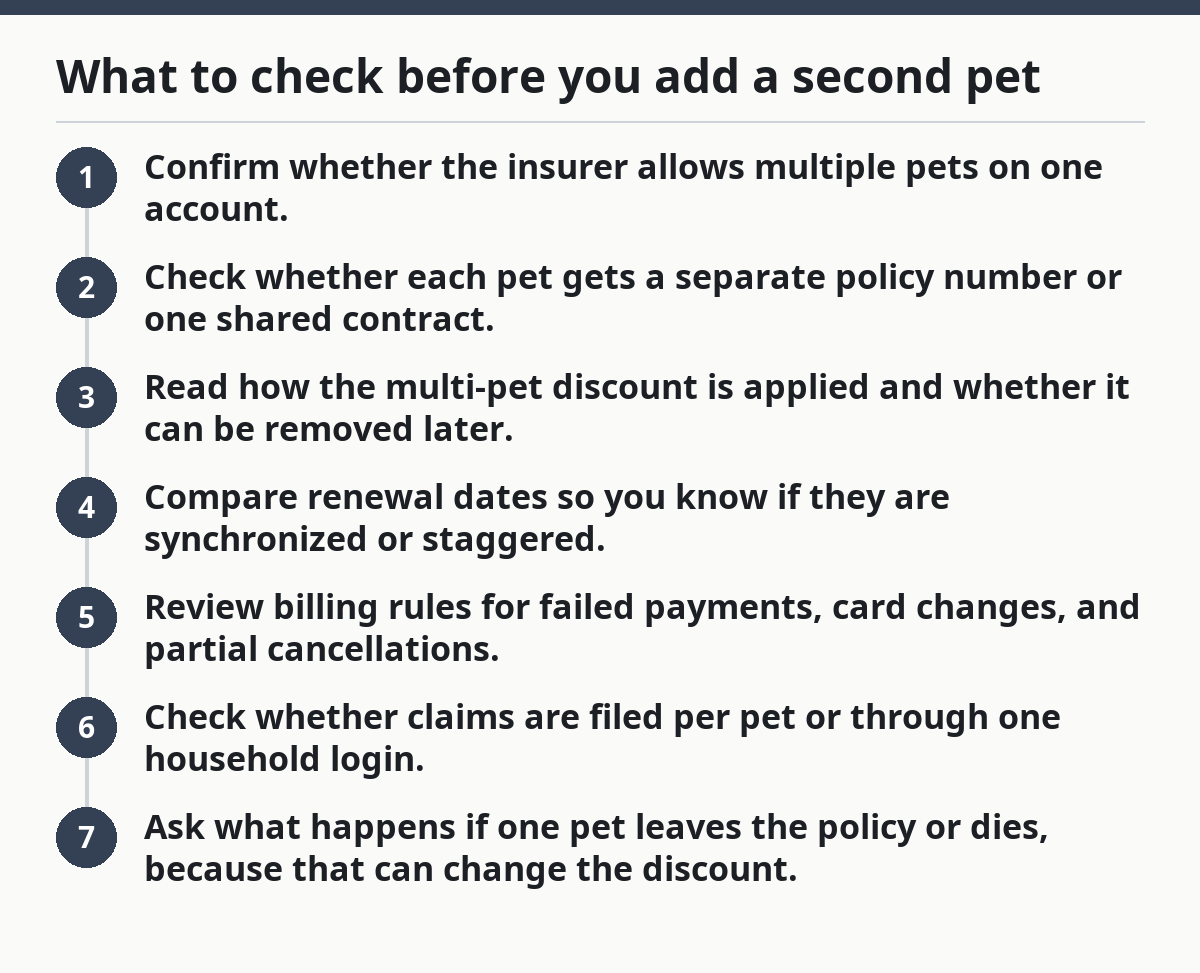
What to check before you add a second pet
You should check the policy structure, the billing setup, and the renewal rules before you add another dog or cat. The cleanest account is not always the clearest cover.
When Can You Insure Multiple Pets Under One Policy or Account? looks simple on the surface, the details still matter. Picture this: you already have one pet insured and now you want to add another. The insurer may ask for the pet’s age, breed, species, microchip status, or vet history. Those details can change whether the pet fits the existing account setup and whether the discount applies.
Use this order:
- Confirm whether the insurer allows multiple pets on one account.
- Check whether each pet gets a separate policy number or one shared contract.
- Read how the multi-pet discount is applied and whether it can be removed later.
- Compare renewal dates so you know if they are synchronized or staggered.
- Review billing rules for failed payments, card changes, and partial cancellations.
- Check whether claims are filed per pet or through one household login.
- Ask what happens if one pet leaves the policy or dies, because that can change the discount.
What indicates a problem? Vague language like “household pets” without policy numbers, billing terms, or separate renewal details. Clear admin language is a good sign. Fuzzy wording is not.
When the standard setup does not fit
The standard setup does not fit when the insurer treats each animal as a separate risk and won’t bundle the account in any useful way. That can happen with certain breeds, older pets, or pets with different cover needs.
That is why Can You Insure Multiple Pets Under One Policy or Account? sometimes has a qualified answer rather than a simple yes. Picture this: one pet is a young cat and the other is an older dog with a long medical file. The insurer may still let you hold both policies, but the pricing and renewal logic can diverge enough that the account feels like two separate plans with one login.
Stop and rethink the setup in these cases:
- The pets are in different households: the account may not be eligible for a multi-pet discount.
- One pet is already on a different insurer: moving it could reset waiting periods.
- The insurer uses separate billing cycles: one missed payment could affect one pet only.
- The policy terms are different by species: dog and cat cover may not be treated the same; check the insurer’s wording or a qualified adviser.
- The account owner changes often: shared billing can become messy fast.
On the other hand, if you mainly want clean admin and the insurer supports it, a single account can be easier to manage than two unrelated logins.
The mistakes people make with multi-pet cover
The biggest mistake is assuming one account means one shared policy. That can create false expectations about claims, limits, and renewal timing.
Because the account only handles administration, Can You Insure Multiple Pets Under One Policy or Account? is easy to misread if you stop at the dashboard. Picture this: you add a cat to the same dashboard as your dog and think any claim can be pooled across both pets. It usually cannot. Each animal still stands on its own policy terms, and that affects how claims are paid.
Common errors and what they cost:
- Assuming cover is shared: one pet’s unused limit usually does not transfer to the other.
- Ignoring separate renewal dates: missed deadlines can cause a gap in cover.
- Not checking payment rules: one failed card charge can create a lapse.
- Skipping the discount terms: the multi-pet discount can change if one pet cancels.
- Mixing up account access and cover: a shared login does not change the legal policy terms.
The correct alternative is simple: treat the account as the filing cabinet and each pet as its own contract. That mindset prevents most billing and renewal problems.
The practical answer for dog-and-cat households
A dog-and-cat household can often run under one account, but the insurance is still usually separate under the hood. That is the most useful way to think about it.
So, for Can You Insure Multiple Pets Under One Policy or Account?, the practical answer is often “yes, one account, separate cover.” Picture this: you want one place to manage a dog, a cat, and the monthly bill. A multi-pet setup can do that, as long as you know whether the insurer gives one account with two policies, or one policy account with separate cover records.
A good setup should let you:
- see both pets in one login,
- track each renewal date,
- file claims for the right animal,
- and understand whether the discount is tied to both pets staying active.
That is the operational difference that matters. The label on the website matters less than the policy documents and billing rules you can actually use.
Final take
A multi-pet insurance setup is usually easiest when the insurer keeps the admin in one account and the cover in separate policies. That gives you cleaner billing without pretending two pets are one risk.
Ultimately, Can You Insure Multiple Pets Under One Policy or Account? is best answered by the insurer’s wording, not the dashboard alone. The wrong setup is the one that hides separate rules behind a single screen. If you cannot tell how claims, renewals, and payments are split, keep asking until the insurer makes it plain.
Your own situation can differ by country, insurer, and policy wording, so a qualified adviser or the insurer’s own policy documents should guide the final choice.
Do multiple pets need separate policies?
Usually, yes. Each pet is often under its own policy even if both pets sit in the same account. That means the dog and cat can have different premiums, claim histories, waiting periods, and renewal dates. A shared account does not automatically mean shared cover.
Can I manage multiple pets in one account?
Usually, yes. Many pet insurers let you use one login or policy account to manage several pets, which makes billing and renewal tracking easier. The account is the admin layer, though, so you still need to check whether each pet has its own policy number and billing cycle.
Do multi-pet discounts change coverage?
No, a multi-pet discount usually changes price, not cover terms. The discount is often just a pricing adjustment for insuring more than one pet with the same insurer. You still need to check each pet’s limits, exclusions, and renewal terms, because those usually stay separate.
Drafted with AI; not yet reviewed by a person.