Last updated: November 29, 2026
How Percentage-Based vs Fixed-Dollar Cost Sharing Differs in Pet Insurance
Quick Answer: percentage-based cost sharing can be 35% of a covered bill, while fixed-dollar cost sharing stays at one set amount. How percentage-based vs fixed-dollar cost sharing differs in pet insurance is a choice between a set copay-like amount and a reimbursement-style split that changes with the bill. This article is information, not financial advice, and a qualified adviser or veterinarian should be consulted for a pet owner’s own situation.
For a plain-language definition of percentage, see Britannica’s percentage entry.
Key takeaways
- Fixed-dollar cost sharing gives the same dollar amount each time, so the bill is easier to forecast.
- Percentage-based cost sharing changes with the claim size, so the insurer and the pet owner each pay a share of the same bill.
- The main difference is not the pet’s care; it is how the remaining cost is split after the covered claim is calculated.
- Fixed-dollar setups can be simpler on paper, but they can also leave the pet owner paying more on a high bill.
- Percentage-based setups can keep the insurer’s share tied to the size of the claim, which can make the plan feel more flexible but less predictable.
What is the real difference?
The real difference is that fixed-dollar cost sharing uses one set dollar amount, while percentage-based cost sharing uses a slice of the bill. In pet insurance, that means the same claim can leave very different out-of-pocket amounts depending on which structure the policy uses.
A percentage must always be relative to a total that equals 100%, according to Britannica’s percentage entry. That is the core idea here: percentage-based cost sharing treats the claim as the total, then splits the covered amount by a percentage, so a qualified adviser can help a pet owner map the numbers to a specific policy. Fixed-dollar cost sharing does not depend on the bill size in the same way.
That difference matters because a set dollar amount is easier to plan around. A percentage changes when the claim changes. If the covered bill is larger, the owner’s share is larger too; if the covered bill is smaller, the owner’s share is smaller. The structure is the decision, not the pet’s diagnosis.
How does fixed-dollar cost sharing work?
Fixed-dollar cost sharing works by using one dollar amount that stays constant for the policy design. That makes it the clearer option for people who want a bill they can picture without doing percentage math.
A simple comparison helps. If 25 out of 100 cars are white, that is 25% of the garage, according to Calculator.net and PercentageCalculator.net. The point is not the cars; it is the count against the whole. Fixed-dollar cost sharing does not work that way. It behaves more like a flat amount that does not change just because the claim is bigger.
This structure wins for predictability. A pet owner can usually understand the spending pattern more quickly because the cost does not rise and fall with claim size in the same way a percentage does. The weakness is just as clear: a fixed amount can feel fair on a small claim and harsh on a large one, because the same dollar amount can be a much larger share of a small bill than of a large bill.
Who it fits best: people who value simple planning, hate surprise calculations, and want the cost-sharing part of the policy to feel stable from claim to claim. Who should skip it: anyone who expects large, frequent claims and wants the insurer’s share to scale more naturally with the bill.
How does percentage-based cost sharing work?
Percentage-based cost sharing works by splitting the covered bill into percentages, so the amount each side pays changes with the size of the claim. That is why these policies are often easier to describe as reimbursement structures than as flat copays.
The math idea is straightforward. According to Calculator.net, 35% is equivalent to the decimal 0.35, and when a percentage is in decimal form it must be multiplied by 100 to convert it back to a percent. That kind of conversion is the same logic behind percentage-based claim sharing: the percentage only means something when it is tied to the total bill.
This structure wins when the reader wants the policy to scale with the claim instead of staying fixed. It is also the more transparent option for people comfortable with percentages, because the bill follows the same rule every time. The downside is predictability. A claim that is twice as large can produce a much larger out-of-pocket amount, even if the percentage itself never changes.
Who it fits best: people who are comfortable thinking in percentages, expect mixed-size claims, and want the split to move with the bill. Who should skip it: anyone who wants the amount due to stay visually simple and easy to estimate before the claim is processed.
Fixed-dollar vs percentage-based cost sharing: side by side
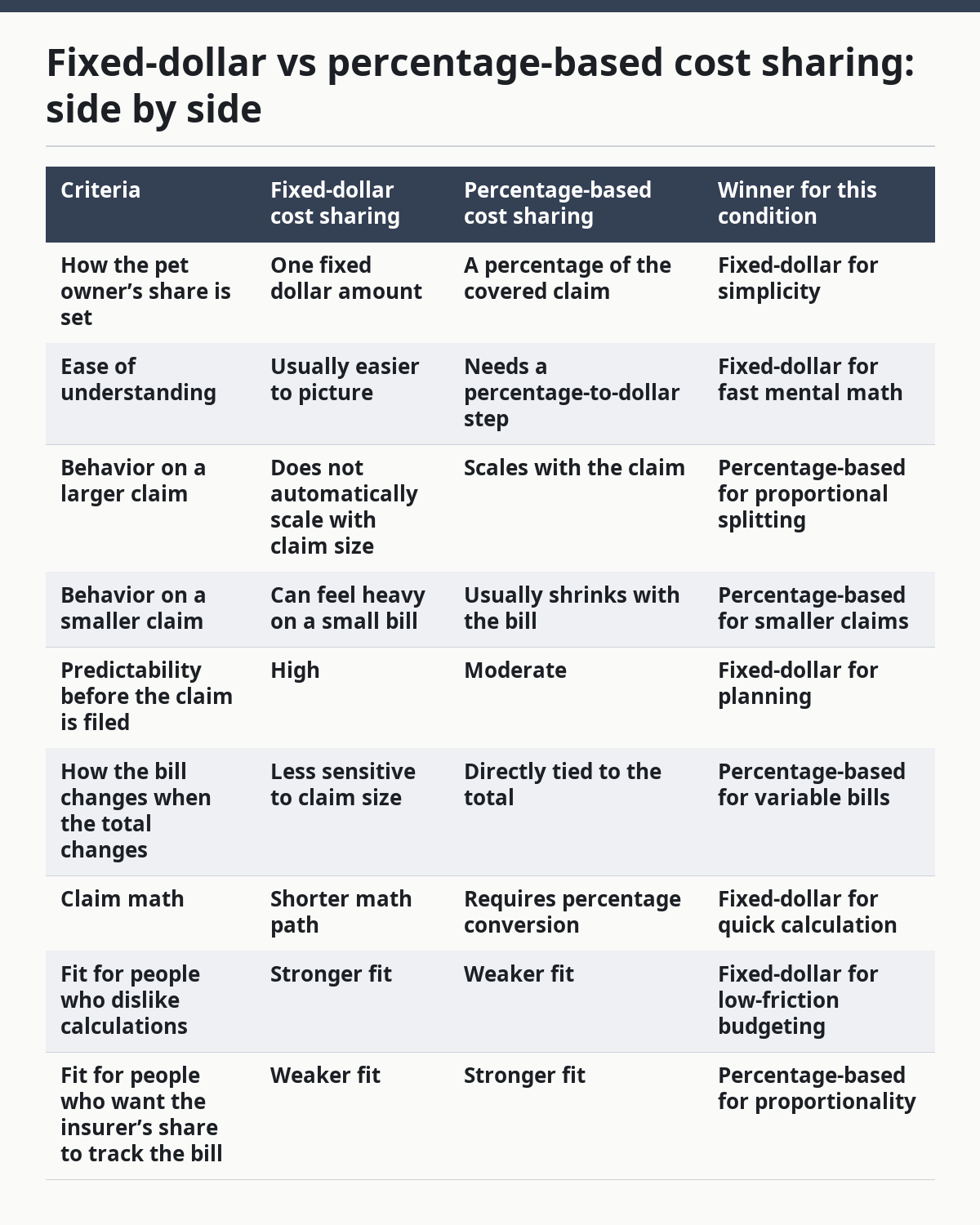
The head-to-head comparison below shows where the choice changes the experience, not just the wording on the policy.
| Criteria | Fixed-dollar cost sharing | Percentage-based cost sharing | Winner for this condition |
|---|---|---|---|
| How the pet owner’s share is set | One fixed dollar amount | A percentage of the covered claim | Fixed-dollar for simplicity |
| Ease of understanding | Usually easier to picture | Needs a percentage-to-dollar step | Fixed-dollar for fast mental math |
| Behavior on a larger claim | Does not automatically scale with claim size | Scales with the claim | Percentage-based for proportional splitting |
| Behavior on a smaller claim | Can feel heavy on a small bill | Usually shrinks with the bill | Percentage-based for smaller claims |
| Predictability before the claim is filed | High | Moderate | Fixed-dollar for planning |
| How the bill changes when the total changes | Less sensitive to claim size | Directly tied to the total | Percentage-based for variable bills |
| Claim math | Shorter math path | Requires percentage conversion | Fixed-dollar for quick calculation |
| Fit for people who dislike calculations | Stronger fit | Weaker fit | Fixed-dollar for low-friction budgeting |
| Fit for people who want the insurer’s share to track the bill | Weaker fit | Stronger fit | Percentage-based for proportionality |
Which option is easier to predict?
Fixed-dollar cost sharing is easier to predict because the amount does not change with the size of the claim. That makes it better for people who want the same kind of cost-sharing pattern each time the policy is used.
The reason is simple: a fixed amount behaves like a set number, while a percentage behaves like a moving share of the total. If a claim changes, the percentage-based share changes with it. That is useful when the goal is proportional splitting, but it is not as tidy for budgeting.
There is a catch. Easier to predict does not always mean easier to live with, especially when a fixed-dollar structure leaves the pet owner carrying more of a large claim than expected. That is why predictability and affordability are not the same thing.
For a person who wants to know what to expect when the claim hits, fixed-dollar cost sharing usually wins. For a person who wants the insurer’s share to adjust with the bill, percentage-based cost sharing is the more natural fit.
Who should use fixed-dollar cost sharing?
Fixed-dollar cost sharing is the better fit for someone who wants the cleanest possible bill structure. It is also the better fit for a reader who plans around fixed amounts rather than around percentages.
The strongest case for it is mental load. A flat amount is easier to understand at a glance than a percentage that has to be converted into dollars. That matters when the policyholder is already dealing with a pet’s vet bill and does not want another layer of math.
The weakness is scale. On a larger claim, the same dollar amount can feel less forgiving. On a smaller claim, it can look like a big bite out of the covered bill. That trade-off makes fixed-dollar cost sharing a poor match for people who want the split to stay proportional to the claim size.
This option is also the weaker pick for anyone who expects claims to vary a lot. The simplicity is real, but the cost-sharing burden can feel uneven when the bill changes sharply from one claim to the next.
Who should use percentage-based cost sharing?
Percentage-based cost sharing is the better fit for someone who wants the split to move with the bill. It is the more natural model for a policyholder who already thinks in shares, not in flat dollar amounts.
The appeal is proportionality. If the claim is larger, the split is larger; if the claim is smaller, the split is smaller. That makes the structure feel more connected to the actual bill, which is why it often fits claim-based reimbursement language better than fixed-dollar setups do.
The weakness is uncertainty. A person may know the percentage, yet still not know the final dollar amount until the claim amount is clear. That is a real downside for people who want very tight budgeting. A percentage can be easy to state and still hard to forecast.
This option is not the best match for readers who dislike bill math or who want the out-of-pocket share to feel stable from one claim to the next. It is strongest when proportional cost sharing matters more than a simple, fixed number.
When does the verdict flip?
The overall choice flips in a few specific cases, and those cases matter more than any generic rule. If the reader values simplicity above all else, fixed-dollar cost sharing becomes the better choice even if percentage-based cost sharing looks more flexible on paper.
If the reader expects claims to vary a lot in size, percentage-based cost sharing can become more appealing because it keeps the split tied to the total bill. A fixed amount may feel too blunt in that situation.
If the reader has a hard time with math, fixed-dollar cost sharing is the safer fit for day-to-day understanding. If the reader is comfortable with percentages and likes seeing every charge expressed as a share of the total, percentage-based cost sharing will feel more natural.
If the policyholder wants the clearest mental model at claim time, fixed-dollar wins. If the policyholder wants the cost-sharing pattern to rise and fall with the claim, percentage-based wins.
The verdict
Choose fixed-dollar cost sharing if the main goal is simple, predictable budgeting and the reader wants the same dollar amount shape each time. Choose percentage-based cost sharing if the main goal is a split that tracks the size of the claim. Neither fits well if the reader wants both total predictability and proportional sharing at the same time.
Does pet insurance use fixed copays?
Yes, some pet insurance cost-sharing structures are fixed-dollar, which works like a copay-style amount. That means the bill uses one set dollar figure rather than a percentage of the claim. The trade-off is that the same fixed amount can feel very different on a small claim than on a large one.
Which cost sharing style is easier to predict?
Fixed-dollar cost sharing is easier to predict because the amount does not change with the claim size. Percentage-based cost sharing is still understandable, but the final dollar amount depends on the total bill. That makes fixed-dollar the simpler choice for a person who wants cleaner budgeting.
Is percentage cost sharing more common?
Percentage-based cost sharing is the more familiar way pet insurance claims are often described. It fits the idea of reimbursement better because the insurer and the pet owner each take a share of the covered bill. Fixed-dollar cost sharing exists, but percentage-based wording is usually the more recognizable model.
Sources
- percentagecalculator.net, Percentage Calculator (checked 29 Nov 2026)
- calculator.net, Percentage Calculator (checked 29 Nov 2026)
Drafted with AI; not yet reviewed by a person.