Last updated: November 20, 2026
Quick Answer: pet insurance pricing and cost control usually start from about $20 apart between quotes, and the right plan is the one that balances premium with deductible, reimbursement rate, and annual limit. Pet insurance pricing and cost control depend on the pet’s species, breed, age, location, and coverage choices, so there is no single normal price you can trust without comparing quotes.
This guide shows what drives the premium, how deductibles, annual limits, and reimbursement rates change the bill, and where pet insurance pricing and cost control actually work.
Key Takeaways
- Premiums move for reasons you can check before buying: breed, age, ZIP code, accident-only versus accident-and-illness, deductible, reimbursement rate, and annual limit.
- The cheapest policy is not always the lowest-cost policy over a year, because a narrow benefit can leave you with a bigger vet bill later.
- The most useful way to compare quotes is to hold coverage steady, then change one variable at a time.
- Cost control works best when you understand the policy math, keep the waiting periods in mind, and avoid paying for features you won’t use.
- This is information, not financial advice; for your own situation, speak with a qualified adviser or insurance professional who can explain how local rules and plan terms apply.
Who this guide is for, and what it assumes
This guide is for pet owners who want to understand why one quote is $20 apart from another and how to lower the premium without making the policy useless. It assumes you already know the basics of what pet insurance is: you pay a monthly premium, then file claims for covered veterinary costs.
It also assumes you can read a quote sheet and spot the main policy parts: deductible, reimbursement rate, annual limit, waiting period, and exclusions. If those terms are still fuzzy, good. That is exactly where pet insurance pricing and cost control begins.
The facts differ by country, insurer, and state or province, and they change often. Treat every example here as a framework, not a promise about what your own quote will be; consult a qualified insurance professional or adviser, and check insurer and regulator guidance before you buy. See NAIC consumer resources at https://content.naic.org/consumer and Pet Insurance Review at https://www.petinsurancereview.com/ for general policy-education context. This is information, not financial advice.
Here’s the catch: pet insurance is not one product. A policy that looks cheap can be expensive if it leaves you with a large share of the vet bill.
- Accident-only policies usually cost less than accident-and-illness policies, but they cover less.
- Deductible means the amount you pay before the policy starts reimbursing eligible claims.
- Reimbursement rate is the share the insurer pays after the deductible.
- Annual limit is the most the policy will pay in a policy year, if the plan has one.
Why pet insurance pricing varies so much
Pet insurance pricing varies because the insurer is pricing risk, not just selling a fixed service. A young mixed-breed dog in a low-cost area can look very different from an older large-breed dog in a high-cost metro ZIP code, even with the same plan structure.
That is why one quote can jump after you change only one field on the application. Age, breed, species, and local veterinary prices all affect the expected claim amount. Some insurers also price by whether the pet is a dog or cat, and some use breed-specific risk models for hereditary and orthopedic issues.
The policy design matters just as much. A plan with a $250 deductible, 90% reimbursement, and a generous annual limit will usually cost more than a plan with a higher deductible and lower reimbursement. That trade-off is not a trick; it is how you control monthly cost.
The truth is, the premium is only one part of the total cost. The total cost is premium plus deductible plus any coinsurance or uncovered care. If you only look at the monthly bill, you can fool yourself into paying more overall.
- Species: dogs often cost more to insure than cats because claims can be larger.
- Breed: some breeds are linked to higher orthopedic, heart, eye, or skin claims.
- Age: older pets usually price higher, and some plans limit new enrollment at advanced ages.
- Location: vet fees differ by market, so the insurer’s expected payout changes too.
- Coverage design: lower deductible, higher reimbursement, and higher annual limit usually raise the premium.
What actually drives the premium
What drives the premium is a mix of pet risk and policy generosity. The insurer is trying to predict how much a claim might cost, how often claims may happen, and how much of that cost the policy will absorb.
For a lot of buyers, the hidden driver is not the pet at all. It is the quote settings. If you ask for a lower deductible or a 100% reimbursement style plan, the premium often rises; if you ask for a higher deductible or a lower reimbursement rate, the premium often falls. That is the basic dial set.
In practice, one breed or one age does not always cost more by a fixed amount. Pricing is insurer-specific and market-specific. But the pattern is stable: more expected claim cost means a higher premium.
Two terms help here. Underwriting is the insurer’s process for deciding the terms and price of coverage. Actuarial pricing is the math behind the premium, built from claim history and expected loss. You do not need the formulas to use the policy well, but you do need to know they exist.
- Age bands can change the quote when a pet crosses a threshold.
- Breed exclusions or breed-related surcharges can appear in some markets.
- Pre-existing condition rules can change what gets covered at all.
- Waiting periods can make the first weeks of coverage effectively non-payable for certain issues.
The parts of the quote that matter most
The parts that matter most are the deductible, the reimbursement rate, the annual limit, and the waiting period. Those four items decide what the premium buys.
A deductible can be annual or per-condition, depending on the insurer. An annual deductible resets each policy year; a per-condition deductible applies separately to each illness or injury category, which can be more expensive if multiple conditions appear. Reimbursement rate is often shown as 70%, 80%, or 90%, though the exact choices vary by insurer and country. Annual limit may be a dollar cap or unlimited coverage, depending on the plan.
If a quote is confusing, ask for the policy wording, not just the sales page. The sales page may show the nice number; the policy form shows the actual claim rules. That difference matters.
- Annual deductible helps with one-off claims across the year.
- Per-condition deductible can stack up if several diagnoses appear, so check the insurer’s wording or ask a licensed insurance professional how it applies to your pet.
- Unlimited coverage may cost more up front but removes the annual cap.
- Waiting periods can block claims early on even if the premium is paid.
How to compare quotes without fooling yourself
Comparing quotes works best when you keep the coverage constant and change only one setting at a time. If you change the deductible, reimbursement rate, and annual limit all at once, you are not comparing prices anymore; you are comparing different products.
Start with the same pet details on every quote: age, breed, sex, spay or neuter status if asked, ZIP or postal code, and microchip status if the insurer asks for it. Then choose one coverage baseline, such as accident-and-illness with an annual deductible and a set reimbursement rate. Only after that should you change a single dial to see the price effect.
This is the core cost-control move. Many buyers chase the lowest premium and later discover the policy is too thin to help. That is not savings; that is just shifting the pain to the vet invoice.
- Compare quotes using the same deductible type.
- Keep the same reimbursement rate until you understand the price effect.
- Compare annual limit to annual limit, not unlimited to capped coverage.
- Check whether exam fees, prescription diets, dental care, or rehab are included or excluded.
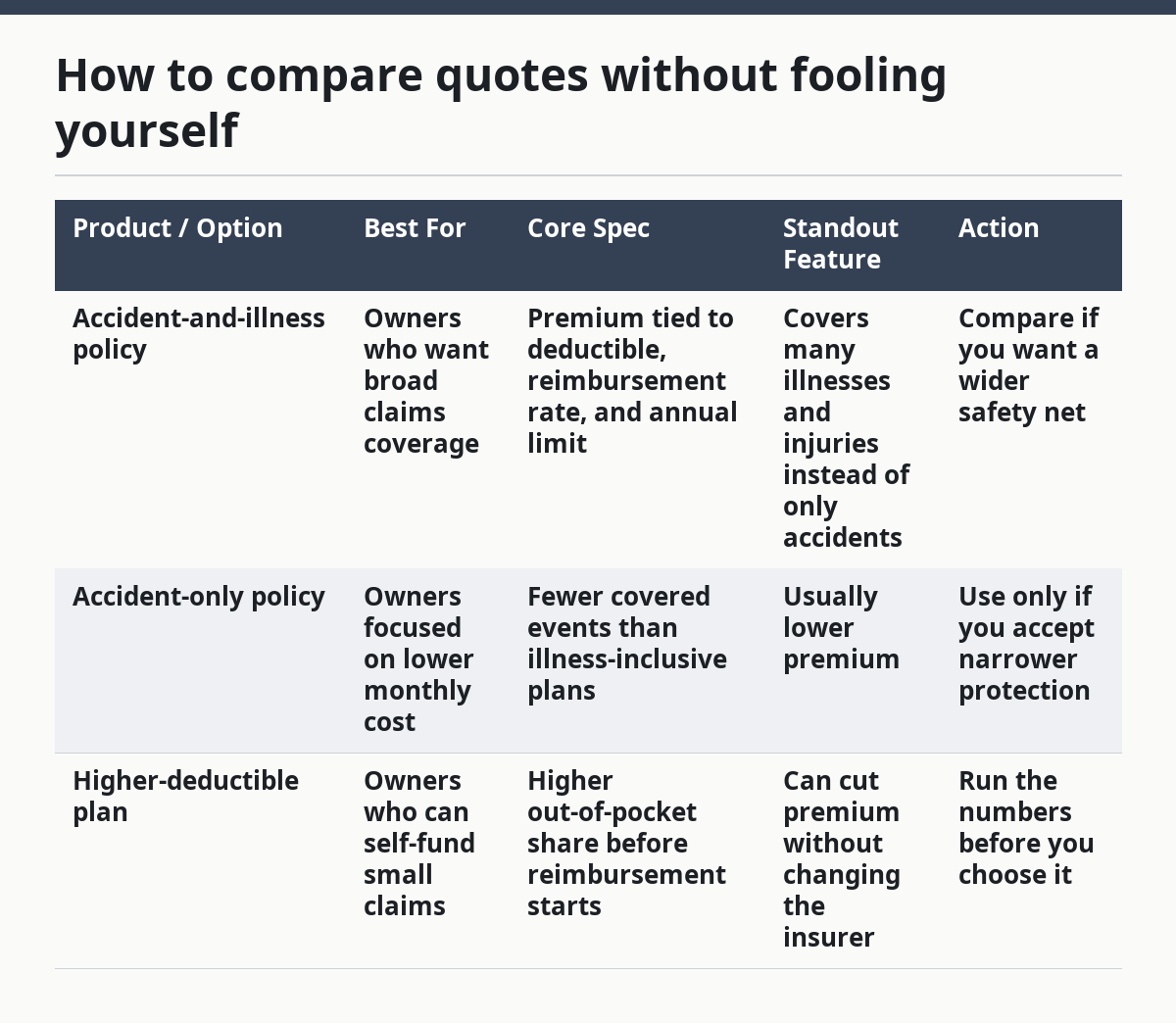
| Product / Option | Best For | Core Spec | Standout Feature | Action |
|---|---|---|---|---|
| Accident-and-illness policy | Owners who want broad claims coverage | Premium tied to deductible, reimbursement rate, and annual limit | Covers many illnesses and injuries instead of only accidents | Compare if you want a wider safety net |
| Accident-only policy | Owners focused on lower monthly cost | Fewer covered events than illness-inclusive plans | Usually lower premium | Use only if you accept narrower protection |
| Higher-deductible plan | Owners who can self-fund small claims | Higher out-of-pocket share before reimbursement starts | Can cut premium without changing the insurer | Run the numbers before you choose it |
What to check before you buy
What to check before you buy is the policy language, not the marketing headline. A low monthly premium can hide a waiting period, a breed exclusion, a per-condition deductible, or a reimbursement method that pays less than you expected.
Read the exclusions first. Then look at whether the plan covers hereditary conditions, chronic care, dental illness, behavioral treatment, prescription drugs, imaging, surgery, and specialist care; if you are unsure, consult a licensed insurance professional and review the policy wording and insurer disclosures. Those categories are where cost surprises live.
Next, inspect the claim timing. Some policies require the bill to be paid upfront, then reimbursed later. Others pay the vet directly only in limited cases. That cash-flow detail matters if a claim is large.
A practical check is to estimate one common claim type for your pet, then see what the policy would actually pay. For a dog prone to joint issues or a cat with dental risk, that exercise can expose weak coverage fast.
- Does the plan use annual, per-condition, or lifetime limits?
- Are pre-existing conditions defined broadly or narrowly?
- Are exam fees reimbursed?
- Are chronic conditions covered after diagnosis, or only one episode?
- Is there a claim form deadline or proof-of-payment rule?
How can you lower pet insurance costs without wrecking the policy?
You can lower pet insurance costs by changing the parts of the policy that move price the most while leaving enough coverage in place for real veterinary bills. The biggest levers are deductible, reimbursement rate, annual limit, pet enrollment age, and species or breed risk.
A higher deductible usually lowers the premium because you are taking on more of the early cost yourself. A lower reimbursement rate does the same thing. A lower annual limit may also drop the premium, but it can leave you exposed in a bad year, especially if surgery, imaging, and follow-up care stack up.
The best cost control is boring and practical. Pick a deductible you can pay without panic, not one that looks clever on a spreadsheet. If a $1,000 deductible would force you to skip care, it is too high for your budget, even if the premium looks nice.
Here’s the catch: lowering the premium can backfire if the plan becomes functionally useless for the claims you’re trying to protect against. The point is not the cheapest quote. The point is the least expensive useful coverage.
- Raise the deductible only to a level you can cover from savings.
- Lower reimbursement if you can handle more of the bill after a claim.
- Keep the annual limit high enough for surgery or multi-visit care.
- Enroll while the pet is younger if the policy and your budget allow it.
- Avoid paying for add-ons you will not use.
A simple way to compare the real cost
A simple way to compare the real cost is to add the expected premium to the amount you would pay if a claim hit the deductible. That gives you a better picture than premium alone.
For example, if one plan has a low premium but a high deductible, and another has a higher premium but a lower deductible, the second plan may cost less in a year when the pet needs care. You do not need to predict the future perfectly. You only need to compare how the policy behaves in ordinary and stressed years.
This is why many generic articles get it wrong: they tell you to look for the cheapest premium and stop there. That is the wrong tool. Cost control means controlling the whole claim path, not just the first monthly bill.
- Premium only tells part of the story.
- Deductible controls what you pay before reimbursement starts.
- Reimbursement rate controls how much comes back after that.
- Annual limit controls the ceiling if claims get large.
When pet insurance is the wrong tool
Pet insurance is the wrong tool when the policy terms are too thin for the risk you are trying to cover or when the premium does not fit your cash flow. In those cases, a separate savings fund or a different coverage level may fit better, but the right choice depends on your own situation and should be reviewed with a qualified adviser if money is tight.
Your pet already has a known condition: The insurer will usually treat it as pre-existing, which means the main reason you bought the plan may not be covered — use the policy only if you understand that gap.
The deductible is higher than your emergency fund: You may pay the premium and still avoid claims because the out-of-pocket bar is too high — look for a lower deductible or a different plan structure.
The annual limit is too low for surgery risk: A cap can run out during one serious illness — compare a higher limit or a different plan if major procedures are realistic for your pet.
The waiting period overlaps an immediate need: Early claims may be denied even though coverage has started — do not rely on the policy for care that is likely to happen before the waiting period ends.
The policy excludes the care your pet is most likely to need: If dental illness, chronic skin problems, or orthopedic care are excluded, the plan may not match the risk profile — choose a plan whose covered categories match the likely bill.
You need reimbursement to pay a vet bill tomorrow: Many policies reimburse after you pay first, which creates a cash gap — use a payment plan or another funding method if timing is the issue.
- If the policy does not cover the likely claim, the premium is wasted.
- If the deductible is unreachable, the policy behaves like a fee, not protection.
- If cash flow is tight, reimbursement timing matters as much as coverage.
What mistakes people make with pet insurance pricing
The most common mistake is buying the lowest premium without checking what was removed to make it cheap. That usually leads to a plan that looks fine on paper but fails on the first serious bill.
Another mistake is choosing a deductible that seems “responsible” but is too high for actual savings. A $1,000 deductible may sound disciplined, but if you do not have that amount set aside, you may avoid care or ignore the policy entirely.
People also confuse lifetime value with first-year price. A plan that raises premium as the pet ages, or changes terms after a claim, can cost more than a steadier policy. The policy form tells you what can change; the sales page often does not.
The last big mistake is not checking exclusions before the pet gets sick. Insurance does not work backward. Once a condition is on the record, it can change the claim picture for the rest of the pet’s life.
- Mistake: choosing the cheapest quote. Consequence: thin coverage and larger bills later. Correct move: compare total out-of-pocket exposure.
- Mistake: ignoring waiting periods. Consequence: denied early claims. Correct move: read the claim-start dates.
- Mistake: picking a deductible you cannot pay. Consequence: coverage you never use. Correct move: set the deductible from real savings, not wishful thinking.
- Mistake: assuming all dental care is included. Consequence: surprise denials. Correct move: check whether dental illness and routine dental work are different.
- Mistake: skipping the policy wording. Consequence: a sales pitch instead of a contract. Correct move: read the exclusions and reimbursement rules.
What should I ask an insurer before I enroll?
You should ask the insurer how the policy pays, what it excludes, and when coverage starts. Those three things explain most pricing surprises.
A short question list works better than a long one. You want the answers in writing, because the brochure and the contract are not always the same. Ask about deductible type, reimbursement basis, annual limit, waiting periods, pre-existing condition definitions, and whether prescription drugs, exam fees, and specialist care are covered.
If the insurer cannot give clear answers, that is a signal. Not a good one. A policy is only useful if the claim rules are readable before you buy.
- Is the deductible annual or per-condition?
- Is reimbursement based on the bill, the allowed amount, or another formula?
- Are hereditary and chronic conditions covered?
- Are there breeds, ages, or regions that cannot enroll?
- What happens to the premium as the pet gets older?
FAQ
Is the cheapest pet insurance usually the best value?
No, the cheapest premium is often not the best value. A low price can mean a high deductible, a low reimbursement rate, a small annual limit, or exclusions that matter to your pet. Value depends on how the policy behaves when a real claim happens, not just on the monthly bill.
Does pet insurance get more expensive as a pet ages?
Usually, yes, the premium often rises with age, though the exact pattern depends on the insurer and the market. Some plans also stop new enrollment at older ages or change what they will cover. Check the policy terms before you assume the premium will stay flat.
What is the biggest way to control pet insurance cost?
The biggest controllable levers are the deductible, reimbursement rate, and annual limit. A higher deductible or lower reimbursement rate usually lowers the premium, but it also raises your share of a future bill. The right balance depends on how much cash you can keep available for a claim.
Should I choose accident-only coverage to save money?
Accident-only coverage can save money, but it covers less. It may fit a very tight budget or a pet whose owner only wants protection against injury, not illness. If your main worry is chronic disease, surgery, or diagnostic testing, accident-only is usually too narrow.
Do pre-existing conditions affect the price?
Pre-existing conditions usually affect coverage more than price. Insurers often exclude conditions that began before the policy started or during the waiting period. That means the premium can look reasonable while the benefit for a known issue is limited or absent.
Drafted with AI; not yet reviewed by a person.