Last updated: November 19, 2026
Key Takeaways
- The EOB is the insurer’s claim summary after review.
- It shows what was billed, allowed, and paid.
- Compare the EOB to the vet invoice line by line.
- A careful read can show whether the issue is math, coverage, or a missing detail.
An explanation of benefits in pet insurance is the statement that shows how your claim was processed, what the insurer allowed, what it paid, and what you still owe. In the topic What Is an Explanation of Benefits in Pet Insurance?, the EOB is the summary you check after a claim is reviewed. It is usually separate from the vet bill, and it may not match the payment timing. The sections below show how to read it, what each line means, and what it is often confused with.
What an explanation of benefits actually is
Picture this: you’ve already filed the claim, the hospital charged you at checkout, and a few days later a statement lands in your inbox. The explanation of benefits, or EOB, is the insurer’s breakdown of that claim after review. It shows the claim breakdown, the allowed amount, any denied amount, and the final reimbursement summary.
For a lot of pet parents, this is the first document that turns a vague claim into numbers they can follow. It is also where billing confusion can start, because the vet invoice and the EOB do not always match line for line.
The EOB is a claim statement. It is not the same thing as the clinic’s invoice, and it is not always the same thing as the money hitting your account. Some insurers use different labels, but the job is similar: show how the claim was handled and what changed along the way.
A plain-language guide from the National Association of Insurance Commissioners explains how claim documents can summarize what was billed, what was covered, and what the policy holder still owes. That basic structure is the same idea here, even though pet insurance terms vary by company and by country.
What does the EOB show line by line?
Picture this: you open the document and see a row of charges, one approved amount, and a balance left behind. The EOB is built to answer three questions: what was billed, what was allowed, and what was paid. That is the heart of the payment summary.
The terms matter. The allowed amount is the portion the insurer recognizes under the policy rules. The approved amount is what it accepts for reimbursement after the policy’s deductible, co-pay, annual limit, exclusions, or benefit structure are applied. If the insurer reduces or rejects part of a charge, that difference may appear as an adjustment or a denied amount.
Here’s the catch: the EOB may look simple, but the math is doing several jobs at once. One charge can be partly covered and partly left to you, especially if the invoice includes exam fees, diagnostics, medication, or services outside the policy terms.
Common pieces you may see:
- the vet’s charge or invoice line
- the insurer’s allowed amount
- the approved amount
- deductible applied
- co-insurance or reimbursement percentage
- amount paid by the insurer
- amount you still owe
If a line looks off, the first thing to check is whether the EOB is showing the claim review result rather than the original bill. Those are not the same document.
How do I read a pet insurance claim statement?
Picture this: you want to know whether the insurer paid correctly, but the page is full of dates and columns. Read the EOB from top to bottom, then compare it to the vet invoice line by line. The goal is to track what was billed, what was covered, and what was left after policy terms were applied.
- Match the claim to the visit. Check the pet name, claim number, clinic name, and service date. Verify that the visit on the EOB is the same one on your invoice. If the dates do not line up, something is being matched to the wrong claim.
- Find the total billed amount. This is the clinic’s charge before insurance changes anything. Verify the amount against the invoice. If it is lower or higher than the bill you have, the document may be incomplete.
- Locate the allowed amount. This is the insurer’s accepted amount under the policy terms. Verify whether any line is capped, excluded, or partially covered. If the allowed amount is blank or zero for a service you expected to be covered, that is a sign to review the policy wording.
- Check the deductible. The deductible is the amount you must meet before reimbursement starts, or before it applies to a claim period, depending on the policy. Verify whether part of the claim was used toward the deductible. If the deductible seems to have been applied twice, compare prior claims in the same period.
- Check the reimbursement rate or co-pay. Some policies pay a percentage of the allowed amount after the deductible. Verify the math on the approved amount. If the percentage on the EOB does not match the policy, the issue may be a policy setup error or a non-covered charge.
- Look for adjustments or denied lines. These lines show reductions, exclusions, or services outside the policy. Verify whether the reason matches the actual service. If the adjustment is vague, note the line item and contact the insurer for a clearer breakdown.
- Confirm the payment summary. Check what the insurer says it paid and where it sent the payment. Verify the payee name and payment method. If the EOB shows a payment but your bank account does not, the document may be ahead of the transfer.
- Compare the final balance. Add the insurer’s payment and your share to see whether they equal the vet’s total charge. Verify that the total closes cleanly. If the math does not tie out, there may be an omitted line, a non-covered fee, or a processing error.
A simple cross-check matters here. If the invoice shows a charge and the EOB leaves it out, that is a clue. If the EOB includes a line the invoice does not, ask for the billing description in writing.
What gets confused with an EOB?
Picture this: you’re staring at two or three documents that all seem to talk about the same visit. That is where a lot of confusion starts. The EOB is often mistaken for the bill, the receipt, or the insurer’s payment confirmation, but each one does a different job.
The vet bill is the clinic’s charge list. The claim statement is the insurer’s processing summary. The reimbursement notice or payment confirmation may show that money was sent, but it may not explain why a line was reduced. The EOB usually sits in the middle: it explains the calculation.
A few common mix-ups:
- Invoice vs. EOB: the invoice says what the clinic charged; the EOB says what the insurer recognized.
- EOB vs. payment: the EOB may show a payment amount, but it is not always proof that funds have cleared.
- Denied line vs. denied claim: a single denied item does not always mean the entire claim was denied.
- Allowed amount vs. billed amount: the insurer may cover only part of the invoice, even when the service is eligible.
This is why policyholders should keep both documents for the same claim. One shows the charge; the other shows the calculation.
Why is the approved amount lower than the vet bill?
Picture this: the clinic charged one amount, but the insurer approved less. That gap usually means the policy rules trimmed the claim, not that something went wrong by itself. The approved amount can be lower for several ordinary reasons, and the EOB should show which one applies.
Common causes include:
- the deductible was not met yet
- the policy reimburses only a percentage of the allowed amount
- part of the bill was outside coverage
- a service was subject to a policy limit
- the insurer adjusted the charge to its allowed amount
- the claim included fees the policy excludes
The key number is not the clinic total alone. It is the insurer’s allowed amount, because reimbursement is often calculated from that figure, not from every dollar on the invoice. That is why two claims with the same vet bill can produce different payments.
If the approved amount seems too low, check the line item details before assuming the insurer made an error. Sometimes the issue is a preventive service, an exam fee, or another charge that the policy may treat differently from treatment, so it is worth reviewing the policy and, if needed, consulting a licensed insurance professional or veterinarian for help interpreting it.
What should you check before you call the insurer?
Picture this: you think the claim was processed wrong, but you want to be sure before spending time on the phone. A careful read of the EOB can save a round trip, because the document itself usually shows whether the problem is math, coverage, or a missing detail.
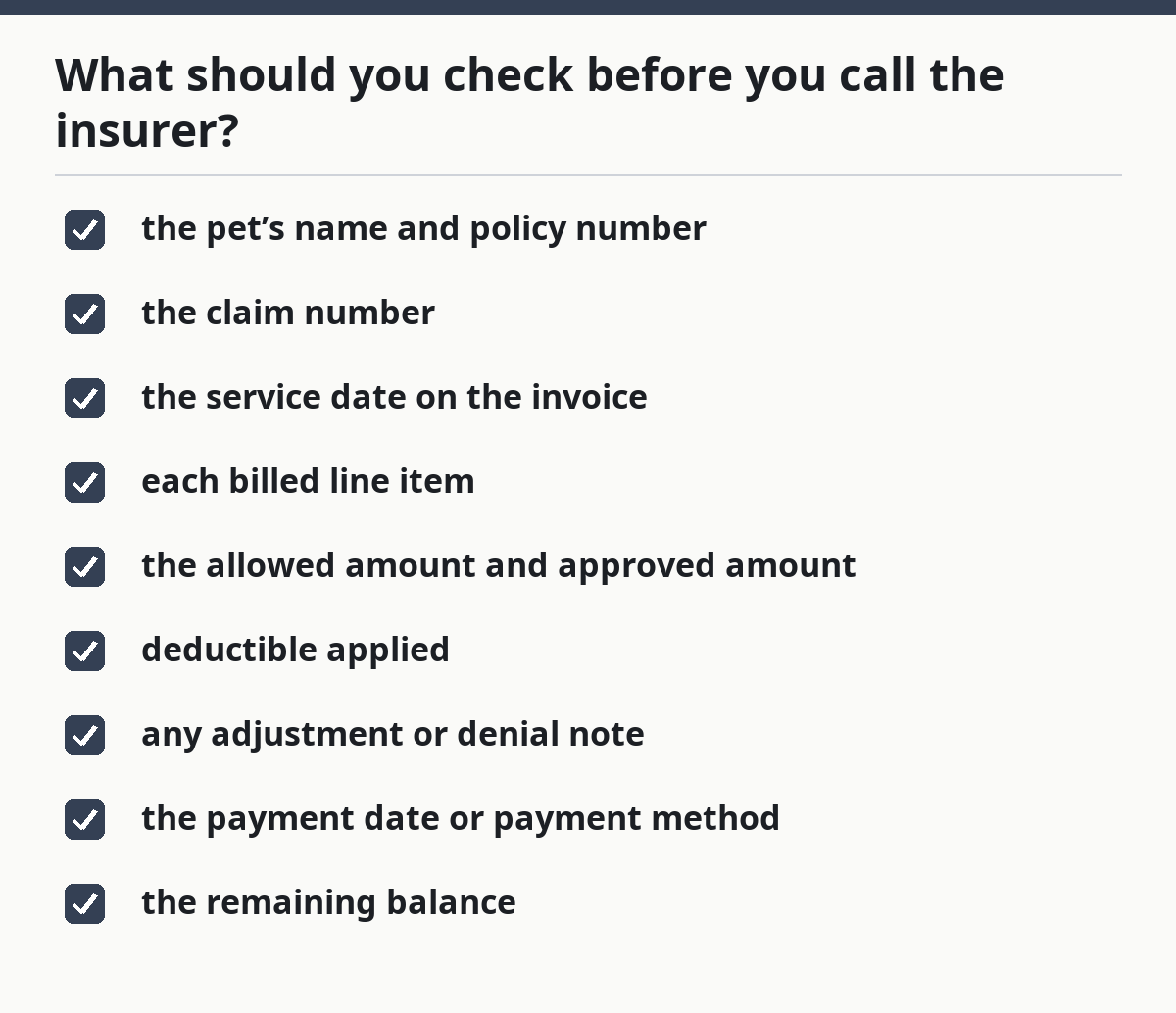
Start with these checks:
- the pet’s name and policy number
- the claim number
- the service date on the invoice
- each billed line item
- the allowed amount and approved amount
- deductible applied
- any adjustment or denial note
- the payment date or payment method
- the remaining balance
If the EOB includes a reason code or short note, read it literally. It may only say that a charge was not covered under the policy terms. That is different from a clinic billing error.
The best part? Once you know where the numbers come from, the document gets easier to scan in under 5 minutes. You are looking for consistency: same visit, same line items, and math that adds up.
For policy terms and claim handling basics, the Pet Insurance Claims and Payments hub can help you connect this document to the rest of the process.
When does an explanation of benefits not tell the whole story?
Picture this: the paper says one thing, but your bank account or clinic balance says another. The EOB is a summary, not the whole claims file, so there are times when it does not answer every question.
Use more caution in these cases:
- The claim is split across multiple visits: one EOB may not reflect all charges tied to the same condition.
- The bill includes bundled services: one line can hide several services, and the EOB may not unpack them fully.
- The clinic corrected the invoice later: the EOB may reflect the earlier version, not the updated bill.
- The policy has waiting periods or annual limits: the EOB may show a reduction without explaining the broader policy cap.
- The payment method changed: the EOB can show approved and paid amounts, while the actual transfer follows a separate schedule.
If the EOB and invoice still do not match after you compare line items, ask for a claim breakdown in writing. That gives you a cleaner paper trail than trying to decode a single summary box.
Insurance terms vary by country and change often, so a qualified adviser or licensed insurance professional should be consulted for your own situation.
The mistakes people make with pet insurance EOBs
Picture this: you see a lower payment and assume the insurer “shorted” the claim. Sometimes that happens, but often the real issue is a reading error. A few common mistakes cause most of the confusion.
- Reading the EOB as the bill. The consequence is that you expect the insurer to pay the clinic total. The correct approach is to compare the EOB to the invoice and the policy terms together.
- Ignoring the deductible. The consequence is a surprise lower reimbursement, especially early in a policy year or claim period. The correct approach is to check how much deductible has already been applied.
- Missing excluded items. The consequence is treating non-covered charges like covered ones. The correct approach is to look for exam fees, routine care, or other services that your plan treats differently.
- Stopping at the payment line. The consequence is missing an adjustment that explains the gap. The correct approach is to read the allowed amount and denial or adjustment notes before you look at the final payment.
- Comparing claims from different dates as if they were identical. The consequence is false alarm over normal changes in policy limits or deductible status. The correct approach is to compare claims only within the same policy terms and time period.
The EOB is useful, but it is only useful if you read it as a calculation, not as a verdict on the whole visit.
FAQ
Is an EOB the same as a payment?
No. An EOB is the explanation of how the claim was processed, while a payment is the money sent by the insurer. Some EOBs show the paid amount, but that line is still a summary. The actual transfer can post later, and the document may not be the same thing as a bank deposit or mailed check.
Why is the approved amount lower than the vet bill?
The approved amount is often lower because the policy only covers part of the invoice. Deductibles, co-insurance, exclusions, annual limits, and allowed amounts can all reduce reimbursement. The EOB should show which part of the bill changed, so the gap is usually visible if you compare each line to the invoice.
What does the insurer pay versus what I owe?
The insurer pays the approved share under the policy, and you owe the rest of the bill. Your share can include the deductible, any uncovered services, and any amount above the insurer’s allowed amount. The EOB is the document that shows how those pieces were split for that claim.
Drafted with AI; not yet reviewed by a person.