Last updated: November 19, 2026
Quick Answer: pet insurance discounts usually come as five common types, and they often lower the premium by 5% to 10% rather than changing coverage. Pet insurance discounts usually come as multi-pet discounts, annual payment discounts, employer perks, association discounts, and occasional breed-specific promos.
This article breaks down how each discount works, what to check before you count on it, and where the fine print can change the value.
Key Takeaways
- Most discounts lower the premium, but they do not change the policy’s core coverage.
- The biggest common offers are for more than one pet, paying yearly, or getting access through work or a member group.
- Some discounts are automatic; others need a code, proof of membership, or enrollment through an employer.
- A discount can be small enough that a different plan still costs more, so the real comparison is the total price after the discount.
- This is information, not financial advice. For your own situation, especially if money is tight, a qualified adviser can help you sort the trade-off.
What pet insurance discounts usually look like
Pet insurance discounts usually reduce the premium by category, not by every feature on the policy.
You’ll most often see 5 basic discount types: multi-pet, annual payment, employer perk, association discount, and limited breed or promotion-based offers.
Picture this: you’re comparing quotes for a dog and a cat, and one site mentions a discount while another says nothing. The catch is that the discount may apply only if you pay for the year up front, enroll through work, or add a second pet on the same billing account. That’s why the discount name matters more than the headline savings.
- Multi-pet discount: a lower rate when more than one pet is insured.
- Annual payment discount: a price break for paying 12 months at once instead of month by month.
- Employer perk: a group rate offered through a job benefit portal.
- Association discount: a member-rate offer through a club, union, alumni group, or professional association.
- Breed-specific promo: a limited-time offer tied to a breed, a campaign, or a special enrollment period.
The truth is, the discount itself is only half the story.
The other half is whether the base premium, deductible, reimbursement rate, and annual limit still fit the budget.
How do multi-pet discounts work?
Multi-pet discounts work by giving each covered pet a lower premium or a reduced total bill when you insure more than one animal with the same company.
The discount often appears as a percentage off each additional pet, but companies can structure it in different ways.
Because the pricing can shift by pet count, the second policy is where the savings usually show up most clearly. Picture this: you already insure one cat, and now you want coverage for a second cat or a dog. The offer may look simple on the checkout screen, but the rules can differ by pet type, age, and plan tier. A policy that looks like one account may still price each pet separately behind the scenes.
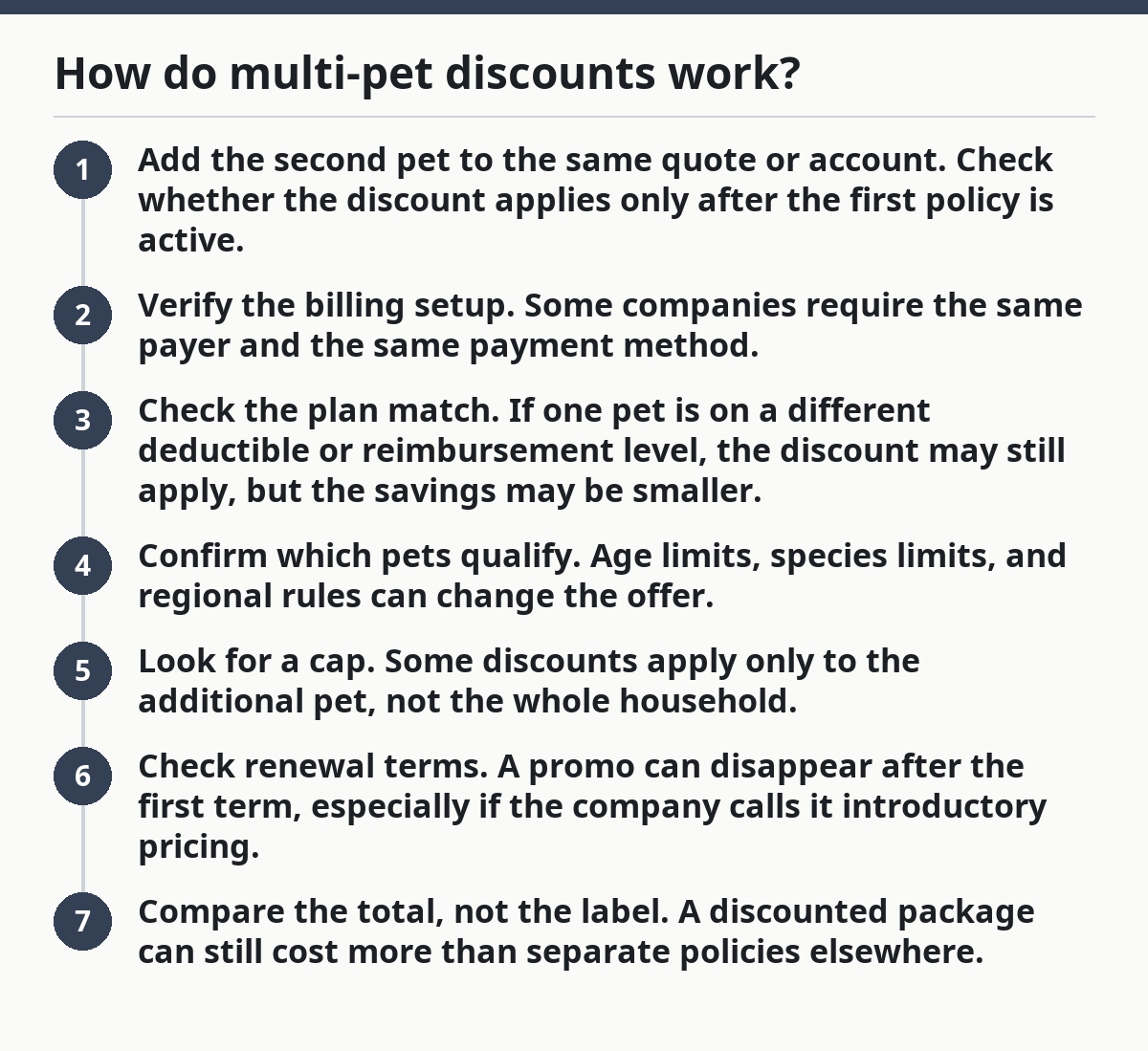
- Add the second pet to the same quote or account. Check whether the discount applies only after the first policy is active.
- Verify the billing setup. Some companies require the same payer and the same payment method.
- Check the plan match. If one pet is on a different deductible or reimbursement level, the discount may still apply, but the savings may be smaller.
- Confirm which pets qualify. Age limits, species limits, and regional rules can change the offer.
- Look for a cap. Some discounts apply only to the additional pet, not the whole household.
- Check renewal terms. A promo can disappear after the first term, especially if the company calls it introductory pricing.
- Compare the total, not the label. A discounted package can still cost more than separate policies elsewhere.
What tells you there’s a problem?
If the quoted total barely changes after adding a second pet, or the site won’t show the discount until the last step, the offer may be smaller than it sounds.
Can you get a discount for paying yearly?
Yes, many pet insurance companies offer an annual payment discount or fee break when you pay for 12 months at once.
That usually helps with monthly billing fees or gives a small price reduction compared with paying each month.
Because the payment timing changes the bill, the annual option can matter as much as the discount itself. Picture this: your budget can handle a larger upfront payment, but you want to know if it actually changes the math. The key detail is that annual payment discounts are about cash flow as much as price. A yearly bill can reduce monthly friction, but it also takes a larger chunk of money on day one.
Here’s the catch: not every company uses the same method.
Some lower the premium itself, while others waive part of a monthly service fee. If the plan has a 30-day waiting period or a separate enrollment fee, that can affect the real first-year cost.
- Check whether the discount is automatic. Some plans apply it only when you select annual billing.
- Ask whether refunds are prorated. If you cancel midyear, the refund method matters.
- Review the renewal bill. A discount can change after the first 12-month term.
- Make sure the payment date works for you. A yearly charge can be harder to absorb than 12 smaller payments.
This is one of the cleaner discounts to understand, because it usually shows up right in the billing choice. Still, it is not a good fit for anyone who needs to keep emergency cash untouched.
What are employer perks and association discounts?
Employer perks and association discounts are group-rate offers tied to where you work or what you belong to.
They usually come through an HR portal, a benefits site, a union, an alumni group, or a professional association.
Because the access point is a workplace or member group, the discount often depends on eligibility rather than pet details alone. Picture this: you’re shopping at work during open enrollment and see pet insurance listed next to health and dental coverage. That is often where the discount starts. The company may have negotiated access to a group plan, but the name on the page can be misleading unless you check eligibility rules and whether the policy is still underwritten the same way.
These discounts often have the widest swing in value because the qualifying group itself can be different.
An employer perk may be available to employees only, while an association discount may extend to members and sometimes household members. The exact rules differ by country, by insurer, and by sponsoring group.
- Confirm eligibility first. Some offers are for active employees only.
- Check whether family members qualify. A spouse or partner may not count.
- Look for proof rules. Membership numbers, payroll verification, or an HR link may be required.
- Compare the policy itself. A group discount does not make a weak plan better.
- Watch for payroll deductions. That can affect how easy it is to cancel or change coverage.
On the flip side, a group discount can disappear if you leave the job or the association.
If the price looks good only because of access through work, read the continuation rules before you rely on it.
Do breed-specific promos really happen?
Yes, breed-specific promos do happen, but they are usually limited, local, or tied to a short campaign rather than being a standard discount.
You may also see offers for certain life stages, shelter adoptions, or wellness enrollment drives instead of a true breed-only price cut.
Because these promos are often narrow, the headline can sound bigger than the actual savings. Picture this: you search for coverage for a breed that insurers often price differently because of common claims patterns. A promo might sound like a break for that breed, but the real discount may only apply to a narrow plan, a first term, or a selected date range. That makes it easy to overread the headline.
The truth is, breed-specific offers are not the same as breed-based underwriting.
Underwriting is how an insurer prices risk based on the pet’s profile. A promo is just a marketing offer layered on top. If the base rate is high, a small promo may not change much.
- Check the dates. Many promos expire fast.
- Check the breed list. Some offers apply only to a few named breeds.
- Check the enrollment channel. A promo code may only work through a partner link.
- Check renewal terms. A first-term promo may not carry forward.
What signals a weak offer?
If the promo is vague, hard to find in writing, or not mentioned in the policy documents, it may be more advertising than savings.
What should you check before counting on any discount?
You should check whether the discount is automatic, repeatable, and written into the quote or policy terms.
A discount that exists only in a sales chat is not the same thing as a discount that appears on the contract.
Because the quote can change after fees or add-ons, the written terms matter more than the headline. Picture this: you’ve found a price that looks better than the others, but you’re not sure why. That is the moment to slow down and read the quote line by line. The number on the first screen can change after taxes, fees, payment method selection, or add-ons.
A practical check list:
- Look for the discount name in writing. If it is not on the quote, assume it may not apply.
- Check whether it stacks. Some companies allow only one discount at a time.
- Confirm whether the discount is permanent. Intro offers may end after the first policy term.
- Read the billing method. Monthly and annual billing can produce different totals.
- See whether the pet profile changes the price. Age, breed, species, and zip code can outweigh a small discount.
- Compare the full first-year cost. Include enrollment fees, monthly fees, and any one-time charges.
- Save the quote or screenshot. If the price changes, you have a record of what was offered.
A quote that cannot be explained is usually a quote that should not be trusted.
Not because it is fake, but because the terms may be incomplete.
When a discount is not the main thing to compare
A discount is not the main thing to compare when the policy terms matter more than the savings.
That happens when deductibles, reimbursement rates, annual limits, waiting periods, or exclusions are more important than the discount name.
Because the policy design can outweigh the savings, a small price break is not always the best deal. Picture this: one insurer offers a small employer perk, and another has no discount at all. If the second plan has a lower deductible or a better reimbursement structure, the better total value may sit with the plan that looks more expensive at first glance. Price cuts can distract from the policy mechanics.
https://www.nia.nih.gov/health/aging-and-health
https://www.consumerfinance.gov/consumer-tools/credit-cards/paying-your-bills/
- High deductible: the discount may not help if out-of-pocket costs stay high.
- Low reimbursement rate: a cheaper premium can still leave you paying more at claim time.
- Short trial discount: the first year may look better than renewal.
- Hard-to-use group access: a work-based discount can vanish after job changes.
- Poor fit for your pet’s age or condition: a discount cannot erase exclusions.
The best comparison is usually simple: what do you pay over the term, and what do you get back when a claim is approved?
If the answer is unclear, the discount is not the right lens.
What mistakes do people make with pet insurance discounts?
People usually make five mistakes: they assume every discount stacks, they ignore renewal pricing, they confuse group access with permanent savings, they skip the written terms, and they let a small promo hide a poor policy fit.
Each mistake can leave the policy more expensive than it looked at signup.
Because the discount headline can overshadow the rest of the quote, it helps to slow down before you buy. Picture this: you see “discount” and stop reading. That move costs people money because discount language is designed to draw your eye before the rest of the terms do. The sensible habit is to read the fine print before you let the savings headline do the work.
- Assuming all discounts stack: you may get only one, which lowers the savings.
- Forgetting renewal changes: the promo may end after the first term.
- Mixing up billing relief with premium relief: a fee waiver is not the same as a lower premium.
- Ignoring cancellation rules: annual billing can make changes more awkward.
- Chasing a promo instead of fit: a weak plan with a bigger discount is still a weak plan.
The correct alternative is boring but effective: compare the full quote, the renewal terms, and the coverage structure together.
That is usually the only way to know whether the discount matters.
How should a beginner compare discount offers step by step?
A beginner should compare discount offers by checking eligibility, billing method, written terms, renewal pricing, and total cost in the same order every time.
This keeps the discount from hiding a bad fit or a bad renewal price.
Because the choice is easier when you follow the same sequence, start with the biggest filter first. Picture this: you have three quotes open and all of them mention a different savings hook. The job is not to chase the biggest percentage. The job is to find the cleanest total offer after the discount is applied and after the first billing cycle is over.
- Start with eligibility. Confirm whether the offer is for a pet count, a job, a member group, or a promo code, and verify the exact rule in the quote.
- Switch the billing term. Compare monthly and annual billing so you can see whether the discount is tied to a 12-month payment.
- Open the policy terms. Check the deductible, reimbursement rate, annual limit, and waiting period, because those often matter more than the discount itself.
- Look for expiration language. Search for “introductory,” “first term,” or “promotion” so you know whether the price may change later.
- Add every fee. Include enrollment fees, monthly service fees, and any policy add-ons that appear after the headline price.
- Check stacking rules. If the site mentions a second offer, verify whether it can be used with the first one or replaces it.
- Save the evidence. Keep the quote page, email confirmation, or screenshot so you can compare the renewal bill later.
A clean result looks like this: the discount is named in writing, the billing method is clear, and the renewal terms do not surprise you.
If any of those are missing, the offer needs another look.
Are pet insurance discounts worth it?
Pet insurance discounts are worth it only when they lower the total cost without changing the policy in a way that hurts you later.
Drafted with AI; not yet reviewed by a person.