Last updated: November 19, 2026
In short: yes, pet insurance often covers surgery after an accident, including fracture repair, orthopedic surgery, soft tissue surgery, diagnostic imaging, anesthesia, and some post-operative care, as long as the policy was active before the injury and the accident is not excluded. On many policies, the bill can include the surgery itself, imaging, and anesthesia, but the exact amount covered depends on the policy wording, the treatment plan, and any waiting period, deductible, reimbursement, or annual limit that applies. For a specific claim, check the policy or ask the insurer, and review guidance from the NAPHIA and your own vet.
Key Takeaways
- The claim usually begins with the diagnosis, then imaging, surgery, and related aftercare.
- Accident surgery can include more than the operation itself.
- Claims go better when the injury, treatment, and paperwork match the same event.
- Accident surgery is not always covered in full.
This article is information, not financial advice. Because policy terms differ by country and insurer, a qualified adviser or the insurer itself should confirm how a specific policy handles your pet’s claim. The NAPHIA consumer resources and your insurer’s wording can help you check the exact rule.
What this answer assumes
This applies to a pet owner who already has a policy in force and wants to know whether an accident-related surgery bill can be claimed. It also assumes the injury happened before the claim, not before the policy started, because pre-existing conditions are usually handled differently.
The topic is accident-related surgery, not accident prevention and not general emergency coverage. That distinction matters because a torn cruciate ligament, a fractured femur, and a laceration repaired under general anesthesia can all look like “one accident” from the outside, but insurers often process the imaging, anesthesia, hospital stay, and follow-up visits as separate line items on the invoice. A claim file that is clean at the start is easier to assess than one built from memory a week later.
If the pet needs urgent stabilization first — for example, oxygen, IV fluids, or pain control before surgery — the veterinary team decides treatment, not the policy. Insurance is a reimbursement question after care is delivered. For general coverage questions around urgent care, the hub on pet insurance emergency coverage should sit alongside this page. For clinical guidance, the AAHA pain management resources can help explain why stabilization may come first.
How accident-related surgery is usually handled on a claim
The claim usually starts with the vet’s diagnosis, then moves through imaging, the operation itself, and the aftercare attached to that surgery. The insurer checks whether the treatment was caused by an accident, whether the policy was active, and whether the procedure is named or reasonably included under surgical coverage. If needed, ask the insurer or a qualified adviser to confirm how your policy treats each item.
Here is the usual sequence:
- Get the injury assessed and documented the same day if possible. Ask the clinic to record the accident history, the date and time, the body part affected, and the physical findings in the medical record. Verify that the notes say what happened, not just “limping” or “trauma.” A problem is vague wording that makes it hard to connect the surgery to the accident. For general recordkeeping guidance, check the AVMA.
- Obtain diagnostic imaging before surgery when the vet recommends it. X-rays, ultrasound, CT, or other imaging may be needed to confirm a fracture or soft tissue damage. Verify that the imaging report links the injury to the proposed procedure. A problem is skipping the report and later needing to prove why surgery was medically necessary.
- Confirm the procedure name in plain terms and in medical terms. For example, “fracture repair,” “orthopedic surgery,” or “foreign body removal” are more useful than “operation.” Verify the invoice shows the surgical code or procedure description. A problem is a bill that lists only a hospital package with no surgery detail.
- Check whether anesthesia is billed separately or bundled. General anesthesia is common for surgery, and the record may show induction, monitoring, and recovery as separate items. Verify the treatment plan says anesthesia was required for the procedure, but ask the insurer or a qualified adviser if the wording is unclear. A problem is assuming anesthesia is automatically covered if the surgery is covered; some policies treat it as part of the surgery, others as a separate charge.
- Keep the pre-op estimate and the final invoice together. A vet estimate is not a guarantee, but it helps show what treatment was planned. Verify the final invoice still matches the same injury and same surgery episode. A problem is a later add-on item with no explanation, which can slow the claim.
- Ask how post-operative care is billed. Follow-up checks, bandage changes, pain medication, and suture removal may appear on different dates. Verify which items are part of the surgical episode and which are separate routine visits. A problem is assuming every follow-up is covered in the same way; some insurers separate “post-op care” from the surgery itself.
- Submit the claim with the full clinical record, not just the receipt. Include the itemized invoice, imaging report, surgical notes, and discharge instructions if the insurer requests them. Verify the forms match the pet’s name, policy number, and accident date exactly. A problem is a missing page or a date mismatch, which can trigger delays or partial payment.
A clean claim file matters because insurers do not pay based on the word “accident” alone. They pay based on what the policy covers and what the records show. That is true whether the operation is a straightforward soft tissue procedure or a complex orthopedic repair involving pins, plates, or external fixation. For policy wording examples, the consumer guide from the Insurance Information Institute can help you compare how benefits are described.
What surgery after an accident can include
Surgery after an accident can include more than the cut itself. The bill may cover the parts needed to diagnose the injury, keep the pet anesthetized, and help recovery go smoothly.
The most common pieces are:
- Diagnostic imaging: X-rays are often the first step for a suspected fracture. A more complex injury may need CT or ultrasound, depending on the site and the veterinarian’s judgment.
- Anesthesia: Surgery on a broken limb, deep wound, or abdominal injury usually needs general anesthesia. Monitoring equipment, oxygen, and recovery supervision can all appear on the invoice.
- Orthopedic surgery: This is surgery on bones, joints, or supporting structures. Fracture repair often falls here, especially when pins, screws, or plates are used.
- Soft tissue surgery: This covers muscle, skin, tendon, or organ repairs. A laceration, bite wound, or abdominal trauma may need this kind of operation.
- Post-operative care: Bandage changes, pain management, rechecks, and suture removal may be included, but not always in the same way across policies.
A useful rule is that the insurer looks for medical necessity. If the vet can show that a procedure was required to treat the accident injury, the claim is easier to connect. If the item is elective, cosmetic, or unrelated to the accident, it is less likely to be covered. The AAHA and AVMA both publish general veterinary guidance that can help explain why a procedure is necessary.
A generic article often stops at “surgery is covered,” but the billing reality is messier. A repaired fracture may be one surgical episode, yet the imaging, anesthesia, hospital stay, and follow-up care can be split across several dates and line items. That split is where confusion starts.
For standards around aftercare and safe handling of pets after procedures, a veterinary professional source such as the American Animal Hospital Association is worth checking, especially when the discharge plan includes pain control or restricted activity.
What to check before you file the claim
The claim usually goes more smoothly if the injury, the treatment, and the paperwork all point to the same event. That sounds basic, but it is where many claims get slowed down.
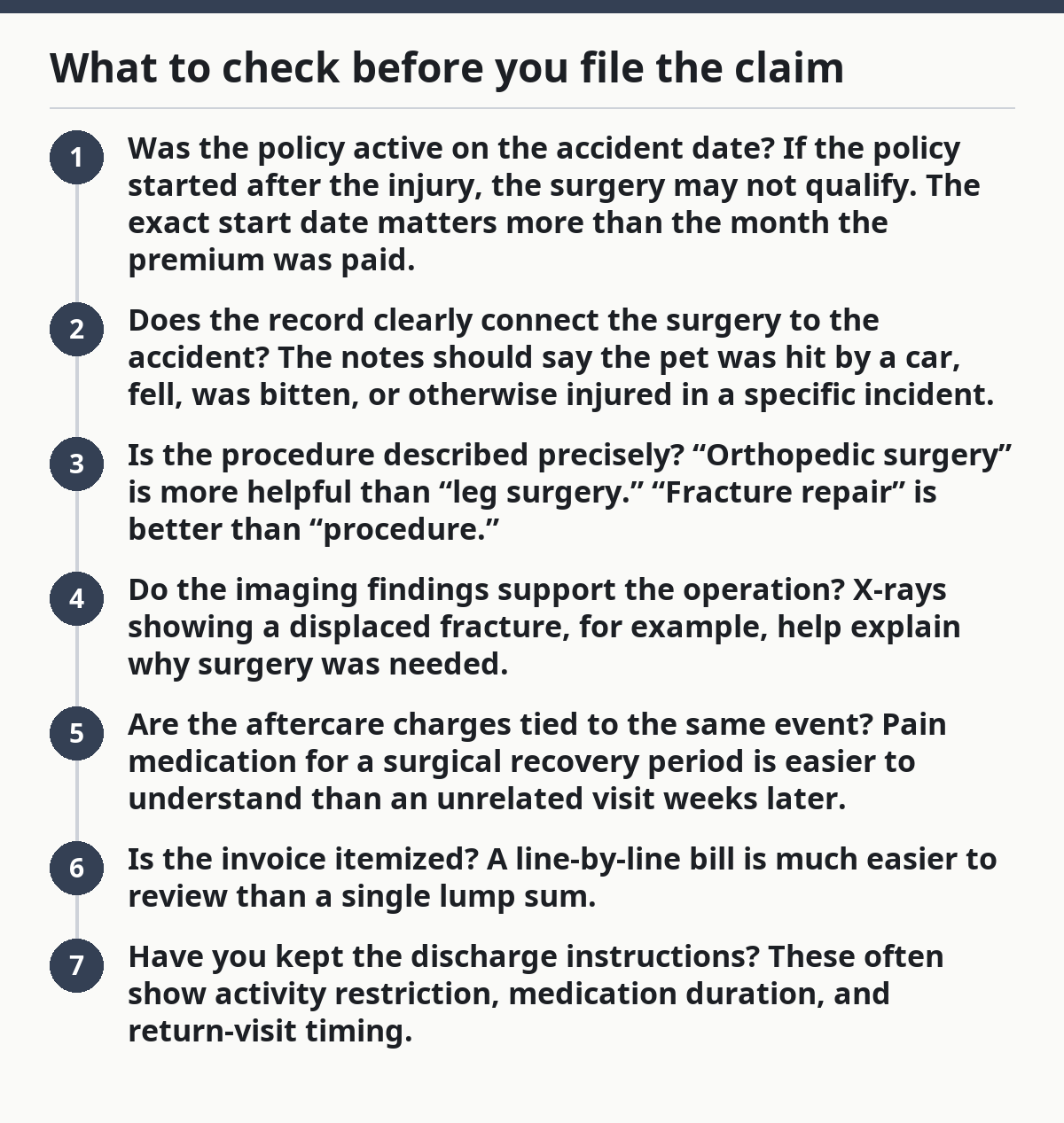
Check these points before submitting:
- Was the policy active on the accident date? If the policy started after the injury, the surgery may not qualify. The exact start date matters more than the month the premium was paid.
- Does the record clearly connect the surgery to the accident? The notes should say the pet was hit by a car, fell, was bitten, or otherwise injured in a specific incident.
- Is the procedure described precisely? “Orthopedic surgery” is more helpful than “leg surgery.” “Fracture repair” is better than “procedure.”
- Do the imaging findings support the operation? X-rays showing a displaced fracture, for example, help explain why surgery was needed.
- Are the aftercare charges tied to the same event? Pain medication for a surgical recovery period is easier to understand than an unrelated visit weeks later.
- Is the invoice itemized? A line-by-line bill is much easier to review than a single lump sum.
- Have you kept the discharge instructions? These often show activity restriction, medication duration, and return-visit timing.
A good result is not necessarily a full payment to you; it is a claim the insurer can read without chasing missing details. That may shorten back-and-forth and reduce the chance that a covered item is hidden inside a poorly labeled bill. If the insurer asks for clarification, a qualified adviser or the claims team can help match the records to the policy.
When surgery after an accident may not be covered
Surgery after an accident is not automatically paid in every case. The policy language and the medical record can both block coverage.
The policy was not active when the accident happened: The injury predates the cover — the surgery is commonly treated as outside the claim. The next step is to confirm the policy’s start date and ask the insurer how it defines the incident date.
The injury is linked to a pre-existing condition: The accident may have worsened an old problem, such as a chronic luxating patella or prior fracture site — the insurer may cover less, or none of the surgery tied to the old condition. The next step is to ask the vet to separate the new trauma from the older diagnosis if that is medically accurate.
The procedure is cosmetic or elective: Surgery that is not medically necessary, such as a non-urgent correction, is often outside accident coverage — the claim may be denied. The next step is to confirm that the surgery is documented as treatment, not preference.
The records do not prove the link to the accident: A bill alone is weak evidence — the insurer may delay or reject part of the claim. The next step is to gather the exam notes, imaging report, and discharge sheet before resubmitting.
The waiting period had not ended: Some policies have a waiting period after enrollment — the surgery may fall into that excluded window. The next step is to check the policy wording and the exact accident date.
The treatment happened outside the covered policy rules: Some policies exclude certain countries, providers, or experimental procedures — the operation may not qualify even if it was medically appropriate. The next step is to read the exclusions section or ask the insurer to point to the clause in writing.
This is where a qualified adviser can help interpret the policy against the actual bills, especially if the pet had earlier joint trouble or if the surgery mixed accident repair with another medical issue.
Common mistakes that make accident-surgery claims harder
A claim can fail for paperwork reasons even when the surgery itself is medically clear. The mistake is often not the injury; it is how the owner documents it.
- Waiting to collect records until after discharge. The consequence is missing notes or incomplete imaging reports. The better alternative is to ask for the medical record and itemized invoice before leaving the clinic when possible.
- Submitting only the receipt. The consequence is that the insurer sees a payment, not a diagnosis. The better alternative is to include the exam notes, surgical report, and any imaging summary.
- Assuming anesthesia is automatically included. The consequence is surprise when part of the bill is treated separately. The better alternative is to ask the clinic how anesthesia, monitoring, and recovery are itemized.
- Using vague accident wording. The consequence is weaker proof that the surgery was accident-related. The better alternative is to state the incident clearly: how it happened, when, and what body part was injured.
- Ignoring follow-up charges until later. The consequence is missing deadlines for supplemental claims. The better alternative is to track post-op visits, bandage changes, and medication refills from day one.
- Mixing unrelated care into the same claim packet. The consequence is confusion and possible delays. The better alternative is to separate accident surgery from routine care, unless the insurer instructs otherwise.
A policy is a contract, not a medical chart. The better the chart, the easier the contract is to apply.
When the usual answer changes
The standard answer changes when the surgery is not a straightforward single-event repair. That matters most in complicated trauma cases.
If the pet has multiple injuries from one accident, the bill may include orthopedics, soft tissue work, and internal imaging in one hospital stay. The claim still can be valid, but the owner should expect separate review of each part. A displaced fracture repaired with pins is not the same line item as abdominal exploration or wound closure.
If the pet needs staged surgery, such as an initial stabilization followed by a later definitive repair, the insurer may want both sets of records. The first operation may be classified as emergency stabilization and the second as the main procedure. That split is common after severe trauma.
If the pet has older joint disease or a previous injury, the insurer may argue that only the new trauma is covered. In that case, the vet’s notes matter more than the invoice total. A diagnosis that clearly separates acute trauma from chronic disease is easier to defend.
If the pet has complications after surgery, such as infection or delayed healing, the follow-up treatment may or may not be considered part of the original surgical claim. The policy wording on post-operative care becomes important here.
If the accident happened in a different country or region, coverage can change fast. Travel-related claims often turn on where the policy was written and where treatment was received, so the insurer’s geographic rules need to be checked before assuming the same coverage applies.
For technical wording, “orthopedic” refers to bones, joints, and supporting structures, while “soft tissue” refers to skin, muscle, tendon, and internal organs. That distinction matters because claims often read differently depending on which system was injured.
What a useful answer looks like at the end
The useful answer is not “yes” or “no”; it is “yes, if the surgery is accident-related, medically necessary, and documented well enough for the policy to match the bill.” That means the owner can usually expect a claimable path for fracture repair, many soft tissue surgeries, anesthesia, imaging, and some post-operative care, but not for every charge attached to the same visit.
A strong claim file has one accident date, one clear diagnosis, one treatment plan, and one itemized bill. If those line up, the insurer has less room to question whether the surgery belonged to the accident claim. If they do not line up, the owner may still have a valid claim, but it is worth asking the insurer or a qualified adviser to review the paperwork before a final decision is made.
Drafted with AI; not yet reviewed by a person.