Last updated: November 19, 2026
Quick Answer: choose the narrowest pet insurance coverage that still protects you from a bill you cannot absorb, then trade deductible, reimbursement rate, and annual limit against each other until the premium fits your fixed budget. For How to Choose Pet Insurance When Your Budget Is Fixed, the goal is usually to keep accident-and-illness protection and trim extras first.
Key Takeaways
- Keep the plan focused on the biggest bill you could not pay all at once.
- Core terms change both your premium and your claim payout.
- Protect the largest covered risk first, not every extra feature.
- Trim add-ons first, then raise the deductible before cutting core protection too far.
This guide is for a dog or cat owner who already knows the basics of pet insurance, has a hard monthly ceiling, and needs to decide what to sacrifice first. It assumes you can compare an accident and illness plan, read a declarations page, and tolerate a few trade-offs. This is information, not financial advice; because insurance rules, terms, and consumer protections differ by country and change over time, a qualified adviser should be consulted for your own situation.
What budget-focused pet insurance actually needs to do

Budget-focused pet insurance needs to protect you from the kind of claim you could not pay in one shot, not cover every possible expense. That usually means looking for a plan that handles unexpected injury and disease, then accepting that some routine or optional care may stay out of pocket.
The core decision is usually not “What is the cheapest plan?” It is “What level of loss would break my budget?” If a $3,000 emergency would force debt, missed rent, or a drained emergency fund, the plan has to make that loss manageable. If you can cover smaller bills but not a hospitalization, a lower-cost accident and illness plan may fit better than a richer package with lots of extras.
A generic guide can get this wrong by treating all coverages as equally valuable, so consult a qualified adviser if you are unsure. They are not. Preventive add-ons, dental extras, and prescription riders can be useful, but they are usually the first place to trim when money is fixed. The must-have benefits are the ones that match the kind of bill that would hurt most: emergency surgery, imaging, specialist care, hospitalization, and treatment for a covered illness or injury, but a professional can help you decide what matters most for your pet.
This also means you need to read exclusions before you compare numbers. Pet insurers commonly exclude pre-existing conditions, and many also limit or exclude certain hereditary, congenital, chronic, or behavioral conditions depending on the wording. Those terms matter because a lower premium can disappear as value if the condition you expect is excluded from the start.
For context on consumer protection and policy language, the U.S. National Association of Insurance Commissioners has a pet insurance consumer page, and the UK Financial Conduct Authority publishes general guidance on insurance conduct and disclosures. Those are useful references for understanding how insurers describe cover, not substitutes for reading the contract you are offered.
How do I choose pet insurance on a tight budget?
You choose pet insurance on a tight budget by ranking the biggest risk first, then choosing the cheapest plan that still covers that risk after the deductible, reimbursement rate, and annual limit are set. The order matters because these levers affect both your premium and what you may still owe after a claim.
- Write down the one bill you cannot absorb. Pick a realistic ceiling for an emergency, such as a surgery, overnight hospitalization, or a specialist referral. If your budget breaks at a four-figure bill, that is the problem the plan must address first. Verify that you are thinking about one large claim, not a string of small vet visits. A problem is trying to insure routine care before you have protected yourself from the bill that would actually derail the month.
- Choose the type of plan before you chase a price. Start with an accident and illness plan if your main concern is injury and disease, because that is the standard base coverage most owners use for financial shock. Confirm that the plan includes both accidents and illnesses, and note whether exam fees, prescription drugs, hereditary conditions, or dental illness are included or excluded. If the quote is only accident coverage, it will usually be cheaper, but it will not help with many common medical claims.
- Set the deductible at a level you can pay once per claim year or per condition, depending on the plan. The deductible is the amount you pay before reimbursement begins. A higher deductible usually lowers the premium, but you must be able to cover that amount without delay. Verify whether the deductible resets annually or by condition, because that changes how much you may pay over time. A problem is choosing a deductible so high that you would avoid claiming at all.
- Set the reimbursement rate next. The reimbursement rate is the share of the covered bill the insurer pays after the deductible. Common structures use percentages rather than fixed amounts, so a lower reimbursement rate generally lowers the premium but increases your share of the bill. Verify whether the quote uses 70%, 80%, or another structure and whether it applies before or after any deductible. A problem is assuming the lowest premium also means the lowest out-of-pocket cost after a claim.
- Choose the annual limit last among the core terms. The annual limit is the most the insurer will pay in a policy year. Lower limits usually reduce premium, but they can leave you exposed if your pet needs ongoing treatment or a high-cost procedure. Verify whether the limit is per year, per condition, or lifetime, and whether the plan has any sublimits for specific treatments. A problem is picking a limit that looks affordable but disappears after one serious event.
- Remove optional add-ons before you reduce core medical protection. Wellness plans, routine care bundles, dental cleanings, and other riders can be useful, but they are not the same as financial protection against a surprise illness. Verify what each add-on pays for and whether it simply pre-pays predictable costs you could budget yourself. A problem is spending scarce monthly room on extras while the main plan is too thin to matter.
- Check exclusions line by line. Look for waiting periods, pre-existing condition definitions, bilateral condition clauses, and any list of excluded diagnoses. Verify the conditions that matter for your pet’s age, breed, and medical history. A problem is assuming “illness coverage” means every illness is covered; it never does.
- Stress-test the quote with one likely claim. Use a simple example: a covered claim that costs more than the deductible but less than the annual limit. See whether the remaining share would still fit your budget after premium plus your expected share of the claim. If the leftover cost would still hurt, the plan is probably too thin even if the monthly bill looks friendly.
The working rule is simple: keep the base plan, trim the extras, and use the deductible and reimbursement rate to bring the premium into range. What that money buys is a reduction in financial shock from covered accidents and illnesses. What it does not buy is universal coverage, predictable reimbursement for every bill, or freedom from exclusions.
What matters most when money is limited?
What matters most when money is limited is protecting against the largest covered bill you cannot self-fund, not maximizing every feature on the quote. That means the ranking is usually: accident and illness coverage first, exclusions second, deductible third, reimbursement rate fourth, annual limit fifth, and optional add-ons last.
The mistake people make is starting with premium alone. Premium tells you what you pay every month, but not whether the plan will still be useful after a claim. A plan with a very low premium and a high deductible can be a poor fit if you would never be able to reach that deductible at the wrong time.
A second mistake is overvaluing wellness benefits because they feel tangible. A routine dental cleaning or annual exam is easier to imagine than surgery for a swallowed object or treatment for a chronic condition, but the financial damage from the latter is usually much greater. If you have to choose, core medical protection matters more than predictable spending.
A third thing to check is whether the insurer uses annual or per-condition rules for deductibles and limits. Those structures change how much protection you really get. A plan can look affordable on paper and still leave you underinsured if the limit is low or the deductible resets in a way that stacks costs against you.
If you want a working shortcut, ask one question: “Which choice lowers my premium without leaving me unable to pay a claim that would seriously hurt me?” If the answer is “drop an optional rider,” that is usually a cleaner cut than lowering the core coverage too far.
What should I trim first on a pet insurance budget?
You should trim optional add-ons first, then consider a higher deductible before you reduce the reimbursement rate or annual limit too far. That order usually preserves the protection that matters most while lowering the monthly premium.
A good example of a trim order is this:
- Remove wellness or routine-care bundles if they mainly prepay predictable visits.
- Drop extras such as exam-fee coverage only if the remaining plan still gives you meaningful protection against a major claim.
- Raise the deductible to a level you can actually pay in a crisis.
- Only then consider a lower reimbursement rate.
- Reduce the annual limit last, and only if the remaining ceiling still covers the kind of claim you fear most.
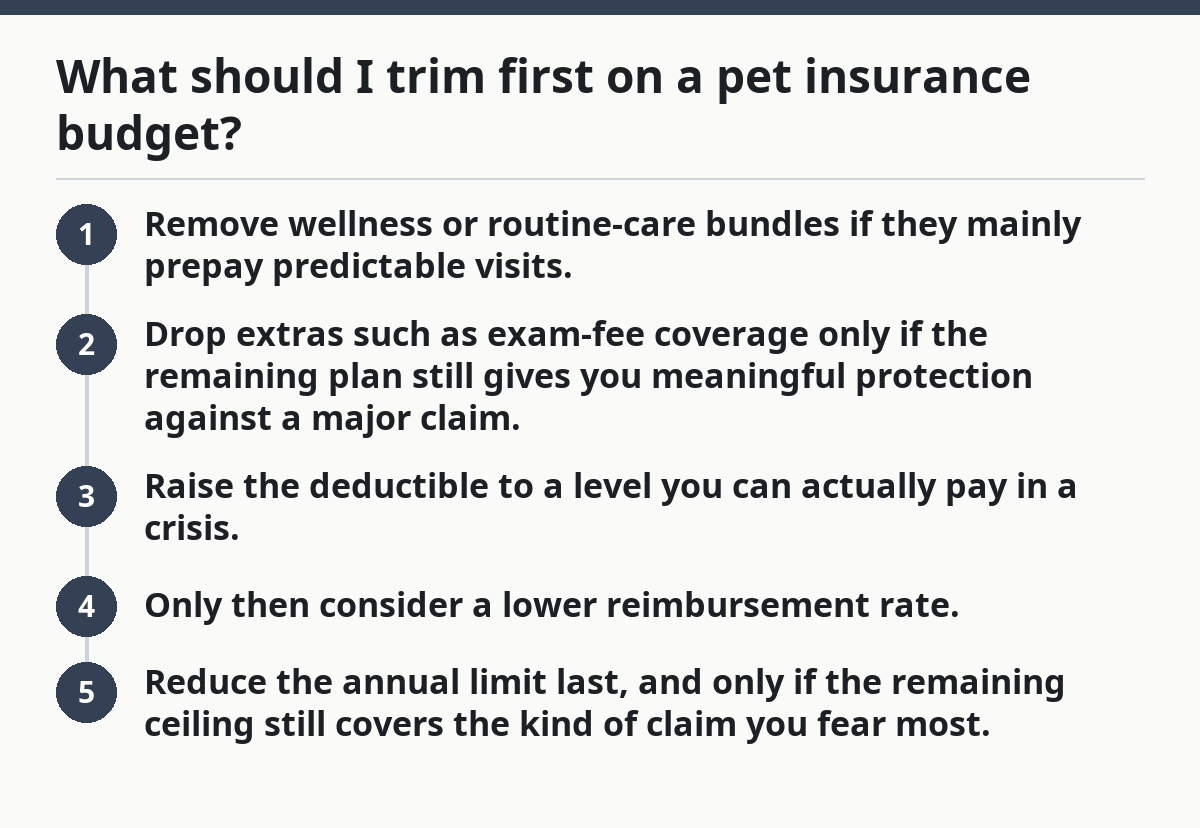
The reason this order works is simple. Add-ons tend to cover smaller, more predictable expenses, while the base plan is there for the large, disruptive bill. Raising the deductible can lower premium without deleting the core safety net, but it shifts more cost back to you when a claim happens. Lowering the reimbursement rate does the same thing, often more sharply. Cutting the annual limit can be the most dangerous move if your pet is young, large, breed-prone, or already at higher risk for costly treatment.
A “fixed budget” does not mean “buy the cheapest label.” It means “preserve the most valuable protection within a hard cap.” That is why a plain accident and illness plan with a sensible deductible often beats a fancier package with a weak core and a lot of small benefits.
When should I stop trying to save money on the plan?
You should stop trimming the plan when the next cut would leave you unable to use it for the very problem you are insuring against. At that point, the quote may be cheap but the coverage is too thin to serve the purpose.
Your pet already has a known medical issue: That condition is likely to be excluded as pre-existing, or handled with restrictions. — Get a written explanation of how the insurer defines and treats pre-existing conditions before relying on the quote.
The deductible would take more than you can pay on short notice: A low premium with an unreachable deductible is false economy. — Raise the monthly budget slightly or choose a different structure.
The annual limit is below the likely cost of the risk you fear most: One claim could exhaust the plan quickly. — Look for a higher limit or accept that the policy is only partial protection.
The policy excludes the condition, breed risk, or treatment you actually care about: The plan may not solve your real problem. — Recheck the wording and treat that exclusion as decisive, not minor print.
You are buying add-ons because the base plan feels too weak: Extras cannot fix a stripped-down core contract. — Keep the core and drop the extras, or keep shopping.
You cannot explain how the deductible, reimbursement rate, and limit work together: If the math is unclear, the cost exposure is unclear too. — Pause and read the wording or get help from a qualified adviser before committing.
The mistakes that cost budget shoppers the most
The most expensive mistake is choosing a low premium that only looks affordable. Another is assuming the same plan design means the same value across insurers. The details inside the contract determine whether the price is buying protection or just buying a label.
- Chasing the lowest monthly payment. The consequence is often a higher deductible, a lower reimbursement rate, or a small annual limit that makes claims disappointingly thin. The better alternative is to compare what a covered claim would leave you owing.
- Ignoring exclusions. The consequence is paying for coverage that cannot be used for the condition that matters most. The better alternative is to read the pre-existing condition and hereditary-condition language before deciding.
- Buying add-ons first. The consequence is squeezing the core plan until it no longer helps with major bills. The better alternative is to protect the accident and illness layer first and treat extras as optional.
- Not checking how the deductible resets. The consequence is surprise repeat out-of-pocket costs over multiple claims or conditions. The better alternative is to verify whether the deductible is annual or per condition.
- Forgetting that annual limits can be exhausted. The consequence is a policy that stops helping in the middle of a difficult year. The better alternative is to choose a limit that matches the worst bill you can reasonably imagine.
- Assuming every “illness” is covered. The consequence is disappointment when the contract excludes a specific diagnosis, procedure, or waiting period. The better alternative is to read the actual covered-services list, not the marketing summary.
A budget plan should be simple to explain in one sentence: “I pay this premium so that a covered accident or illness will not wipe out my monthly finances.” If you cannot say that sentence clearly, the plan needs another look.
What does a good budget fit look like?
A good budget fit looks like a plan you can keep paying for 12 months without strain and that still helps in the kind of claim you fear most. It is not the cheapest quote on the screen; it is the one whose trade-offs are deliberate.
The simplest test is this: if your pet had one covered emergency, would the premium plus your share of the bill still stay within the amount you can realistically absorb? If yes, the plan may be a fit. If no, the premium is not actually low enough, or the coverage is too thin.
A good result also has three visible traits. First, the contract covers accidents and illnesses rather than only one side of the risk. Second, the deductible is high enough to bring the premium down but not so high that you would avoid claiming. Third, the annual limit is large enough that one serious event does not empty the policy immediately.
It is also acceptable to decide that pet insurance is the wrong tool for part of your budget and to keep a separate emergency fund for predictable care. That is not failure; it is matching the tool to the job.
Drafted with AI; not yet reviewed by a person.