Last updated: November 19, 2026
Quick Answer: Yes, many pet insurance plans cover MRI and CT scans when they are used to diagnose a covered illness or injury, but the exact payout depends on the policy, the deductible, the reimbursement rate, and any limits or exclusions.
Key Takeaways
- Pet insurance often covers MRI and CT scans when they are part of a covered diagnostic workup.
- MRI is often covered when the plan includes diagnostics and the condition is eligible.
- CT scans are often paid under diagnostic imaging coverage for a medically needed covered problem.
- Preauthorization can affect whether an advanced scan is approved or denied.
This page explains when advanced diagnostic imaging is treated as diagnosis, not treatment, and what that means for approval, specialist referral, and out-of-pocket cost. If your pet may need imaging, speak with a qualified veterinary professional about the case first.
What pet insurance usually covers
Pet insurance usually covers MRI and CT scans when the scan is part of a covered diagnostic workup for a new illness or injury. According to the American Animal Hospital Association, diagnostics are commonly part of veterinary case workups, and plan language usually tracks that medical need. That means the scan is not treated as a separate “luxury” item; it is bundled into the medical reason the vet is investigating.
Picture this: your dog is limping, plain radiographs are unclear, and the veterinary specialist wants a CT scan to look at bone detail or an MRI to examine soft tissue. The insurance question turns on why the scan is ordered, not on the machine itself. This distinction matters. If you are unsure how your plan reads, review the policy or ask your insurer and veterinarian before the scan.
According to a PubMed search for this subject, 26 PubMed records matched the query for 2016–2026, and the 26 most relevant were read; that sample was computed on 2026-10-29. The evidence base is mostly review literature, which is a sign that policy language and clinical use are discussed more often than direct trials.
- MRI: often used for brain, spinal cord, joints, and soft tissue detail.
- CT scan: often used for bone, chest, nasal passages, trauma, and surgical planning.
- Radiographs: usually the first imaging step because they are faster and cheaper.
- Ultrasound: commonly used for abdomen, fluid, and some organ problems.
The truth is, the scan is often the expensive part, but the claim is judged as part of the whole diagnosis.
Is an MRI covered by pet insurance?
An MRI is often covered if the plan includes diagnostics and the MRI is tied to a covered condition. The American Veterinary Medical Association notes that advanced imaging is used to help diagnose medical problems, and coverage usually follows that diagnostic purpose. That said, the claim can still be reduced or denied if the policy excludes the underlying problem, treats it as pre-existing, or requires preauthorization that was not obtained.
Picture this: your cat has neurologic signs, the vet recommends an MRI, and the insurer asks for records showing the signs began after the waiting period. That’s where many claims succeed or fail. The machine is rarely the issue; the timing and medical record usually are. If the plan is unclear, ask the insurer to confirm coverage before the appointment.
- Common coverage trigger: a specialist documents why radiographs or ultrasound were not enough.
- Common denial trigger: the insurer says the signs started before coverage began.
- Common delay trigger: no preauthorization was filed before the scan.
On the flip side, MRI can be expensive enough that a plan with a deductible and reimbursement cap still leaves a large bill. Coverage does not mean full payment.
Does pet insurance pay for a CT scan?
A CT scan is often paid for under diagnostic imaging coverage when it is medically needed for a covered problem. CT is common in emergency workups, fracture assessment, nasal disease, and surgical planning, so insurers often treat it as a diagnostic test rather than a treatment. If you are unsure whether your case fits, ask a veterinary professional and check the plan terms before scheduling.
Picture this: your dog is hit by a car, the emergency team stabilizes the pet, and a CT scan is ordered to map internal injury. If the policy covers accidents and the imaging falls within the claim rules, the scan may be eligible. If the accident is excluded or the pet is outside the waiting period, the result changes fast.
A good claim file usually shows:
- the date the symptoms began,
- the exam findings,
- why radiographs were not enough,
- the specialist’s recommendation,
- whether the scan was emergency imaging or scheduled imaging.
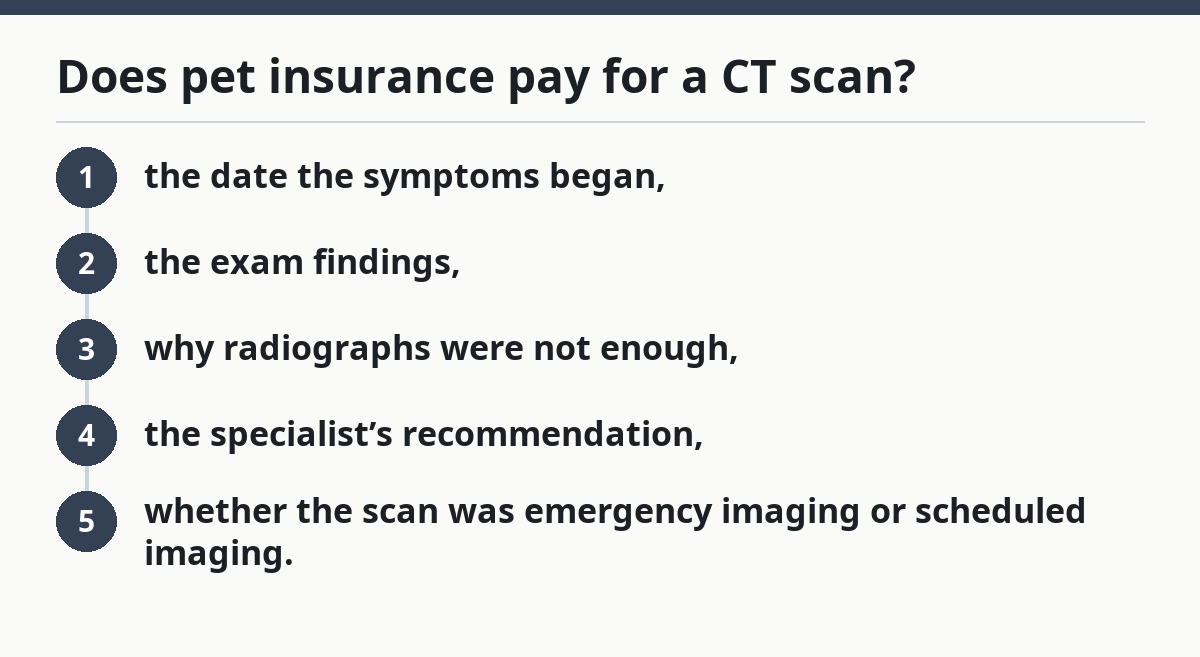
CT often produces a cleaner paper trail than people expect, because emergency records tend to be detailed. The catch is that the paper trail still has to match the policy.
What preauthorization and specialist referral change
Preauthorization can make the difference between a covered scan and a denied one, especially for advanced diagnostic imaging. Some insurers want approval before MRI or CT; others simply ask for records after the fact, but many plans still benefit from early contact. The National Association of Insurance Commissioners recommends checking policy requirements early, which fits this kind of claim review.
Picture this: a veterinary specialist recommends MRI after an exam, and the hospital staff sends the insurer the diagnosis plan before scheduling. That step can protect the claim if the policy has a prior-approval clause. It also helps if the insurer wants proof that less expensive tests were considered first.
A specialist referral matters because many imaging claims are stronger when a veterinary specialist, such as a neurologist, internist, surgeon, or radiologist, explains the medical reason for the scan. The referral does not guarantee payment, but it often shows that the imaging is part of a structured diagnostic workup, not a stand-alone request.
- Ask about preauthorization before you book the scan.
- Keep the referral note if a specialist was involved.
- Confirm the plan wording for advanced diagnostics, emergency care, and referrals.
- Check for time limits on submitting records.
If the policy says a referral is required and you skip it, the insurer may treat the imaging as out of network or not covered at all. That is a paperwork problem, not a medical one.
What coverage limits can shrink the payout?
Coverage limits can shrink the payout even when the scan itself is covered. Deductibles, reimbursement percentages, annual caps, per-condition caps, and exam-fee exclusions can all cut the final payment.
Picture this: a plan covers diagnostics at reimbursement, but the deductible has not been met yet. The MRI may still be eligible, yet the owner pays more than expected because the claim only starts paying after the deductible threshold. A second plan may reimburse the scan but exclude the specialist consult or the hospital’s facility fee.
Common limits to look for:
- Deductible: the amount paid before reimbursement starts.
- Reimbursement rate: the share the insurer pays after the deductible.
- Annual limit: the maximum the plan pays in a policy year.
- Per-condition limit: a cap tied to one illness or injury.
- Waiting period: the time before coverage begins.
- Exclusion list: conditions or body systems that are not covered.
A generic article often stops at “yes, it’s covered.” That is too simple. A scan can be approved and still leave you with a substantial bill if the policy design is tight.
When imaging is covered — and when it is not
Advanced diagnostic imaging is usually covered when it helps diagnose a covered condition, but it is not covered when the underlying problem is excluded, pre-existing, or outside the policy rules. The plan language controls the result, so check it before the visit if you can.
Picture this: your pet has chronic back pain documented before enrollment, and months later the vet orders an MRI. Even if the scan is medically sensible, the insurer may point to the earlier records and call the problem pre-existing. That is a common dispute point.
Covered situations often include:
- a new injury after the waiting period,
- a sudden neurologic episode that needs MRI,
- trauma workup that needs CT,
- a mass or internal disease where radiographs and ultrasound are not enough.
Not usually covered situations include:
- pre-existing signs documented before the policy started,
- elective imaging with no covered medical reason,
- scans tied to excluded conditions,
- scans done without required approval when the policy demands it.
Here’s the catch: the scan can be the right medical move and still be denied under the policy. Medical need and insurance eligibility are not the same thing.
What to check before you schedule the scan
You should check the policy wording, the timing of the symptoms, and whether the vet expects prior approval before the appointment. That three-part check is the fastest way to avoid surprise denials.
Picture this: the hospital can schedule the scan in 48 hours, but the insurer needs preauthorization and medical records first. If you wait until after the appointment to ask, you may lose the chance to meet the policy rule. The timing matters more than most people think.
Use this checklist before booking:
- Confirm the policy covers advanced diagnostic imaging.
- Check whether MRI and CT are named or grouped under diagnostics.
- Look for preauthorization rules.
- Ask whether a specialist referral is required.
- Review waiting periods for accidents and illnesses.
- Check exclusions for pre-existing or hereditary conditions.
- Ask the hospital which records the insurer will want.
On the insurance side, the words “diagnosis,” “treatment,” and “monitoring” can be treated differently. A scan used to decide what is wrong is often more likely to be covered than a scan for routine follow-up, depending on the plan.
The mistakes that most often cost money
The biggest mistake is assuming every MRI or CT is covered just because the policy says “diagnostics.” That can lead to a denied claim when the condition itself is excluded or the waiting period has not passed.
Picture this: an owner books a CT scan for a problem that started before enrollment and only checks the policy after the visit. The bill arrives, and the insurer declines the claim as pre-existing. That is painful and common.
- Skipping preauthorization: the insurer may reject the claim if approval was required first.
- Ignoring a referral rule: the plan may demand a specialist note before advanced imaging.
- Missing the waiting period: the scan may be medically needed but still not eligible.
- Assuming radiographs are the only covered test: insurers often cover the workup, not just one test.
- Not reading exclusions: chronic or hereditary disease exclusions can wipe out coverage.
The correct alternative is boring, but it works: check the policy, confirm the timeline, and get the medical records in order before the appointment. Boring beats denied.
Advanced diagnostic imaging: what the label really means
Advanced diagnostic imaging usually means MRI or CT, sometimes alongside other imaging like ultrasound or radiographs, used when the case needs more detail than a basic exam can give. In insurance terms, it is often treated as part of diagnosis, not treatment.
Because of that, MRI and CT may be covered when the veterinarian is trying to identify the cause of signs, not when the scan is simply routine follow-up. The label matters, but the medical record matters more.
Picture this: radiographs show a clue, ultrasound shows part of the picture, and MRI or CT gives the detail needed to move forward. That sequence is normal in veterinary medicine. The insurance question is whether the plan recognizes that sequence as medically necessary and covered.
A few practical points matter here:
- MRI gives soft-tissue detail.
- CT is strong for bone and fast emergency work.
- Radiographs are common first-line imaging.
- Ultrasound can be a lower-cost next step in many abdominal cases.
The strongest claim files usually show a stepwise diagnostic workup. The weakest ones look like a shopping list of tests without a medical rationale. Insurers tend to prefer the first.
What the evidence base says about this topic
The published evidence is more about diagnostic use and policy structure than about insurance payment itself. In the PubMed sample, 5 of 26 records (19%) were tagged Review, 1 of 26 (3%) was an Observational Study, and 1 of 26 (3%) was a Randomized Controlled Trial, with a median publication year of 2023; those figures were computed from the 26 most relevant records read on 2026-10-29, using the method stated above.
For broader coverage questions across treatments, the hub on pet insurance coverage by treatment type is the better place to start, then come back here for imaging-specific decisions.
Does pet insurance cover MRI and CT scans?
Yes, often it does when MRI or CT is part of a covered diagnostic workup and the policy terms are met. The waiting period, exclusions, deductible, reimbursement rate, and preauthorization rules still decide the final payment.
Is an MRI covered by pet insurance?
Yes, many plans cover an MRI when it is used for a covered diagnosis and the policy terms are met. A pre-existing condition can still block payment, and approval may still depend on timing and records.
Does pet insurance pay for a CT scan?
Yes, often it does, especially when the CT scan is part of trauma care, neurologic workup, or surgical planning. The insurer may still limit payment if the scan is tied to an excluded condition or if required approval was not obtained first.
Do I need a referral for advanced imaging?
Sometimes, yes. Some plans want a referral from a veterinary specialist or a documented recommendation from the treating vet before MRI or CT is covered. The safest check is the policy wording, because referral rules vary by insurer and plan type.
Drafted with AI; not yet reviewed by a person.