Last updated: November 19, 2026
Quick answer: usually only 1 part of the bill may be covered. A boarding fee during pet hospitalization can be reimbursed only if the policy treats it as part of covered hospital care; otherwise, it is often excluded as boarding or custodial care. Check the policy and invoice, and if the wording is unclear, consult your insurer, veterinarian, or a qualified adviser. See the NAIC’s pet insurance guidance and the AVMA pet insurance page for general policy terms and exclusions.
Sometimes, but only if the boarding fee is treated as part of the hospital stay and your policy covers that kind of facility charge. Many pet insurance plans pay for medical treatment and hospitalization, but not for a separate daily care fee, kennel fee, or post-op boarding charge that looks like room-and-board on the bill; if the wording is unclear, consult the insurer or a qualified adviser before filing.
Key takeaways
- A boarding fee during hospitalization is often billed separately from medical care, so coverage depends on the policy wording.
- The label on the invoice matters. “Monitoring fee” or “facility charge” may be treated differently from a pure boarding charge, so check the policy or ask the insurer if needed.
- A claim is easier to review when the hospital itemizes medical treatment, overnight monitoring, and non-medical care on separate lines, according to common claims guidance from the NAIC.
- If the stay is mostly for observation after surgery, the bill may still be covered in part, but not every extra fee will qualify.
- This is information, not financial advice; a qualified adviser should be consulted for your own policy and claim situation.
This article is for a pet owner looking at a vet bill and trying to tell whether the boarding fee during hospitalization belongs in a claim. It assumes the policyholder already has a plan, a hospital invoice, and the basic idea that pet insurance usually reimburses covered veterinary costs after a deductible and any cost-sharing. For broader claim basics, see pet insurance claims guidance and pet insurance exclusions.
What counts as a boarding fee during hospitalization?
A boarding fee during hospitalization is a charge for keeping a pet at the veterinary hospital outside the core medical treatment itself. That charge can appear as a daily care fee, kennel fee, facility charge, or overnight monitoring charge, depending on how the clinic writes invoices.
The label matters because insurers do not all treat those words the same way. A facility charge may be bundled with the hospital stay, while a boarding fee can be viewed as non-medical housing, especially if the animal is stable and simply staying overnight because the owner cannot pick up the pet. If the wording is unclear, consult the insurer or a qualified adviser before you file.
Here is the basic split most readers need to understand:
| Bill line | What it usually means | Often easier to claim? |
|---|---|---|
| Boarding fee | Housing, feeding, and routine care | No, unless policy wording says otherwise |
| Facility charge | Hospital overhead tied to treatment or stay | Sometimes |
| Monitoring fee | Observation, checks, or nursing oversight | More likely than pure boarding, but not always |
| Daily care fee | General care during the hospital stay | Depends on how the insurer defines it |
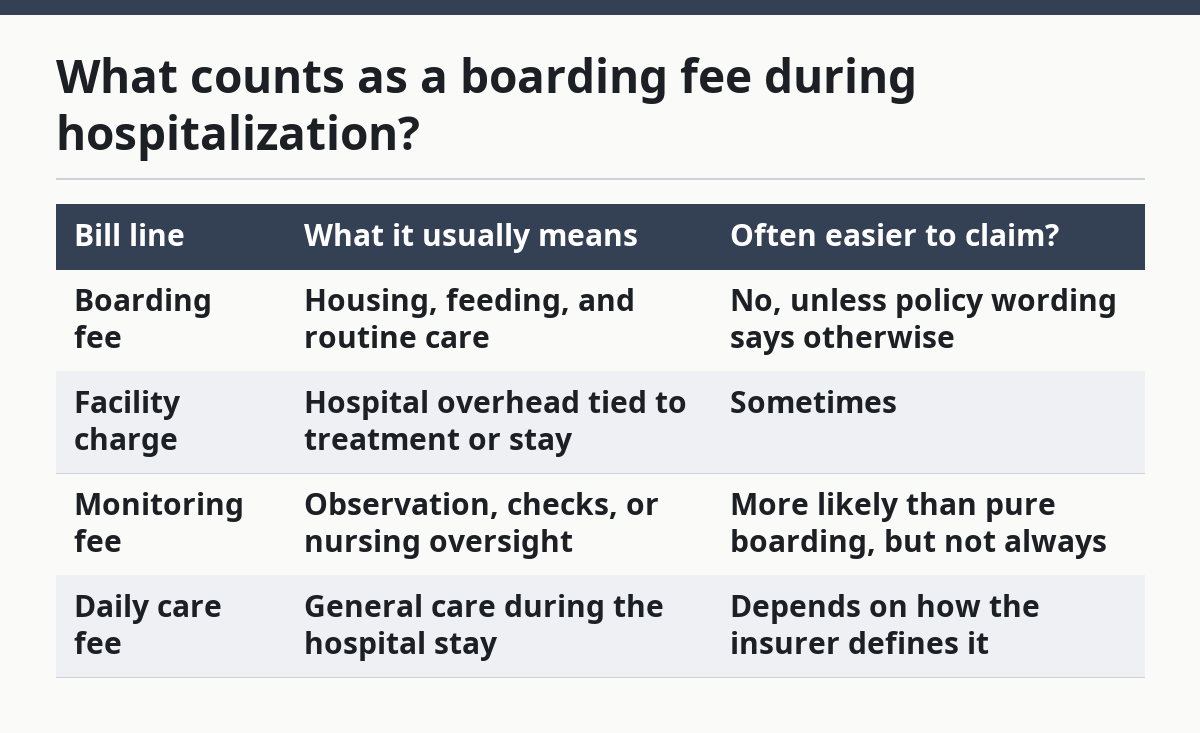
That split is why two invoices from the same clinic can lead to different claim outcomes. The bill may show one total for a 2-day hospital stay, but the insurer may only reimburse the part tied to medical care and skip the part that looks like non-medical boarding.
How pet insurance usually treats these charges
Pet insurance usually covers medical treatment first and treats housing or routine care as a separate expense. That means the covered part is often the exam, surgery, medicine, diagnostics, or medically necessary monitoring, while the non-covered part is the kennel space or overnight care that is not itself treatment.
The key question is whether the charge was required for medical reasons or added because the pet could not go home yet. A post-op boarding charge after anesthesia may still be reviewed as part of the hospital stay, but the insurer may deny the portion that is really room-and-board rather than treatment; if you are unsure, ask the insurer to explain how it applies the policy.
Policies vary by country, insurer, and plan tier, so there is no universal rule. A plan may cover “hospitalization” without covering every facility charge that appears on the same invoice, and another plan may exclude boarding fees in plain language. The policy wording is the controlling document, not the clinic’s billing label. For plan comparisons, see pet insurance coverage and pet insurance deductible basics.
One useful way to think about it is this: if the line item pays for the pet’s medical care, it has a better chance of being eligible. If it pays for the pet to stay somewhere because the owner cannot take it home, coverage is weaker.
What should you check before filing the claim?
You should check the policy wording, the invoice labels, and the reason for the stay before you submit the claim. Those three things usually decide whether a boarding fee during vet hospitalization gets paid, partly paid, or denied.
Start with the policy’s exclusions section and look for terms such as boarding, kennel, custodial care, non-medical boarding, or routine care. Then review the hospital invoice line by line and separate the daily care fee from the surgery, medication, x-ray, lab work, and actual monitoring.
A clean claim file often needs these checks:
- Confirm whether the policy covers hospitalization at all, because a boarding fee cannot be covered if the stay itself is excluded.
- Look for any exclusion for kennel fees, boarding fees, or custodial care in the policy wording.
- Ask the clinic for an itemized invoice if the bill shows one lump sum for a 1-night or 2-night stay.
- Mark the lines that are medical, such as surgery, drugs, and observation, and the lines that are housing-related.
- Check whether the pet stayed because of medical monitoring or because pickup was delayed for convenience.
- Keep discharge notes, since they can show whether the extra night was medically tied to recovery or simply administrative.
- Submit the claim with the full invoice and any explanation from the hospital if the billing label is ambiguous.
A problem shows up when the invoice uses one broad term like “hospital boarding” without separating treatment from room charges. In that case, the reviewer may ask for more detail, and that can slow payment even when part of the stay is eligible.
How do you tell a medical stay from simple boarding?
A medical stay is tied to treatment, while simple boarding is tied to housing. That difference often decides whether a monitoring fee or facility charge is more likely to be reimbursed than a plain kennel fee.
The strongest sign of a medical stay is active care: anesthesia recovery, post-op checks, fluids, pain control, lab monitoring, or observation ordered by the clinic. The weaker sign is a pet staying overnight only because the owner could not collect the animal before closing time.
Look for language on the invoice or discharge sheet that shows medical necessity. Terms such as “post-op monitoring,” “overnight observation,” or “hospital care” usually point toward treatment-related billing, while “boarding,” “kennel,” and “daily care” usually point toward custodial care.
If the pet was in the hospital for surgery, the stay may include both. That is common, and it is why one line on the claim may be eligible while another line is not. The claim does not need to be all-or-nothing, but the exact split depends on the policy.
When will the standard answer not apply?
The standard answer does not apply when the stay is mostly non-medical, when the bill is bundled, or when the policy uses a narrow definition of covered care. In those cases, a boarding fee during hospitalization may be denied even if the pet was physically in the hospital.
The invoice is one flat “hospital stay” charge: It hides the medical and non-medical parts, so ask the clinic to itemize the bill before filing.
The pet stayed after discharge was medically complete: The extra night looks like custodial care, so expect weaker coverage for that day’s fee.
The clinic billed a kennel fee separate from treatment: That is usually housing, not care, so do not assume it matches a covered monitoring fee.
The policy excludes boarding or custodial care: The wording controls the claim, so check whether any medical part of the stay is still listed separately.
The stay was mainly for owner convenience or scheduling: The reason was not treatment, so expect denial for the non-medical portion.
The bill mixes post-op boarding with nursing care: The insurer may split the charge, so ask for line-item detail to protect the medical part of the claim.
Those are the points where a simple yes or no breaks down. The result often depends on one line item, one exclusion, or one discharge note.
What mistakes make claims harder?
The biggest mistake is treating every hospital charge as if it were medical. That can turn a mixed bill into a denied claim, or at least delay review while the insurer asks for more records.
Another common error is filing with a single invoice that has no breakdown. If the clinic lists “boarding during hospitalization” as one lump sum, the insurer has little way to separate the covered monitoring fee from the non-covered kennel fee.
A third mistake is assuming that a nightly charge is automatically the same as a medical room charge. A daily care fee can sound clinical, but the wording may still describe housing rather than treatment.
A fourth mistake is skipping the discharge paperwork. The discharge note often shows why the pet stayed, and that can matter more than the invoice title.
A fifth mistake is guessing from a website summary instead of the actual policy PDF. Coverage language can differ inside the same insurer’s plan tiers, and summaries rarely spell out how a facility charge is handled.
The better alternative is simple: collect the invoice, the discharge note, and the policy wording before you submit the claim. That gives the reviewer a clear record to match against the exclusion language.
What if the hospital stay and boarding are mixed together?
Mixed bills are common, and the cleanest way to handle them is to separate the medical care from the housing charge before you submit the claim. That is the best chance to get the eligible part reviewed without dragging the whole invoice into a denial.
A good mixed bill usually has distinct lines for surgery, medication, monitoring, and boarding. If your clinic does not separate them, ask for a corrected invoice or an itemized statement that shows each 1-day or overnight charge on its own line.
This is where a “facility charge” can be confusing. In one clinic, it may mean the pet occupied a hospital cage while receiving medical monitoring. In another, it may mean a separate room-and-board fee that looks just like boarding.
If the bill cannot be clarified, the insurer may default to the plainest reading of the charge. That is why the words on the invoice matter as much as the care itself. The closer the line item is to custodial housing, the less likely it is to be covered.
Questions people ask right away
The short answer is that pet insurance may cover a boarding fee during vet hospitalization only when the fee is tied to covered medical care or a covered hospital stay. If the charge is really kennel space, daily care, or a non-medical overnight hold, it is less likely to be reimbursed.
That answer still leaves a few common follow-ups, and they matter because the labels are messy. A hospital may call the same cost a monitoring fee, facility charge, or boarding fee depending on how it is billed.
Is overnight monitoring the same as boarding?
No, overnight monitoring is not the same as boarding. Monitoring means the pet is being watched for medical reasons, such as post-op recovery or observation after treatment, while boarding usually means housing and routine care. An insurer may treat the first as part of hospitalization and the second as a non-medical charge.
Are kennel fees ever included in a claim?
Yes, kennel fees can sometimes be included if the policy wording treats them as part of a covered hospital stay, but that is not the default. More often, a kennel fee is viewed as a separate boarding cost. The invoice should show whether the fee paid for medical observation or just for keeping the pet overnight.
Do discharge delays change coverage?
Sometimes they do, because the reason for the extra time matters. If the pet stayed longer for medical observation, the extra charge may fit the hospitalization benefit better than if the discharge was delayed for pickup timing. A discharge note can help show which part of the stay was medically necessary.
Bottom line for a boarding fee during hospitalization
A boarding fee during hospitalization is covered only when the policy and the invoice make it part of eligible medical care. If the charge is really a facility charge tied to treatment, it has a better chance of being reimbursed than a plain kennel fee or daily care fee.
The practical move is not to guess from the wording alone. Read the policy, ask for an itemized bill, and separate the monitoring fee from the housing charge before filing. If the policy language is unclear, a qualified adviser should review the policy details for your situation because coverage rules and exclusions can differ by plan and country.
Drafted with AI; not yet reviewed by a person.