Last updated: November 19, 2026
Medical record reviews can decide whether a pet’s condition is covered, treated as pre-existing, or held for more information. They matter most during underwriting and claims review, and the result often turns on dates, symptom history, and what the veterinary records actually say. This is information, not financial advice; for a case that could affect money or coverage, a qualified adviser should be consulted for your situation.
Key takeaways
- Record reviews are used twice: once when an insurer assesses risk, and again when it checks a claim.
- The deciding details are usually dates, symptom notes, diagnoses, and gaps in the veterinary records.
- Missing pages do not always mean a denial, but they can slow the decision or trigger a narrower review.
- The best outcome is a clean paper trail, not a polished explanation after the fact.
- If the file is messy, a case can move from routine review to dispute fast.
Who this is for, and who should skip it
This applies to pet owners who already have a policy or are comparing policies and want to know how medical record review changes coverage decisions. It assumes you have access to veterinary records, know your pet’s symptom timeline, and can read a claim explanation without guessing at the terms. If you do not have those records yet, the first problem is not coverage logic; it is getting the file complete enough to review.
This is also for people deciding whether a condition looks likely to be covered, delayed, or flagged as pre-existing based on what appears in the chart. That can include routine care notes, vaccine visits, sick visits, referrals, and the diagnosis date that first appears in the record. The review process is often less about the final diagnosis than about what the record shows before that diagnosis was written down.
This is not the right page if you want a list of what to put on an application, or a fix for a vet office that has not sent records for a specific claim. Those are separate problems. It is also not the right tool if the file involves a contested medical judgment, a rushed timeline, or records from more than one clinic with mismatched dates. In those cases, a qualified professional who can look at the whole file is the better route.
What does a medical record review actually check?
A medical record review checks whether the paper trail supports the coverage decision being made. In pet insurance, that usually means an underwriter or claims reviewer looks for the first mention of symptoms, the date a diagnosis appears, and any note that suggests the condition started before coverage rules allow it.
The review is not just a search for a label like “arthritis” or “vomiting.” It also looks at context around the note. A one-line mention in a wellness visit, a referral note from a specialist, or a 3-month history of coughing can matter more than the final diagnosis name. The reviewer is trying to connect the dots between the symptom timeline and the policy terms.
That is why veterinary records are so influential. A clean record with dates, exam notes, and follow-up visits gives the insurer a timeline to work from. A thin record with gaps, missing pages, or vague wording gives the insurer more room to ask for more documents or to treat the condition conservatively.
For a broader explanation of how coverage rules fit together, the hub on pet insurance coverage rules is the place to start.
How do medical record reviews affect coverage decisions?
Medical record reviews affect coverage decisions by giving the insurer evidence to place a condition into one of a few buckets: covered, excluded, delayed for more review, or denied as pre-existing. The same record can help one claim and hurt another, depending on what the insurer is checking.
The biggest pressure point is timing. If the records show symptoms before the policy date, before the waiting period ends, or before an add-on took effect, the insurer may treat the condition differently from a new illness that first appears later. Diagnosis dates matter, but so do the earlier symptom notes that show the condition was already underway.
The other pressure point is consistency. If one record says the issue began “last week” and another says it has been going on for “months,” the reviewer may pause. That does not always mean a denial, but it often means more scrutiny. A claim can also be narrowed if the reviewed records support only part of the treatment, not the whole episode.
Here is a simple comparison of how the same review can land in different places:
| Review result | What the insurer is usually checking | Who it helps | What to skip |
|---|---|---|---|
| Covered | No prior symptoms, no conflicting notes, treatment fits policy terms | People with a clean timeline and complete records | Do not assume a diagnosis name is enough |
| Held for more review | Missing pages, unclear dates, or mixed notes from different clinics | People who can produce more records fast | Do not ignore requests for the chart details |
| Excluded as pre-existing | Symptoms or diagnosis appear before the policy point the insurer uses | People who need to know the real risk before filing again | Do not rely on the final diagnosis alone |
| Partially covered | Some services fit the policy, others do not | People with mixed claims, such as exam plus treatment | Do not treat one approved item as proof the rest will pass |
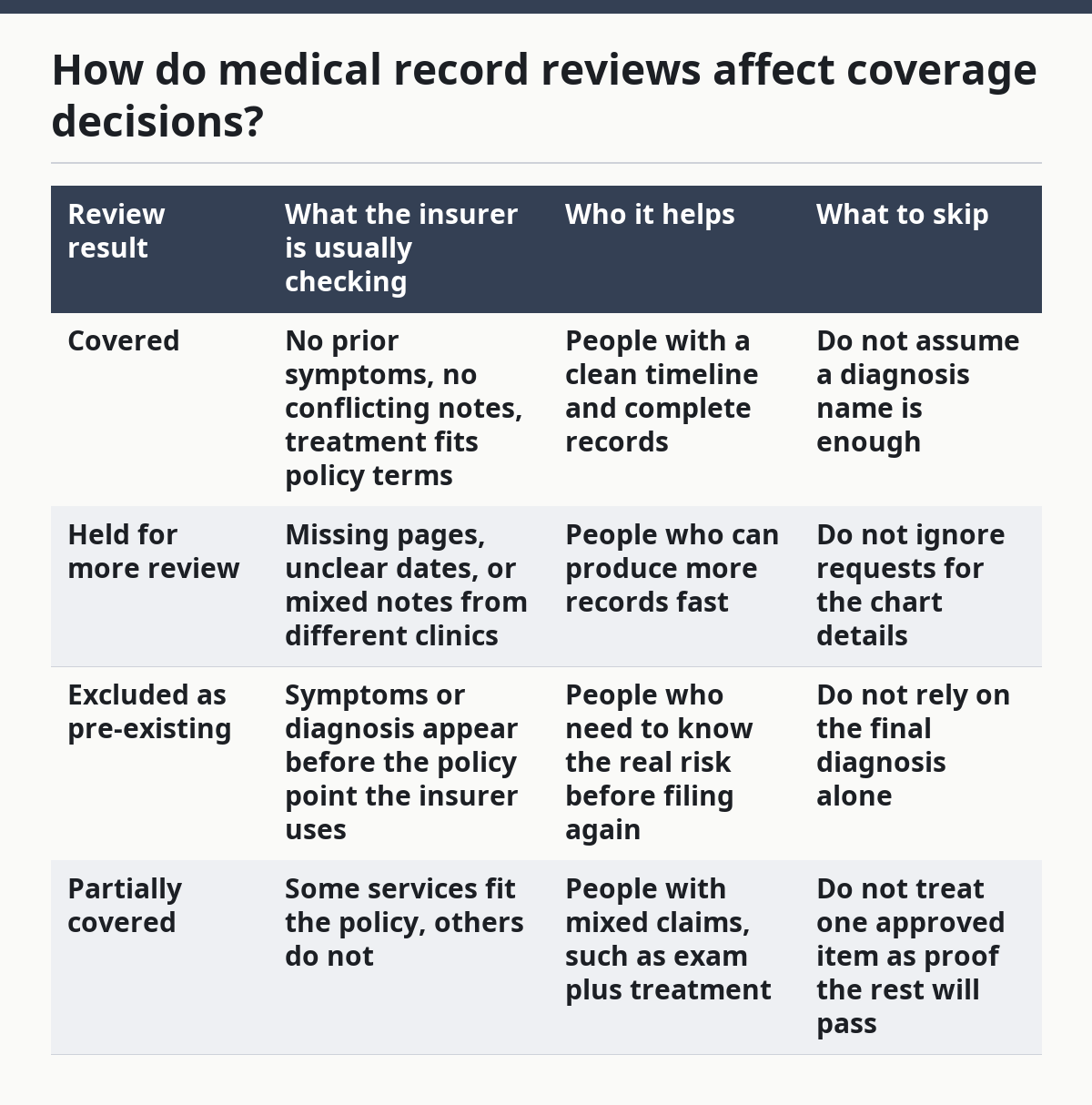
This is why a record review is not a formality. It can change the decision itself, not just document it after the fact.
How do symptom dates and diagnosis dates change the decision?
Symptom dates and diagnosis dates change the decision because insurers often care about when the condition began, not only when a vet named it. A diagnosis date can be later than the first clinical signs by weeks or even months, and that gap is where many coverage disputes start.
A useful way to read the file is to build a timeline with 3 points: first symptom, first veterinary mention, and first diagnosis. If those points line up after the policy start and after any waiting period, the file is usually easier to review. If symptoms appear earlier in a note, the insurer may treat the condition as already existing, even if the diagnosis came later.
This is where missing records can matter. One blank month in the chart can make the timeline look clean when it was not, or messy when it was. The reviewer may ask for earlier notes, specialist records, imaging reports, or follow-up visits to fill the gap.
The timeline also affects how far back the insurer looks. In practice, that lookback is not a fixed universal rule, because policy language and country rules differ. The safest reading is that the insurer can review as far back as the records needed to judge whether the condition was present before the policy point it is testing. A 2-line summary from a clinic is rarely enough for that job.
What records usually matter most?
The records that matter most are the ones that show dates, clinical signs, and what the vet observed over time. That usually includes exam notes, discharge summaries, referral letters, lab reports, imaging reports, and any follow-up entries that show whether the condition improved, stayed the same, or got worse.
The insurer may ask for the full veterinary record set instead of just the page that mentions the claim. That is because a single line can be misleading without the surrounding notes. A sick visit on one date, a recheck 10 days later, and a medication change can tell a much clearer story than a diagnosis code alone.
A good file usually answers three questions: when did the problem start, what did the vet find, and what happened next. If those answers are spread across different clinics, the reviewer may need records from each one. If the pet moved between general practice and a specialist, both sets of notes can matter.
The most common weakness is not the diagnosis itself but the record trail. A claim can stall when the chart has vague wording, no clear symptom start, or an unexplained gap between visits. That is one reason record review affects both underwriting and claims review: the same paper trail is used to assess risk and to test coverage.
When should the review stop being DIY?
The review should stop being a solo job when the file has a disputed timeline, mixed records from multiple clinics, or a coverage decision that turns on one note. In those cases, the paperwork itself is part of the problem, and a quick read-through is not enough.
Symptoms began before the policy date: The insurer may treat the condition as pre-existing — stop treating the issue as a routine claim and read the policy wording with qualified help.
The chart has missing months or blank pages: The timeline may be incomplete — gather the full record set before pushing for a decision.
Two clinics used different dates for the same problem: The file is inconsistent — expect a deeper review and do not assume the newest note controls.
The diagnosis came after several symptom notes: The diagnosis date may not protect the claim — focus on the earlier symptom entries first.
The insurer asks for more records after an initial review: The claim is not settled yet — the decision may change once the full chart is reviewed.
Part of the claim is approved and part is not: Coverage is being split by service or date — separate the approved items from the disputed ones before you rely on the outcome.
These are the points where the issue stops being simple paperwork and starts becoming a records problem. A careful read can still help, but the stakes are higher than a normal claim check.
What mistakes make the decision worse?
The biggest mistakes are filing before the timeline is clear, assuming a diagnosis date is enough, and sending only the records that seem helpful. Each one can distort the picture the reviewer sees.
One common error is to ignore small symptom mentions such as limping, vomiting, or itching because they seem minor. Those notes can become the anchor for a pre-existing finding. The better move is to line up every relevant entry, even the ones that look harmless on their own.
Another mistake is to treat “records requested” as a denial. It is usually a sign that the reviewer wants more context, not proof that the claim is lost. The cost of that mistake is delay and confusion, not just frustration.
A third mistake is to rely on memory instead of the chart. Pet owners often remember the first clear emergency, not the earlier subtle signs. The record review does not care what seemed important at the time; it cares what the notes say.
A fourth mistake is to assume all veterinary records are equally complete. Some notes are brief and some are detailed. When the timeline matters, the most detailed note is not always the most important one; the earliest note often is.
How long does the review take, and what should a good result look like?
A good result is a decision that matches the policy language and the record trail, even if the answer is not the one the owner hoped for. That means the insurer explains which dates, symptoms, or notes drove the decision and does not leave the file hanging in vague language.
How long the review takes depends on how complete the records are and whether one clinic or several clinics are involved. A complete file usually moves faster than one with missing pages or conflicting dates, because the reviewer does not need to stop and ask for more context. A 1-clinic record set is often simpler than a file that crosses general practice, emergency care, and a specialist.
A good review also leaves a clean trail for the next step. If the claim is covered, the reason should connect to the record. If it is excluded, the reason should point to the timeline or prior notes, not to a guess. If more records are needed, the request should be specific enough to identify what part of the chart is missing.
That clarity matters because medical record review is where pet insurance coverage decisions often begin to harden. Once the date trail is set, it can be hard to change later. The best outcome is not “fast at any cost”; it is a decision that follows the medical records, the underwriting rules, and the claim file without leaving hidden gaps behind.
Drafted with AI; not yet reviewed by a person.