Last updated: November 19, 2026
Quick answer: yes, sometimes — but usually only when the policy treats the telehealth or virtual vet visit as a covered veterinary consultation, not just advice by phone or chat. Many pet insurance policies will reimburse telemedicine if it is tied to an eligible illness or injury and the insurer accepts the visit record, while others exclude virtual care or limit it to follow-up use. If you are unsure how your plan reads, consult a veterinarian and the insurer before you file.
Key takeaways
- Virtual vet care may be covered when it functions like a real exam, not a casual advice call.
- The policy wording matters more than the app, clinic, or video platform used.
- Tele-triage is often a gray area, and some plans do not reimburse it.
- A covered virtual visit may still need an in-person exam later, depending on the insurer’s rules and the pet’s condition.
- State rules can change what a veterinarian is allowed to do remotely, which can affect coverage.
- For many plans, the deciding detail is whether the invoice shows a covered veterinary consultation.
This is information, not financial advice. A qualified adviser should be consulted for your own situation if the claim terms, deductible, or reimbursement rules are unclear.
What counts as a telehealth vet visit?
A telehealth vet visit is a remote veterinary consultation done by video, phone, or chat, and coverage depends on how the insurer classifies it. Some policies treat it as a normal exam substitute, while others see it as advice only and exclude it from reimbursement.
That distinction matters because pet insurance usually pays for eligible treatment after a covered event, not for every contact with a veterinarian. A 10-minute video call about itchy skin may count as triage in one plan and as a covered consultation in another. The label on the bill is not enough on its own; the policy language controls the claim. For a plain-language overview, see the AVMA telehealth guidance.
The term “telemedicine” usually means clinical care delivered at a distance, while “tele-triage” means sorting urgency and giving next-step advice. A “virtual visit” can cover either one, which is why the same app session may be reimbursed under one policy and denied under another. If you are comparing plans, check the pet insurance claims process and the pet insurance glossary.
How coverage usually works
Coverage usually works by asking three questions: was the visit allowed under local veterinary rules, was it for a covered condition, and does the policy include remote care at all. If the answer to any one of those is no, the claim can fail.
A simple way to think about it is this: the insurer is not paying for the medium, it is paying for the medical event. A video consult that leads to a diagnosis, treatment plan, or follow-up care may be treated differently from a short call that only confirms the pet should be seen in person. The difference often shows up in the invoice wording, such as “consultation,” “exam,” “advice,” or “triage.” The NAIC consumer page on pet insurance explains why policy terms matter.
Some insurers cover virtual visits only when they are tied to a covered illness or injury and documented by a licensed veterinarian. Others allow telehealth only after an established relationship exists, which means the pet has already had an in-person exam. State rules can affect that part, because remote prescribing and remote assessment are not handled the same way everywhere.
A useful reference point is the AVMA telehealth guidance, which explains how veterinary telehealth is used in practice. The rules that govern coverage can also be shaped by state veterinary boards, so the plan may look different from one state to another.
Which visits are more likely to be reimbursed?
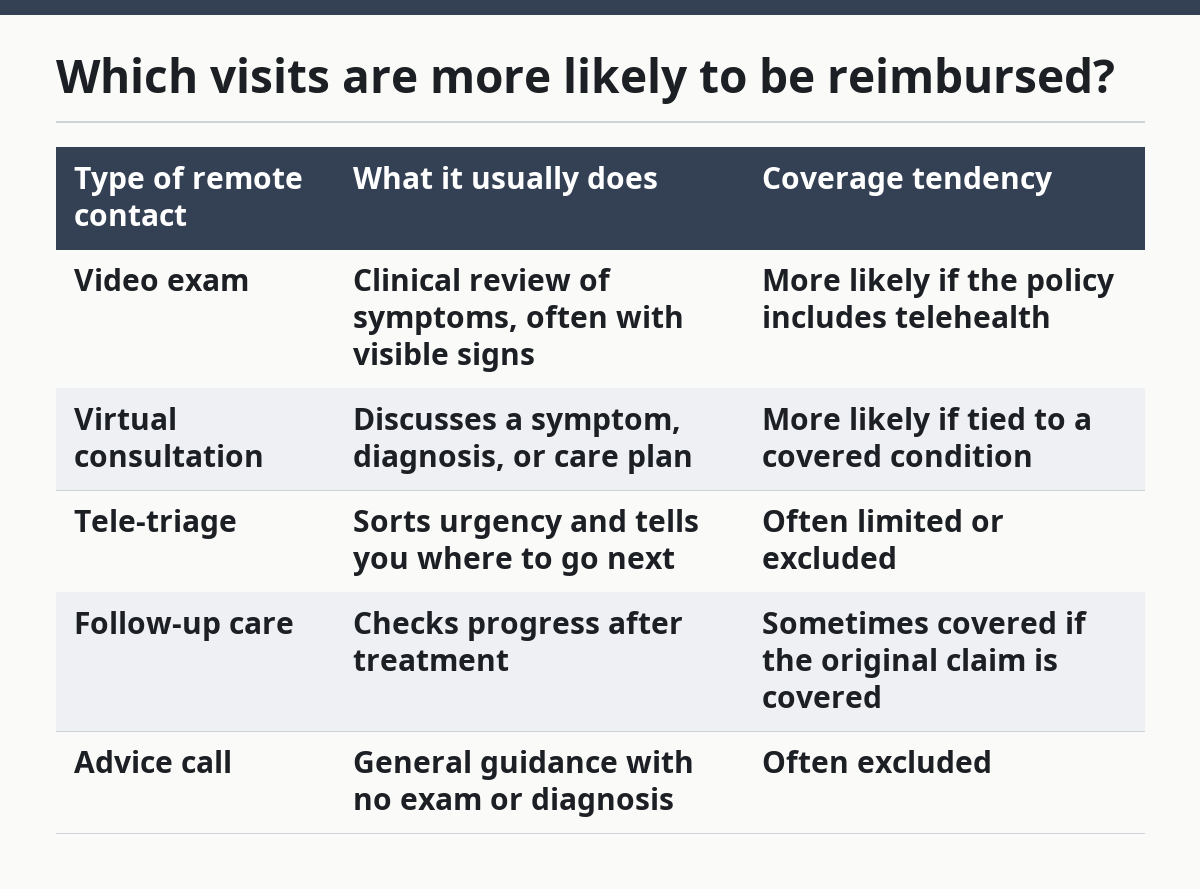
Virtual visits are more likely to be reimbursed when they function like a real veterinary consultation and less likely to be reimbursed when they are only advice. The table below shows the common split.
| Type of remote contact | What it usually does | Coverage tendency |
|---|---|---|
| Video exam | Clinical review of symptoms, often with visible signs | More likely if the policy includes telehealth |
| Virtual consultation | Discusses a symptom, diagnosis, or care plan | More likely if tied to a covered condition |
| Tele-triage | Sorts urgency and tells you where to go next | Often limited or excluded |
| Follow-up care | Checks progress after treatment | Sometimes covered if the original claim is covered |
| Advice call | General guidance with no exam or diagnosis | Often excluded |
The hardest line is between a covered exam and an excluded advice call. A 15-minute video visit can still be denied if the insurer views it as general counseling rather than an exam. The same is true for a chat session that never results in a formal medical record or treatment recommendation.
This is where a policy’s definitions matter more than its marketing language. “Virtual care” may sound broad, but the contract may only reimburse telehealth when it replaces an in-person exam that would otherwise have been needed. If the plan never says that, it may be outside the benefit. If you want to compare terms, start with covered treatments and pet insurance exclusions.
What should you check before you file a claim?
You should check the policy language, the invoice, the veterinarian’s notes, the state rules, and the timing of the visit before you file. Those five items decide most telehealth claims.
-
Read the coverage section for telehealth, telemedicine, or virtual visits. Look for exact wording, not summaries on a sales page. Verify whether remote care is included, and flag any phrase that says “advice only,” “not covered,” or “subject to an exam requirement.” A problem sign is vague wording with no definition.
-
Check whether the condition is eligible. Some plans cover illness and injury but not wellness or routine care. Verify whether the virtual visit was for a covered event, not a general check-in. A problem sign is a bill that only says “consultation” with no diagnosis or injury listed.
-
Confirm the veterinarian is licensed for remote care in the right state. State rules can affect whether a telemedicine visit is valid. Verify the clinic’s location, the pet owner’s location, and whether a veterinarian-client-patient relationship is already in place if the policy requires it. A problem sign is a state mismatch or unclear licensing status.
-
Ask for an itemized invoice. The bill should separate consultation, exam, medication review, and any follow-up. Verify that the remote service is described clearly enough for a claims adjuster to match it to the policy. A problem sign is one flat fee with no service description.
-
Save the visit notes. Screenshots, PDFs, and emails help show what happened during the 5- to 30-minute visit. Verify that the record states the reason for the visit, the advice given, and the next step. A problem sign is a chat log with no professional sign-off.
-
Check the deductible and reimbursement rules. A covered telehealth visit can still leave a large out-of-pocket share if the deductible has not been met. Verify how the claim is applied in the policy year. A problem sign is assuming a covered service will be reimbursed right away.
-
Watch the timing of the claim. Some policies require the visit to fall within the policy period and after the waiting period. Verify the dates before filing. A problem sign is a consultation that occurred before coverage started.
When does telehealth not count?
Telehealth does not count when the policy excludes advice-only contacts, when state rules block the remote service, or when the visit is not tied to a covered condition. In those cases, the insurer may treat the contact as informational rather than medical.
Advice-only call: This usually means the veterinarian gave general guidance without a formal exam — File with caution, because many plans deny advice calls even when they are useful in real life.
No licensed vet involved: This means the contact was with a technician, app agent, or general support line — The claim may fail because pet insurance usually looks for a veterinary service, not customer support.
Wellness check with no illness or injury: This means the visit was preventive rather than treatment-based — Many plans exclude routine care unless a wellness add-on exists.
State rule conflict: This means the remote service may not meet local veterinary practice requirements — The visit may be valid as advice but not as a reimbursable exam.
No documentation: This means the insurer cannot verify what was done — Submit the claim only if there is a clear record, or expect a denial.
Policy exclusion for virtual care: This means the contract leaves telemedicine out or limits it sharply — The remote visit will likely not be reimbursed, even if the clinic billed for it.
What mistakes do people make with virtual vet claims?
People usually lose money on telehealth claims by assuming a video call is treated the same as an office visit. It is not. The policy can separate them by a single word.
One common mistake is filing a claim for a general advice call. The result is often a denial, because no exam or covered diagnosis appears in the record. The better move is to check whether the invoice labels the visit as a consultation, exam, or triage.
Another mistake is ignoring state rules. A telehealth session can feel official and still fail the insurer’s test if the veterinarian was not allowed to deliver that service remotely in that state. The fix is to verify location and licensing before assuming the claim is valid. For more context, see the veterinary telemedicine basics.
A third mistake is leaving out documents. Without an itemized invoice and visit notes, the insurer may not be able to tell whether the contact was a covered veterinary consultation. The better alternative is to keep the bill, chart note, and any follow-up instructions together in one file.
A fourth mistake is assuming follow-up care is always covered because the first visit was. Some plans pay for the first telehealth exam but not every remote follow-up. The better alternative is to check whether the policy treats follow-up care as part of the original claim or as a separate service.
When should you expect a claim problem?
A claim problem is likely when the visit is only advice, when the policy excludes telehealth, or when the paperwork does not show a covered service. In those cases, the issue is not the pet’s need for care; it is the insurer’s definition of a payable event.
If the telehealth visit led to medication, the claim may still face trouble if the policy requires an in-person exam first or if the medication review does not meet the plan’s rules. If the visit was the only contact and no diagnosis was made, the insurer may classify it as triage. If the invoice is vague, the claim may stall until more records are sent.
The practical test is simple: if the claim file cannot show a veterinary consultation that fits the policy’s definitions, reimbursement is harder to justify. That is why telehealth is often easiest to claim when it is paired with a clear medical reason, a clear record, and a policy that mentions remote care directly. If you are unsure, ask the insurer for a written coverage decision before you submit.
How do you compare telehealth with in-person care on a policy?
You compare them by looking at the policy’s definition of a covered exam, not by assuming both visits are treated the same. A telehealth visit may count as an exam in one plan and as excluded advice in another.
The cleanest comparison is this:
- In-person exam: Usually easier to document and easier for an insurer to classify.
- Telehealth exam: Can be covered, but only if the policy allows remote care.
- Advice call: Often the weakest form of coverage.
- Follow-up virtual care: Depends on whether the original claim was covered and whether the plan allows remote follow-up.
That makes telehealth useful, but not automatic. It can help with access, time, and early sorting of symptoms, yet it can also create claim friction if the paperwork is thin or the policy is narrow. The best reading of the contract is plain: if remote care is named and defined, it has a better chance of reimbursement; if it is not, the visit may be medically useful but financially unreimbursable.
Are video visits covered like regular exams?
Sometimes they are, but only when the policy says telehealth or virtual visits are covered and the veterinarian’s record shows a true medical consultation. A video visit that looks like a standard exam in the chart may be reimbursable. A short video chat that only gives general advice is more likely to be denied.
Do insurers cover tele-triage?
Often not in full, because tele-triage is usually treated as urgency sorting rather than a complete exam. Some plans may reimburse it if the policy explicitly includes remote consultation, but many do not. The deciding factor is whether the insurer sees the contact as a clinical service or as advice only.
Can a virtual visit lead to a reimbursable claim?
Yes, if the visit is tied to a covered illness or injury and the policy includes telehealth. The claim is stronger when the invoice, notes, and state rules all line up. If the visit is only a brief advice call, or if the plan excludes virtual care, reimbursement is much less likely.
Drafted with AI; not yet reviewed by a person.