Last updated: November 19, 2026
Quick Answer: Pet Insurance Coverage for Specialist Vet Visits: When a Referral Matters can cover a specialist vet visit, but referral language often decides whether the consult is paid as a covered diagnostic exam or treated as a non-covered wellness visit.
This guide sorts out the rules that matter for specialist veterinary care—including dermatologist, surgeon, cardiologist, ophthalmologist, and referral language—so you can read a policy without guessing.
Key takeaways
- A specialist consult can be covered on many accident-and-illness plans, but the consult itself is not automatic.
- A referral from your general vet often changes how the claim is coded and reviewed.
- Board-certified specialists are more likely to fit the policy wording than a general vet who also offers specialty-style care.
- Diagnostic work tied to the consult may be treated differently from the exam fee itself; check your policy and consult a professional or the insurer before you file a claim.
- Policy wording, waiting periods, and pre-existing condition rules can change the result more than the specialty name does.
What Pet Insurance Coverage for Specialist Vet Visits means for your policy

Specialist vet care means you are seeing a doctor who has extra training in one field, such as dermatology, surgery, cardiology, or ophthalmology. If your policy only covers illness and injury, the question is not “Is this a specialist?” but “Does the claim match the policy’s covered-care rules?”
Picture this: you already paid for a regular exam, and your vet says the next step is a referral to a board-certified specialist. That referral can matter because insurers often separate the first consult, the diagnostic exam, and any treatment that comes after. The consult may be covered under the medical-benefit part of the plan, or it may need the referral to be treated that way at all; check the policy and consult a professional if you are unsure.
This is information, not financial advice. Pet insurance rules, limits, and reimbursement terms vary by country and by policy, so a qualified adviser or the insurer’s claims team should be used for your own situation. For general coverage definitions, see the AVMA pet insurance overview and the North American Pet Health Insurance Association.
A few terms help here:
- Consult: the appointment where the specialist evaluates the pet.
- Referral: written or recorded direction from your general vet to a specialist.
- Board-certified: the specialist has met formal training and credential checks in that field.
- Claim coding: how the visit is labeled for reimbursement review.
Does a referral change whether the consult is covered?
Yes, a referral can change the reimbursement result because some policies require it, while others only recommend it.
The referral language is often one of the fastest ways to tell whether the specialist visit will be treated as part of covered medical care or as an optional visit.
Picture this: your pet sees a cardiologist after a heart murmur, but the policy says specialist exams need a referral from the primary vet. If that paper trail is missing, the insurer may still cover the condition later and deny the consult fee itself, or they may ask for more records before paying.
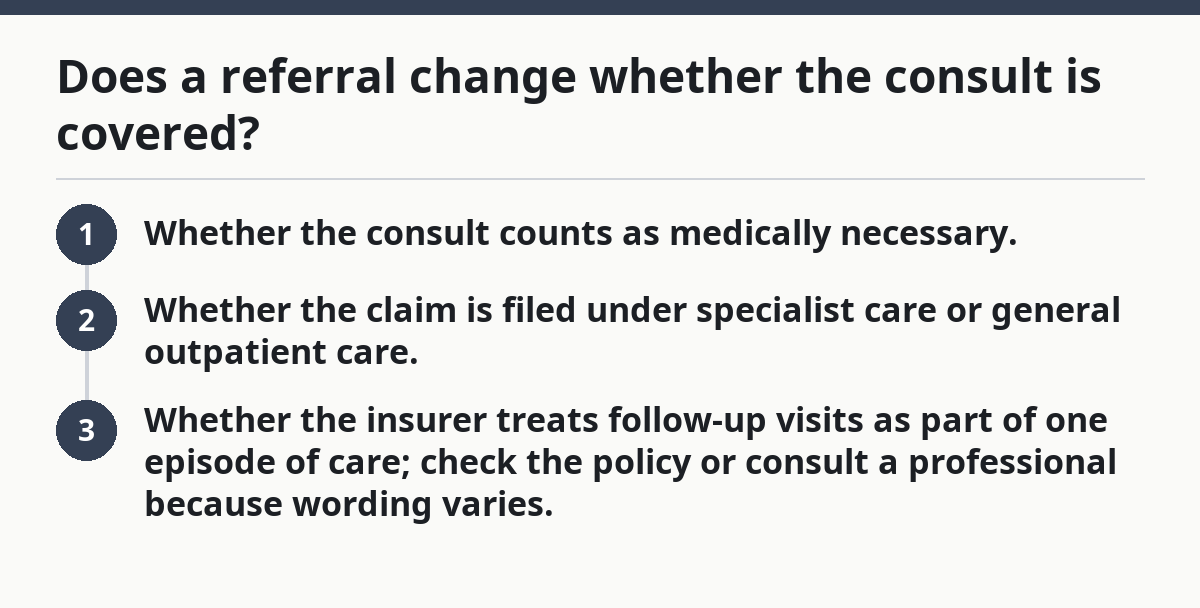
Here’s the catch: a referral is not just a note that says “please see a specialist.” It can shape three things at once:
- Whether the consult counts as medically necessary.
- Whether the claim is filed under specialist care or general outpatient care.
- Whether the insurer treats follow-up visits as part of one episode of care; check the policy or consult a professional because wording varies.
Policies that mention “referral required” usually want evidence that the general vet identified a problem first. Policies that say “referral recommended” are more flexible, but that still does not guarantee payment. The specialist visit can be covered only if the underlying illness or injury is a covered condition, the waiting period has passed, and the case is not excluded as pre-existing.
A policy can also draw a line between:
- the consult itself
- the diagnostic exam
- the procedure or surgery consult
- the actual treatment
That line matters because a specialist visit for a skin rash can involve a dermatologist’s opinion, lab work, and a treatment plan. One part may be reimbursable while another is not.
What to check before the appointment
Check the policy wording, the referral rule, and the claim documents before you book the visit.
That is where most confusion starts.
Picture this: you have a paper copy or app copy of your policy and a message from your regular vet. You need to know whether the visit is being treated as a specialist exam, whether the policy asks for pre-approval, and whether the insurer wants the referral before the appointment or just before the claim.
Use this checklist:
- Find the section on specialist care, referrals, or diagnostic services.
- Look for wording like “required,” “recommended,” or “may be requested.”
- Check whether the plan covers illness only, accident and illness, or a broader package.
- Confirm the waiting period has ended before the specialist visit.
- Read the pre-existing condition rule for the body system involved, such as skin, heart, eyes, or orthopedic issues.
- Save the general vet records that explain why the referral happened.
- Ask whether the specialist must be board-certified or whether any referral center qualifies.
If the policy says the consult is covered only with a referral, missing that document can turn a payable visit into an out-of-pocket charge. If the policy is silent on referrals, the insurer may still ask for records to prove medical necessity. That is why the paper trail matters as much as the appointment itself.
For broader context on plan design, the hub page on pet insurance policy features and limits belongs next in the reading path. See also our pet insurance deductible guide, pet insurance reimbursement rates guide, and pet insurance waiting periods explainer.
How to file a specialist visit claim
File the claim with the referral, the specialist invoice, and the general vet records attached.
The most useful claim packet is the one that tells one clean story from first exam to specialist visit.
Picture this: your dog sees a surgeon for a procedure consult after a lump is found. The claim should show why the general vet referred the case, what the surgeon examined, and how the visit ties to the covered condition. If the paperwork is scattered, the insurer has to guess. Guessing slows payment.
Use these steps:
- Book the visit only after checking whether the policy wants a referral first; verify the wording in the specialist-care section, and watch for “required” versus “recommended” because that changes the claim path.
- Ask the general vet for a written referral or recorded referral note; verify it names the condition, not just the specialist type, and treat missing dates as a problem.
- Bring the policy terms to the appointment if the clinic asks about coverage; verify the specialist’s billing codes match the care given, and flag any vague label such as “wellness consult.”
- Request itemized invoices for the consult and any diagnostics; verify each line item is separate, and look out for one blended charge that hides the consult fee.
- Submit the claim soon after the visit through the insurer’s portal or form; verify the uploaded files are readable, and fix any blurry referral scan before sending.
- Track the explanation of benefits or claim decision; verify whether the insurer paid the consult, the diagnostics, both, or neither, and note any request for records.
- Appeal or ask for review only with the missing evidence in hand; verify that the referral rule was met, and if the denial is based on policy language, compare that language line by line before resubmitting.
A clean claim packet usually includes:
- referral note
- specialist invoice
- general vet records
- test or treatment summary
- claim form with policy number
A problem often shows up when the specialist visit is billed under one umbrella charge. That can make the consult harder to separate from treatment. Ask for itemization before you leave the clinic if the invoice is unclear.
Are specialist exams covered by pet insurance?
Sometimes, but only when the policy treats the exam as covered medical care and the condition itself is eligible.
The exam fee is not the same thing as the treatment outcome, and that split is where many claims get messy.
Picture this: your cat sees an ophthalmologist for eye redness. The visit may include a specialist exam, a pressure check, and treatment planning. The insurer may cover one of those items and deny another if the policy separates consult fees from procedures or excludes a pre-existing eye condition.
The key question is not just “specialist or not?” It is:
- Is the visit tied to a covered illness or injury?
- Was the waiting period over?
- Did the policy ask for a referral?
- Is the specialist exam listed as a reimbursable service?
- Are there annual caps, sub-limits, or exam-fee exclusions?
Some plans reimburse specialist exams only after a general vet referral. Some cover them without referral but still require medical records. Others cover the condition, yet exclude exam fees for any vet visit. That is why a reader can have “cover” for the illness and still owe the consult bill.
When a referral matters most
A referral matters most when the policy says it does, when the specialist visit is the first step in a long workup, or when the clinic is billing a board-certified expert.
In those cases, the referral can be the difference between a clean claim and a long back-and-forth.
Picture this: your pet needs a dermatologist after months of itching, or a surgeon after a complex mass check, or a cardiologist after an abnormal heart sound. Those are the visits where the insurer is most likely to look for a referral note, records from the general vet, and evidence that the problem started after the policy waiting period.
Common referral-sensitive situations include:
- specialist consults for a chronic skin, eye, heart, or orthopedic issue
- first-time visits to a specialty hospital
- diagnostic workups that begin with a primary vet and continue elsewhere
- claims where the policy uses the phrase “referred by a licensed veterinarian”
- situations where the insurer wants proof that the visit was not elective
The referral matters less when the policy does not require one and the claim is otherwise clean. Even then, keeping the referral is still smart. It gives the insurer a simple reason to see the visit as medically driven, not optional.
When the standard rule does not apply
The standard rule changes when the policy language, the pet’s history, or the clinic setup is unusual.
That happens more than people expect.
Picture this: your pet has seen the same body system before, but the insurer has already labeled part of it pre-existing. Or the visit happens at a teaching hospital where multiple clinicians bill under one case. Or the specialist is part of the same clinic as the general vet, and the billing looks like a normal exam to the insurer. Each of those setups can change how the claim is reviewed.
Important edge cases:
- No formal referral available: the insurer may still pay if the policy does not require one, but you may need the general vet records to prove medical necessity.
- Direct specialist booking: some policies accept it; others deny the consult fee until a referral is documented.
- Same-day primary and specialist care: the insurer may split the charges by provider and treat them as separate services.
- Board-certified specialist in the same building: the credential matters, but it does not replace referral wording if the policy asks for one.
- Chronic condition flare-up: the insurer may review whether the condition is excluded as pre-existing, even if the specialist visit itself was necessary.
In these cases, do not assume the title on the clinic door decides coverage. The policy language and the claim file do.
The mistakes that cost people money
The biggest mistake is assuming every specialist visit is covered the same way.
It isn’t, and that mistake often means a denied consult fee even when part of the treatment would otherwise qualify.
Picture this: you hear “specialist” and assume that means “covered.” That can lead to a claim with no referral, no itemized invoice, and no records from the first vet. The insurer then has little to work with.
Common errors:
- Skipping the referral note — consequence: the consult can be denied under referral-required wording; correct alternative: get the note before the visit if the policy asks for one.
- Mixing the consult with treatment on one bill — consequence: the insurer may not separate the covered part from the non-covered part; correct alternative: ask for itemized lines.
- Ignoring waiting periods — consequence: the claim may be tied to an illness not yet eligible; correct alternative: check the policy dates before booking.
- Assuming a board-certified title guarantees payment — consequence: credentials do not override policy exclusions; correct alternative: match the claim to the plan wording.
- Leaving out earlier records — consequence: the insurer may treat the issue as pre-existing or under-documented; correct alternative: send the general vet notes with the claim.
- Not checking the body-system history — consequence: repeated skin, eye, heart, or joint issues may trigger a pre-existing review; correct alternative: review prior records for the same problem.
A tidy file beats a hopeful one every time.
What a good specialist claim outcome looks like
A good result is a claim that is paid, or partly paid, under the terms you actually had in force.
That means the insurer accepted the referral rule, matched the visit to a covered condition, and processed the consult according to the policy’s limits.
Picture this: the specialist visit shows up in the claim decision as a covered exam, while a separate diagnostic item is handled under a different rule. That is normal. A “good” outcome does not always mean every line is paid. It means the insurer used the policy the way the policy says it should be used.
A strong outcome usually has these signs:
- the referral was accepted
- the consult was categorized correctly
- the insurer did not ask for repeated documents
- the payment matched the policy’s reimbursement structure
- any denial came with a clear reason, not a vague one
If the claim is denied, the first thing to inspect is the referral language. Then check the waiting period, the condition history, and whether the visit was billed as a specialist exam or as something else.
FAQ
Do I need a referral for a specialist visit?
Often, yes, if the policy says specialist care requires one.
Drafted with AI; not yet reviewed by a person.